Most freelancers set their rates by looking at what competitors charge, rounding up slightly, and hoping the number feels reasonable to clients. The problem with this approach is that it has nothing to do with whether the rate actually sustains a profitable business. Rates set this way tend to be too low, and the evidence is consistent: a large proportion of self-employed professionals in both the United States and the United Kingdom regularly undercharge relative to what their skills command and what their cost structure requires. This guide walks through the actual calculation that determines what you must charge to meet your income goals, cover your tax obligations, account for your real cost structure, and build a sustainable freelance business in 2026.
What This Guide Covers
This article is written for freelancers, independent consultants, and self-employed professionals operating in the United States or United Kingdom who want to set rates that reflect the true economics of their business rather than guesswork or market comparison alone. It covers the complete rate calculation formula, the specific tax obligations that affect your net income in both countries, the most common mistakes that lead to undercharging, and how to use the Biveron Freelancer True Rate Calculator to run these numbers for your specific situation. A worked example using real numbers is included to make the calculation concrete.
Why Most Freelancers Undercharge
The undercharging problem has a specific cause that goes beyond confidence or market awareness. Most freelancers calculate their desired income, divide it by the number of hours they plan to work, and call that their rate. This calculation is wrong in three important ways that systematically produce rates that are too low.
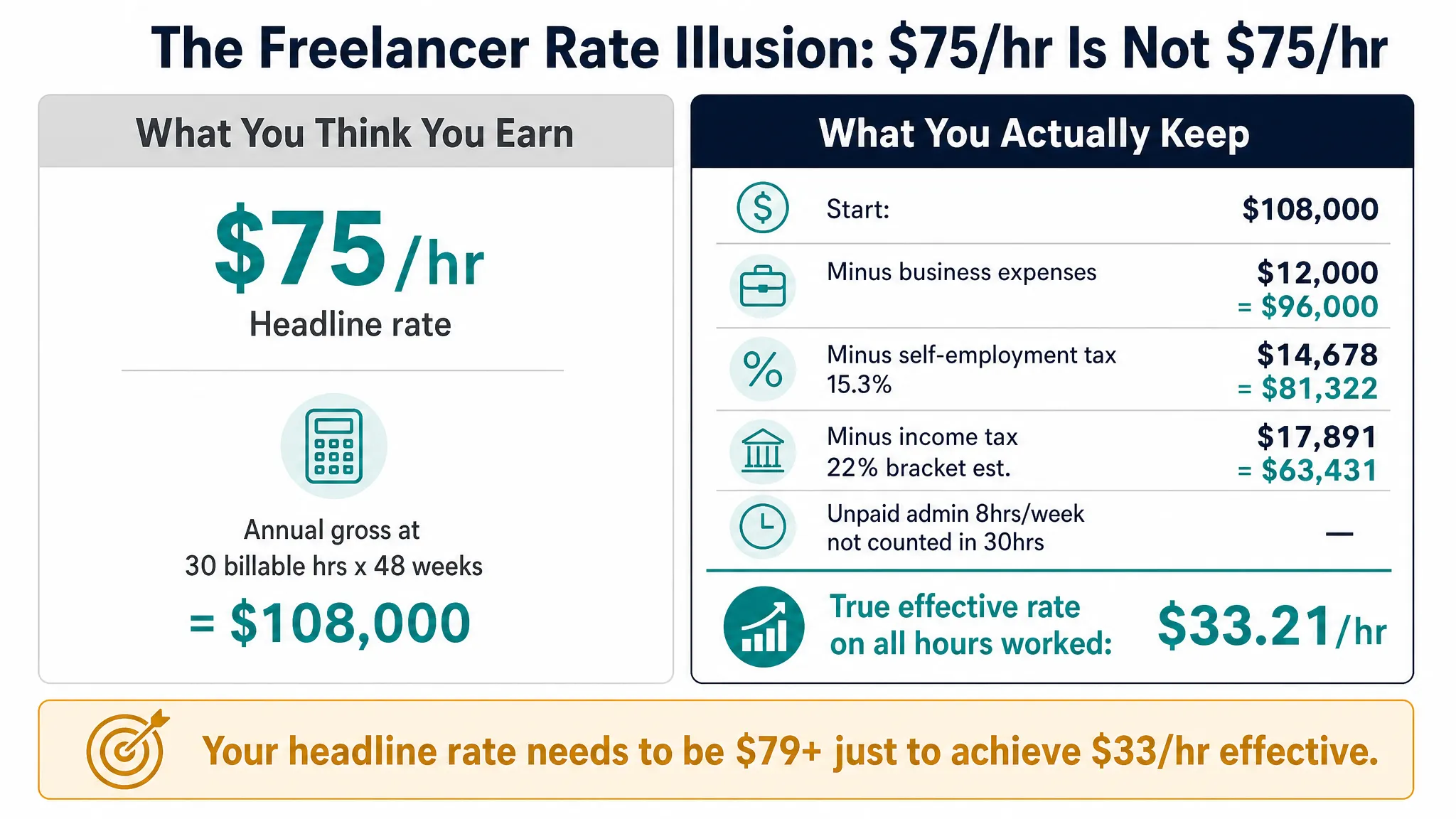
The first error is confusing billable hours with total working hours. A freelancer who works 40 hours per week does not bill 40 hours per week. Client work, the actual billable activity, is surrounded by unpaid time: writing proposals, managing invoices, chasing payments, updating skills, marketing, administrative tasks, and the inevitable gaps between projects. In practice, most full-time freelancers bill between 25 and 32 hours per week even when they are working 40 to 50 hours. Using 40 billable hours in a rate calculation when the reality is 28 produces a rate that is roughly 30 percent too low before any other factors are considered.
The second error is failing to account for the self-employment tax and National Insurance contributions that apply to freelance income. Employed workers split these contributions with their employer. Self-employed people pay both sides themselves. In the United States this is the self-employment tax of 15.3 percent on net self-employment income. In the United Kingdom this includes Class 2 and Class 4 National Insurance contributions. These obligations are not optional and not small, and failing to build them into your rate means your net take-home income will be significantly lower than you planned.
The third error is ignoring business expenses in the rate calculation. Freelancers have real costs: software subscriptions, professional development, home office costs, equipment, insurance, accountancy fees, and marketing expenses. When these costs are not factored into the rate, they come directly out of net income rather than being recovered through client billing.
The Complete Freelancer Rate Formula
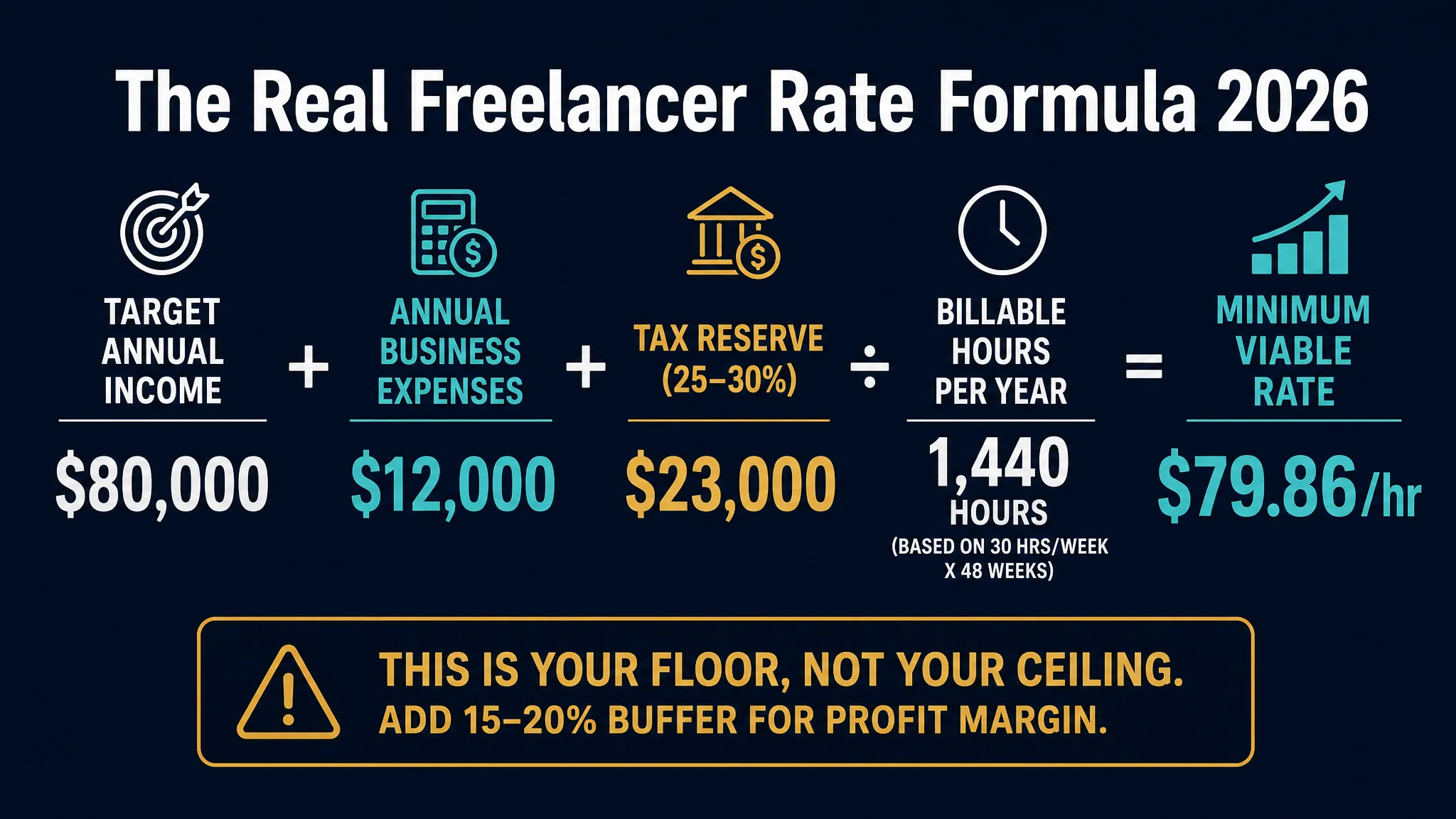
The correct rate calculation starts with your desired net annual income, which is the amount you want to actually take home after taxes and expenses, and works backward to determine what gross rate you need to charge to achieve it. This approach is the opposite of the common method of starting with a market rate and hoping the math works out.
The formula has four components. The first is your target net annual income. This is a personal decision based on your cost of living, savings goals, and financial objectives. It is the number that represents what you actually want to have available after the business has covered its costs and you have paid your taxes.
The second component is your annual business expenses. These include all costs directly related to operating your freelance business. Common categories include software and subscriptions, professional development and training, equipment and technology, professional liability insurance, accounting and legal fees, marketing and website costs, and home office expenses where applicable. Adding these to your target income gives you the total gross income your business needs to generate.
The third component is your tax reserve. You need to add enough to your target gross income to cover your tax obligations at your expected income level. In the United States this means federal income tax at your marginal bracket plus the 15.3 percent self-employment tax. In the United Kingdom this means income tax at the applicable rate plus National Insurance contributions. Because the self-employment tax is calculated on net self-employment income after deducting half of the self-employment tax itself, the calculation is slightly circular and is most easily handled by using a percentage buffer. For most US freelancers, reserving 28 to 35 percent of gross income for taxes is a reasonable starting point depending on income level and state of residence. UK freelancers typically reserve 25 to 30 percent.
The fourth component is your realistic billable hours. This is your expected working weeks per year, typically 48 accounting for holidays, illness, and gaps between projects, multiplied by your expected weekly billable hours, not your total working hours. For a freelancer working 40 hours per week with 28 billable hours, the annual billable hours figure is approximately 1,344.
Dividing your total required gross income by your annual billable hours gives you your minimum viable hourly rate. Adding a 15 to 20 percent profit buffer above this minimum gives you a sustainable rate that builds a business rather than just covering costs.
Rate Calculation Comparison by Income Target and Business Type
| Target Net Income | Annual Expenses | Tax Reserve | Billable Hours Per Year | Minimum Rate | Recommended Rate with Buffer |
|---|---|---|---|---|---|
| $50,000 USD | $8,000 | 28% of gross | 1,344 hrs (28 hrs x 48 wks) | $80.60/hr | $93 to $97/hr |
| $70,000 USD | $10,000 | 30% of gross | 1,344 hrs | $107.14/hr | $123 to $129/hr |
| $100,000 USD | $14,000 | 32% of gross | 1,344 hrs | $148.81/hr | $171 to $179/hr |
| £40,000 GBP | £6,000 | 27% of gross | 1,344 hrs | £61.73/hr | £71 to £74/hr |
| £60,000 GBP | £9,000 | 30% of gross | 1,344 hrs | £87.30/hr | £100 to £105/hr |
| £80,000 GBP | £12,000 | 35% of gross | 1,200 hrs (25 hrs x 48 wks) | £133.33/hr | £153 to £160/hr |
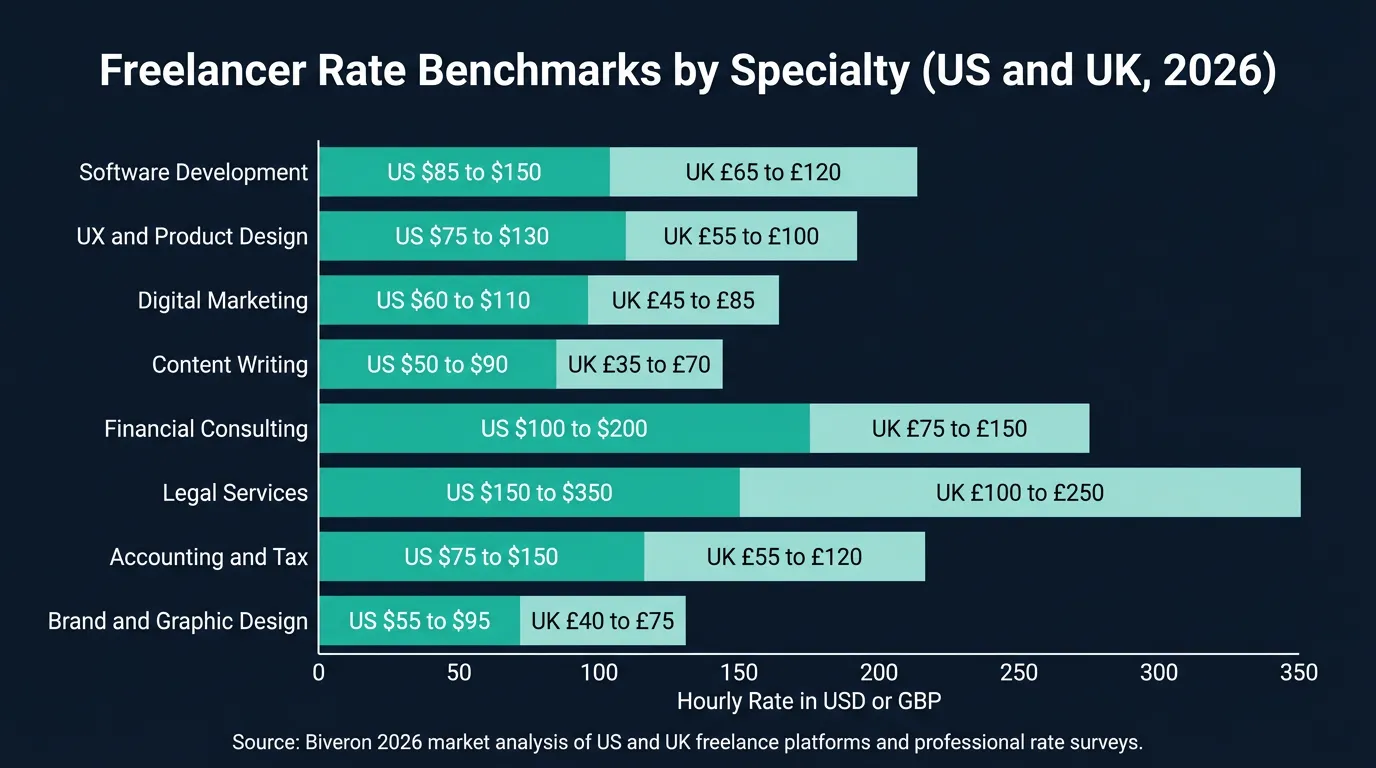
The rates in the table above are minimum viable rates, not market rates. Whether the market in your specific specialty supports these rates is a separate question that requires market research in your sector. What the table shows is the rate floor below which you cannot achieve your income target regardless of how many clients you find. If your current rate is below your minimum viable rate, the only sustainable paths forward are raising your rate, reducing your target income, cutting your business expenses, or increasing your billable hours.
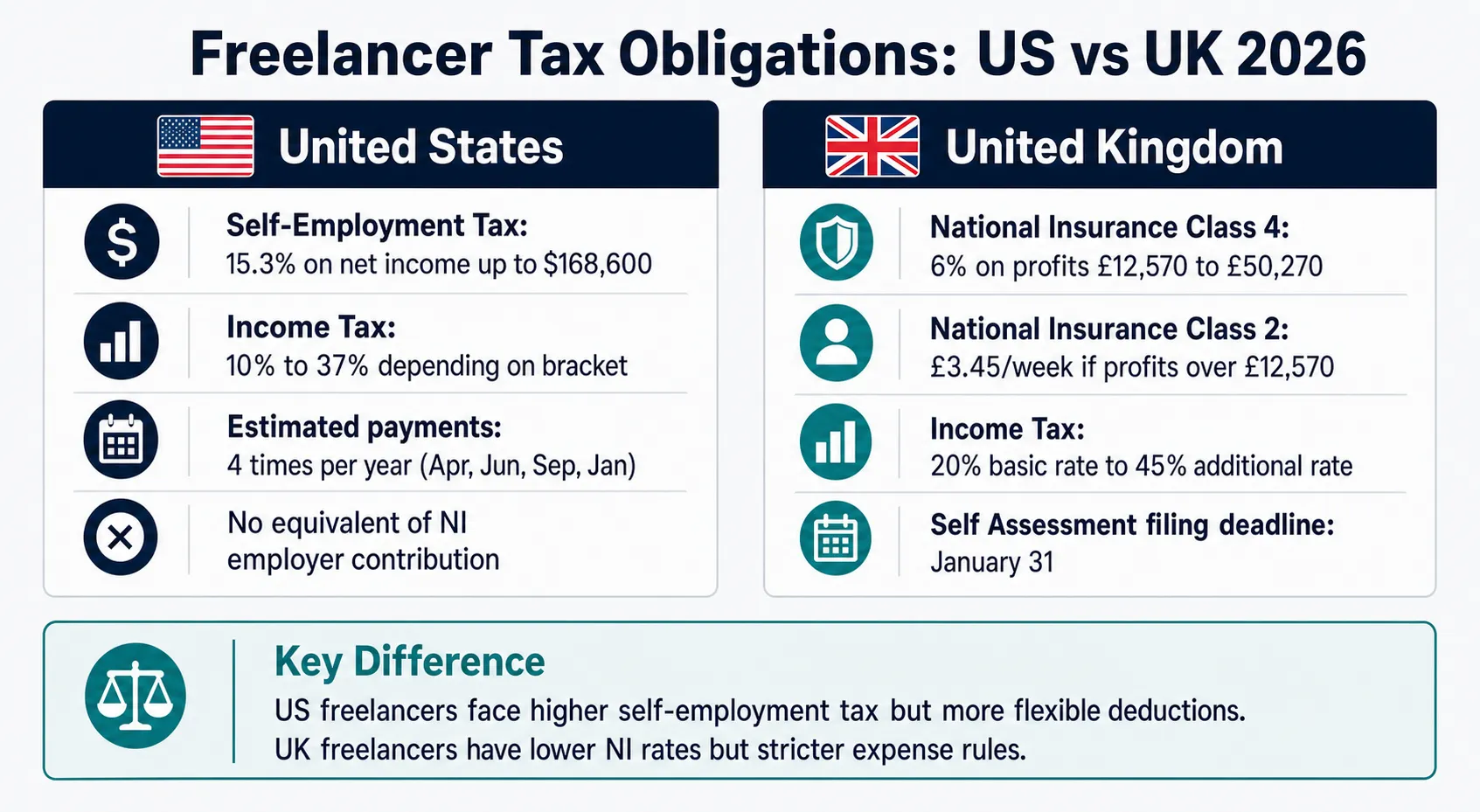
US and UK Tax Obligations for Freelancers
The tax component of the rate calculation differs significantly between the United States and the United Kingdom and is worth covering in detail because it is the most commonly underestimated cost in freelance rate setting.
United States: Self-Employment Tax and Income Tax
US freelancers and self-employed individuals pay federal self-employment tax of 15.3 percent on the first 168,600 US dollars of net self-employment income in 2026, with the Medicare component of 2.9 percent continuing on all net income above that threshold. This is the combined employer and employee share of Social Security and Medicare that employed workers split with their employer. Self-employed individuals pay the full amount themselves, though they can deduct half of the self-employment tax from their gross income for income tax calculation purposes.
Federal income tax is calculated on taxable income after deductions, including the deduction for half of self-employment tax and the standard deduction or itemized deductions. The marginal federal income tax rate for a single filer with 85,000 US dollars in taxable income in 2026 is 22 percent on income between 47,150 and 100,525 US dollars. State income taxes are additional and range from zero in states with no income tax to over 13 percent in California.
US freelancers are generally required to make quarterly estimated tax payments to the IRS by April 15, June 16, September 15, and January 15 of the following year. Failing to make adequate quarterly payments results in underpayment penalties. Use our Quarterly Tax Estimator to calculate your specific payment amounts based on your projected annual income and filing status.
United Kingdom: National Insurance and Income Tax
UK self-employed individuals pay Class 4 National Insurance contributions of 6 percent on profits between 12,570 and 50,270 GBP per year, and 2 percent on profits above 50,270 GBP. Class 2 National Insurance of 3.45 GBP per week applies if annual profits exceed 12,570 GBP, though this can be paid voluntarily if below the threshold to protect State Pension entitlement.
Income tax for UK freelancers applies at 20 percent on income between the Personal Allowance of 12,570 GBP and 50,270 GBP, 40 percent on income between 50,271 and 125,140 GBP, and 45 percent on income above 125,140 GBP. The Personal Allowance is tapered for income above 100,000 GBP, creating an effective 60 percent marginal rate on income between 100,000 and 125,140 GBP.
UK freelancers file their Self Assessment tax return by January 31 following the end of the tax year. HMRC’s Making Tax Digital initiative is progressively extending digital record-keeping requirements to self-employed individuals, with the timeline for mandatory compliance depending on income level.
Real World Example: Building a Rate From Scratch
A practical illustration of the complete rate calculation makes the formula easier to apply. Consider a freelance UX designer based in Austin, Texas, in 2026. The designer wants to take home 75,000 US dollars net after taxes and business costs. Their annual business expenses are approximately 11,000 US dollars covering software subscriptions, professional development, equipment depreciation, professional liability insurance, and accounting fees. They realistically bill 28 hours per week across 48 working weeks, giving annual billable hours of 1,344.
The total gross income needed before taxes is the target net income plus business expenses, which is 86,000 US dollars. To determine how much gross income is needed to net 75,000 US dollars after taxes, the designer estimates a combined federal income tax and self-employment tax rate of approximately 31 percent on their income level. Working backward, the required gross income before tax is approximately 124,638 US dollars (calculated as 75,000 divided by 0.69 to account for the 31 percent tax rate, plus 11,000 for business expenses).
Dividing 124,638 US dollars by 1,344 annual billable hours gives a minimum viable rate of approximately 92.74 US dollars per hour. Adding a 15 percent profit buffer brings the recommended rate to approximately 107 US dollars per hour.
If this designer is currently charging 65 US dollars per hour and working the same hours, their true net income after taxes and expenses is approximately 44,000 US dollars, which is 31,000 US dollars less than their target. The gap is not a market problem. It is a rate calculation problem.
US and UK Difference: Beyond the tax rate differences covered above, US and UK freelancers face different expense deduction rules that affect the net cost of running a freelance business. US freelancers operating as sole proprietors can deduct a wide range of business expenses on Schedule C including a home office deduction calculated either by the simplified method (5 US dollars per square foot up to 300 square feet) or the regular method (actual costs proportional to office square footage). UK freelancers under Self Assessment can claim allowable business expenses against income but HMRC applies stricter wholly and exclusively tests that disallow expenses with any personal element more aggressively than the IRS. UK freelancers operating through a limited company rather than as sole traders have additional flexibility through salary and dividend splitting that can meaningfully reduce overall tax, a structure worth discussing with a UK accountant once income reaches approximately 30,000 to 40,000 GBP per year.
Using AI Tools to Reduce Your Non-Billable Time
One of the most direct ways to improve your effective hourly rate without raising your headline rate is to reduce the non-billable hours that currently surround your billable work. Every hour of unpaid admin, proposal writing, or invoice chasing that can be eliminated through AI automation effectively increases your true hourly earnings from the same number of working hours.
Freelancers who use AI writing tools for proposal drafting and client communication consistently report reducing non-billable writing time by 40 to 60 percent. At eight non-billable admin hours per week, eliminating four of those hours through AI assistance is equivalent to adding four billable hours per week to your capacity, which at 90 US dollars per hour represents approximately 17,280 US dollars in additional annual revenue potential from the same total working hours.
AI-powered invoicing and bookkeeping tools reduce the time spent on financial administration, another common non-billable time drain. For freelancers managing ten to twenty invoices per month, AI tools that automate invoice generation, payment tracking, and expense categorization typically recover one to two hours per week that can be redirected to billable work or genuine rest. For a broader look at how AI is changing the economics of independent work, see our guide on the best AI tools for freelancers to manage clients and invoices.
The connection between AI tool adoption and effective hourly rate is direct and quantifiable. Running the numbers on your own situation using the Biveron Freelancer True Rate Calculator before and after factoring in realistic AI time savings gives you a concrete picture of the financial case for AI tool investment in your specific freelance business. For more detail on building this kind of AI-integrated workflow, see our guide on how to build an AI-powered workflow for your small business.
How to Raise Your Rate Without Losing Clients
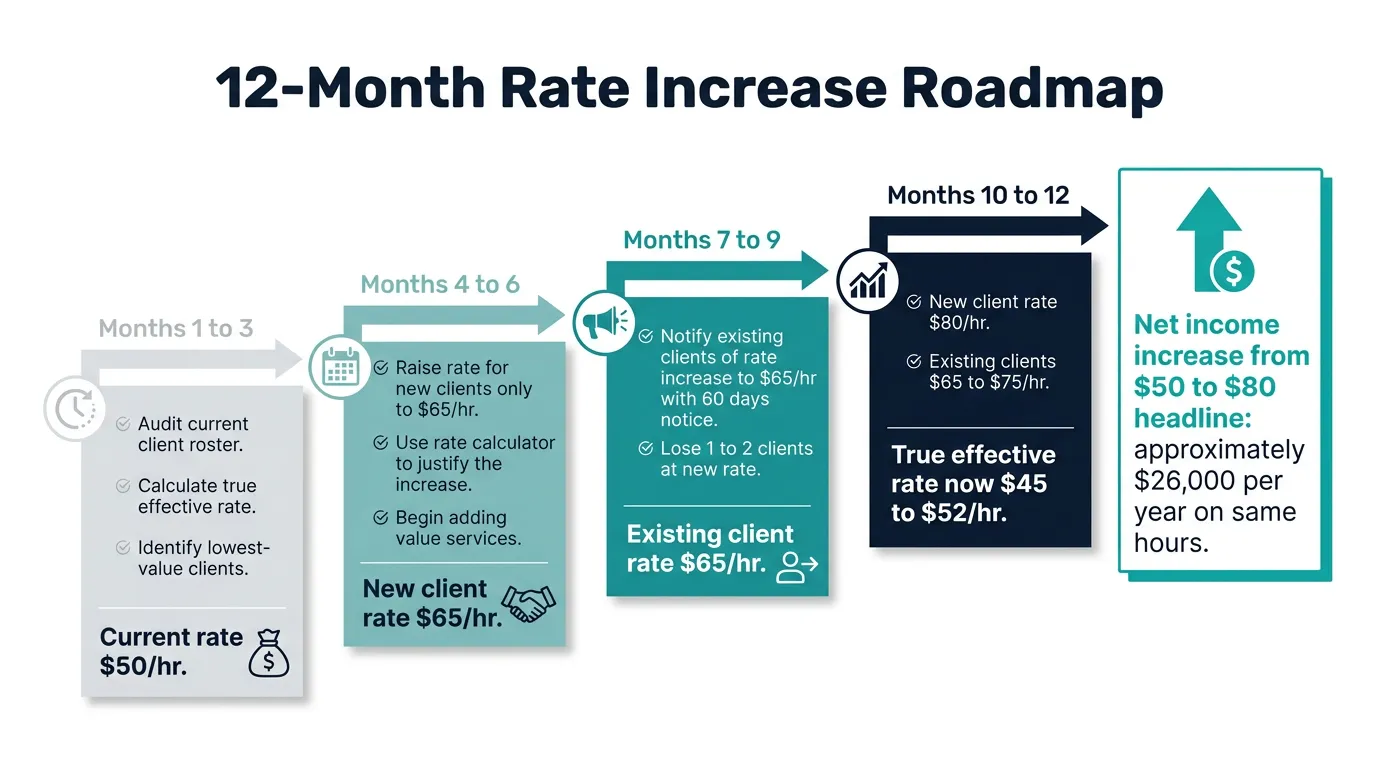
For freelancers who discover through this calculation that their current rate is below their minimum viable rate, the next question is how to raise it without losing the client relationships that sustain the business. The answer is a phased approach that separates new client pricing from existing client pricing and gives existing clients enough notice and context to accept the change.
The first step is raising your rate for all new clients immediately. New clients have no reference point for your previous rate and will evaluate your new rate against the market and your demonstrated value. Starting new relationships at a rate that reflects your actual cost structure is significantly easier than raising rates for existing clients who have anchored to a lower number.
For existing clients, a rate increase notice of 60 to 90 days gives them time to budget for the change and signals that you respect the relationship enough to provide adequate warning. The communication should be matter of fact rather than apologetic. You are running a business and your rates reflect the value of your work and the cost of delivering it. Clients who leave over a well-considered rate increase were typically not sustainable at the old rate anyway.
The clients most likely to accept rate increases are those for whom you solve a specific, high-value problem and with whom you have a track record of reliable delivery. Investing in these relationships and in the documentation of the value you deliver, through reporting, case studies, and clear communication of outcomes, strengthens your position before a rate conversation.
Frequently Asked Questions
Should I charge the same rate for all clients or use different rates?
Most experienced freelancers use variable rates based on project type, client size, industry, and the strategic value of the relationship rather than a single fixed rate for all work. Rates for large corporate clients with significant budgets should typically be higher than rates for small businesses or non-profits, not because the work is different but because the value delivered and the budget available differ significantly. Variable pricing requires confidence and clear positioning, but it generally produces better overall income outcomes than a single fixed rate applied uniformly across all situations.
How do I calculate my rate if I work on project fees rather than hourly?
Project fees should be anchored to your hourly rate calculation rather than replacing it. Estimate the realistic number of hours a project will take, including all non-billable time directly related to that project such as briefing, revisions, and communication, multiply by your minimum viable hourly rate, and add a scope risk buffer of 15 to 25 percent to account for scope creep and underestimation. Quoting project fees without an underlying hourly rate anchor is a common cause of unprofitable projects even when the headline project fee looks reasonable.
What is the difference between my rate and my effective hourly rate?
Your rate is the number you quote to clients for an hour of your time. Your effective hourly rate is what you actually earn per hour when all your working hours, both billable and non-billable, are divided into your net annual income after taxes and expenses. The gap between these two numbers is what this article addresses. For most freelancers who have not done this calculation, the effective rate is 30 to 50 percent lower than the headline rate, which explains why many freelancers who appear to charge reasonable rates still feel financially stretched.
How often should I review and raise my freelance rates?
Reviewing your rates annually at minimum is a sound practice, ideally at the same time each year so it becomes a routine rather than a reactive decision. Rates should also be reviewed following significant skill development, after completing high-profile projects that strengthen your portfolio, when you can demonstrate measurable business outcomes for clients, and when your cost structure changes significantly through increased expenses or changes in tax obligations. Inflation also affects the real value of a fixed rate over time. A rate that was adequate three years ago may now be insufficient in real terms even if it was correctly calculated when it was set.
Is it better to be a sole trader or set up a limited company for my freelance business in the UK?
The tax efficiency of operating through a limited company versus as a sole trader in the United Kingdom depends significantly on your income level and personal circumstances. At lower income levels, the administrative overhead of a limited company typically outweighs the tax savings. At higher income levels, the ability to split income between salary and dividends, with dividends taxed at lower rates than income under the current tax framework, can produce meaningful tax savings. The crossover point varies depending on individual circumstances but is often cited around 30,000 to 40,000 GBP of annual profit. This decision should be made with the guidance of a qualified UK accountant rather than on general guidance alone, as the optimal structure depends on factors specific to your situation including your other income, your plans for the business, and your personal financial goals.
Latest Research