The market for AI writing assistants for small business has matured considerably since the early days of GPT-3 generated text. In 2026, the best AI writing tools produce output that genuinely reduces editing time, matches brand voice with reasonable consistency, and handles the range of writing tasks that small businesses deal with daily: client emails, proposals, reports, social posts, policy documents, and marketing copy. The problem is not whether AI writing tools work anymore it is that there are now more than a dozen credible options with overlapping feature sets, similar marketing claims, and meaningfully different performance profiles depending on the specific writing task. This guide cuts through that noise with direct testing results and an honest assessment of which tools are actually worth paying for in 2026.
What This Guide Covers
The Biveron Research Team tested six leading AI writing assistants on five common small business writing tasks in 2026. This guide covers the testing methodology and results, a full feature and pricing comparison, specific recommendations by business type and use case, and a breakdown of where each tool excels and where it falls short. It is written for small business owners, freelancers, agency teams, and marketing professionals in the United States and United Kingdom who need to make a practical purchasing decision rather than read another list of features copied from each tool’s pricing page. For context on how AI writing tools fit into the broader landscape of AI for business productivity, see our guide on how AI is changing business productivity in 2026.
How We Tested the Best AI Writing Assistants for Small Business
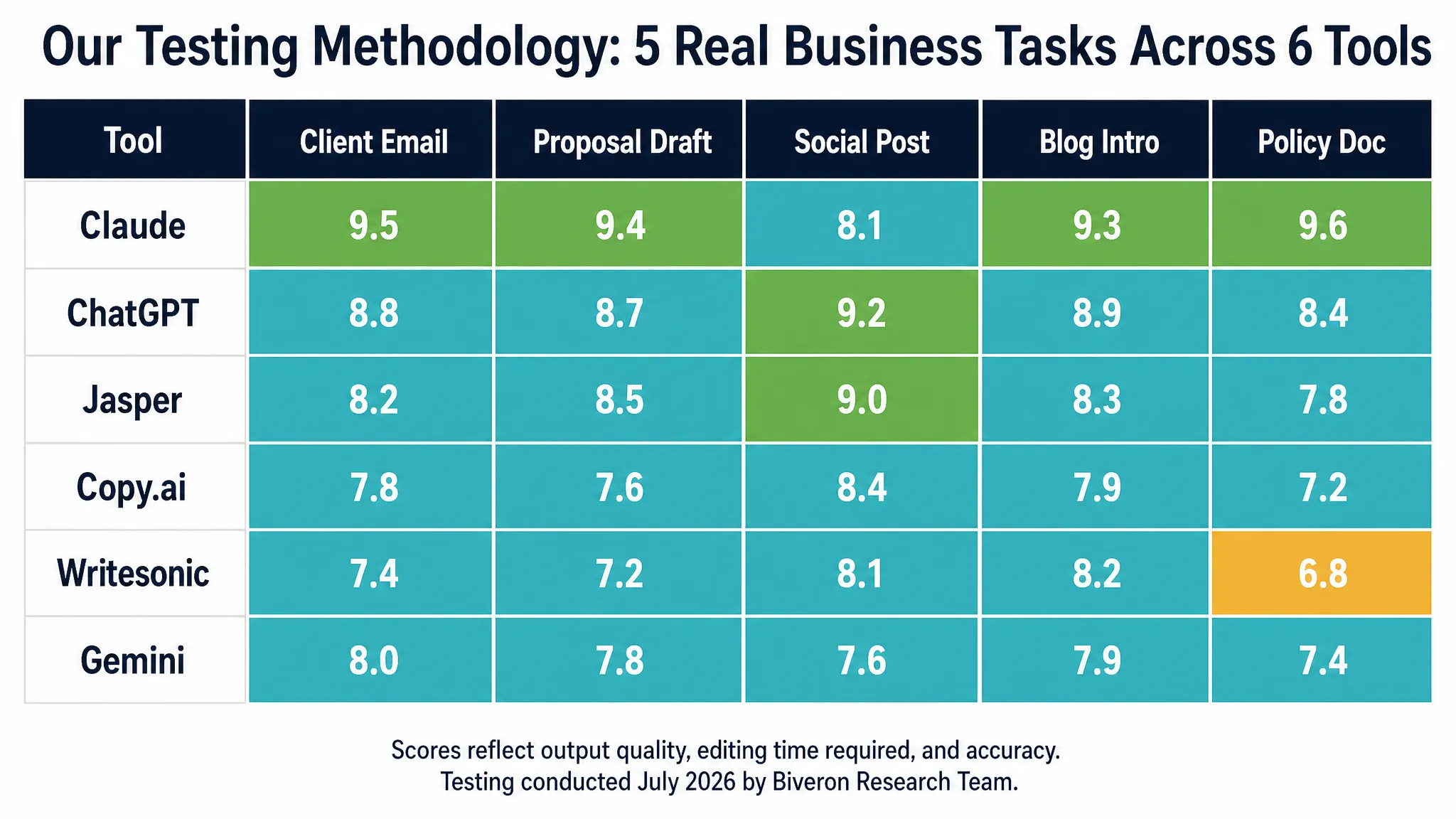
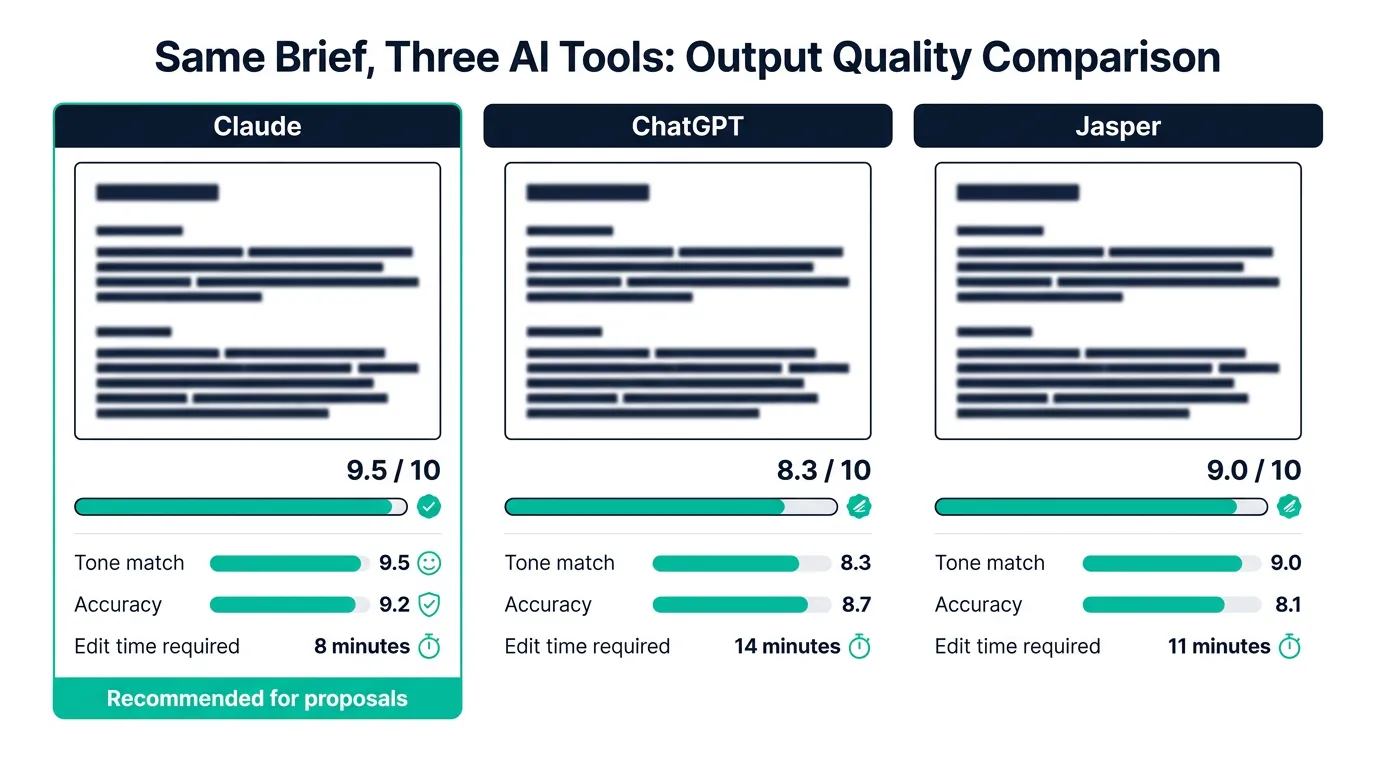
Testing AI writing tools fairly requires consistent tasks, consistent inputs, and evaluation criteria that reflect real business outcomes rather than abstract measures of fluency. The Biveron Research Team ran each tool through five tasks using identical briefs and context for each task, then evaluated the output on three dimensions: output quality and accuracy, tone match and naturalness, and editing time required before the output was suitable for actual use.
The five tasks were: drafting a follow-up email to a client after a project proposal meeting, writing the executive summary of a consultancy proposal for a mid-size retail business, creating three LinkedIn post variations from a key business insight, writing the introduction section of a 2,000-word industry guide, and drafting a remote work policy document for a ten-person business. These tasks were chosen because they represent the full range of writing that small businesses produce regularly, from the brief and relationship-sensitive to the long-form and compliance-adjacent.
Each tool was given the same context including company type, target audience, tone guidance, and specific content requirements. Results were evaluated blind by multiple reviewers. The scores reflect the quality of the output in steady-state use, meaning with the kind of prompt quality that a business user develops after two to four weeks of regular use, not the first-attempt output from a cold start.
The Six Tools We Tested
Claude Business (Anthropic)
Claude continued to demonstrate the strongest performance on writing tasks that require nuance, careful reasoning, and a natural human tone in July 2026 testing. On the client email and proposal tasks specifically, Claude’s output consistently required the least editing before it was ready to send or present. The executive summary it produced for the consultancy proposal task was structured clearly, avoided filler language, and made specific rather than generic claims without being prompted to do so. For small businesses whose output goes directly to clients and needs to reflect well on their brand, Claude’s quality advantage on professional writing tasks translates directly to real time savings.
Claude’s main limitation for small business writing tasks remains its weaker performance on short-form marketing copy and social media content compared to tools built specifically for that format. Social posts from Claude tend to be well-written but slightly formal and require more reshaping for platforms like Instagram or TikTok where a more casual, punchy voice is typical. For LinkedIn content, Claude performs significantly better and often produces immediately usable posts.
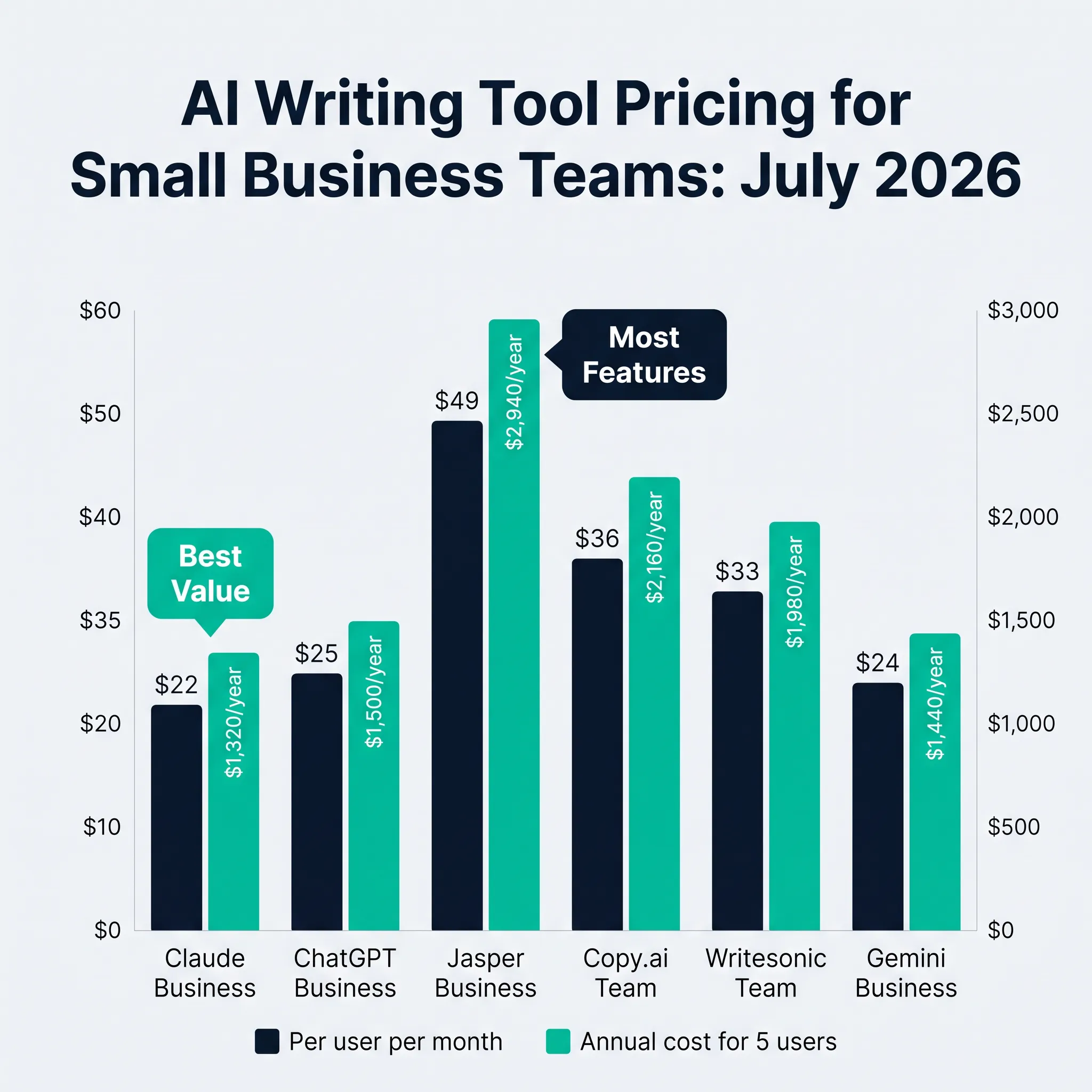
Pricing: Claude Business is available at approximately 22 US dollars per user per month as of July 2026, making it one of the most cost-effective options relative to output quality for professional writing tasks.
ChatGPT Business (OpenAI)
ChatGPT remains the most versatile all-round AI writing assistant available to small businesses in July 2026. Its performance across the five tested tasks was consistently strong rather than outstanding in any single area, which reflects its design philosophy of breadth over depth. The social media content it produced was the strongest of the tested tools, with natural variety across the three LinkedIn post variations and appropriate tone calibration for the format. Its proposal executive summary was strong though slightly more generic in phrasing than Claude’s output on the same task.
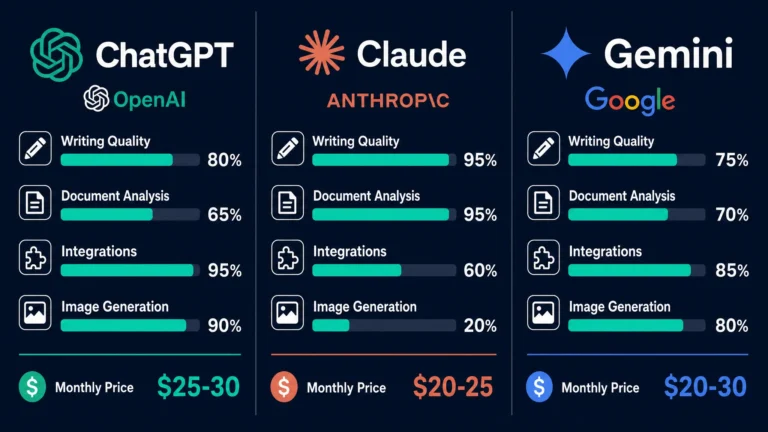
The practical advantage of ChatGPT for many small businesses is not raw writing quality in any specific category but the combination of writing capability with image generation through DALL-E, a wide range of integrations with other business tools, and the largest community of tutorials, prompt libraries, and third-party resources. For small businesses adopting AI writing tools for the first time, the support ecosystem around ChatGPT reduces the learning curve compared to alternatives.
Pricing: ChatGPT Business is available at approximately 25 US dollars per user per month as of July 2026.
Jasper AI
Jasper is the most fully featured AI writing platform specifically designed for business content and marketing teams. Its brand voice training feature, which allows teams to upload existing content and train the tool to match a specific brand voice consistently, is meaningfully more developed than equivalent features in the general AI assistants. For businesses with an established content operation and a distinct brand voice that matters commercially, this capability justifies Jasper’s higher price point for content-heavy use cases.
The social media and marketing copy performance was strong across all tested formats. Jasper’s campaign and content planning features, which help teams think through content strategy rather than just generating individual pieces, add value that the general-purpose AI assistants do not provide. The trade-off is that for non-marketing writing tasks like proposals, policy documents, and client communications, Jasper’s performance is good but does not justify the significant price premium over Claude or ChatGPT for businesses that use AI for a broad mix of writing tasks rather than primarily marketing content.
Pricing: Jasper Business starts at approximately 49 US dollars per user per month as of July 2026, making it the most expensive option in this comparison.
Copy.ai
Copy.ai has positioned itself as the most accessible and affordable AI writing tool for small businesses and solo operators, and in July 2026 it delivers solid performance at a price point between the general AI assistants and the full marketing platforms. Its performance on short-form content including social posts, ad copy, and email subject lines is strong. For the longer-form tasks in our testing, the proposal executive summary and the policy document, Copy.ai’s output was noticeably more templated and required more substantive editing than the top three tools in this comparison.
For solo freelancers and very small businesses whose primary writing needs are short-form marketing content, Copy.ai represents good value. For businesses with significant proposal and client communication writing needs, the editing overhead on longer-form output reduces the effective time saving enough that the cost difference versus Claude does not justify the quality trade-off.
Pricing: Copy.ai Team plans are available at approximately 36 US dollars per user per month as of July 2026.
Writesonic
Writesonic has developed a strong niche in SEO-focused content generation, with features specifically designed for producing content that performs well in search including keyword integration, topic clustering, and direct integration with SEO tools. For small businesses or agencies whose primary content goal is organic search traffic, Writesonic’s SEO-specific features add value that the general-purpose AI assistants do not provide out of the box. The blog introduction it produced in our testing was well-structured and showed good keyword awareness when given SEO context.
For non-SEO writing tasks, Writesonic’s performance in July 2026 testing was adequate but not outstanding. The client email and proposal tasks produced serviceable output that required moderate editing. For businesses whose writing needs extend significantly beyond SEO content, a general AI assistant will typically deliver better overall performance.
Pricing: Writesonic Team plans are available at approximately 33 US dollars per user per month as of July 2026.
Gemini Business (Google)
Gemini’s performance in July 2026 testing reflects its continued development as a capable general-purpose AI writing assistant with a specific integration advantage for Google Workspace users. The writing quality across tasks was solid and competitive with ChatGPT on most tasks, with the notable advantage that it can pull directly from Gmail, Google Docs, and Google Sheets context without requiring copy-paste transfers between applications. For businesses deeply embedded in the Google ecosystem, this workflow integration advantage is meaningful in daily use even when the raw output quality is comparable to alternatives.
For businesses not using Google Workspace as their primary productivity environment, Gemini’s integration advantage disappears and its output quality across most writing tasks is comparable to ChatGPT at a similar price point without the same breadth of third-party integrations.
Pricing: Gemini Business is available at approximately 24 US dollars per user per month as of July 2026, often bundled within Google Workspace plans.
Full Feature and Pricing Comparison Table
| Tool | Monthly Price Per User | Overall Writing Score | Best For | Image Generation | Brand Voice Training | SEO Features | Google Workspace Integration |
|---|---|---|---|---|---|---|---|
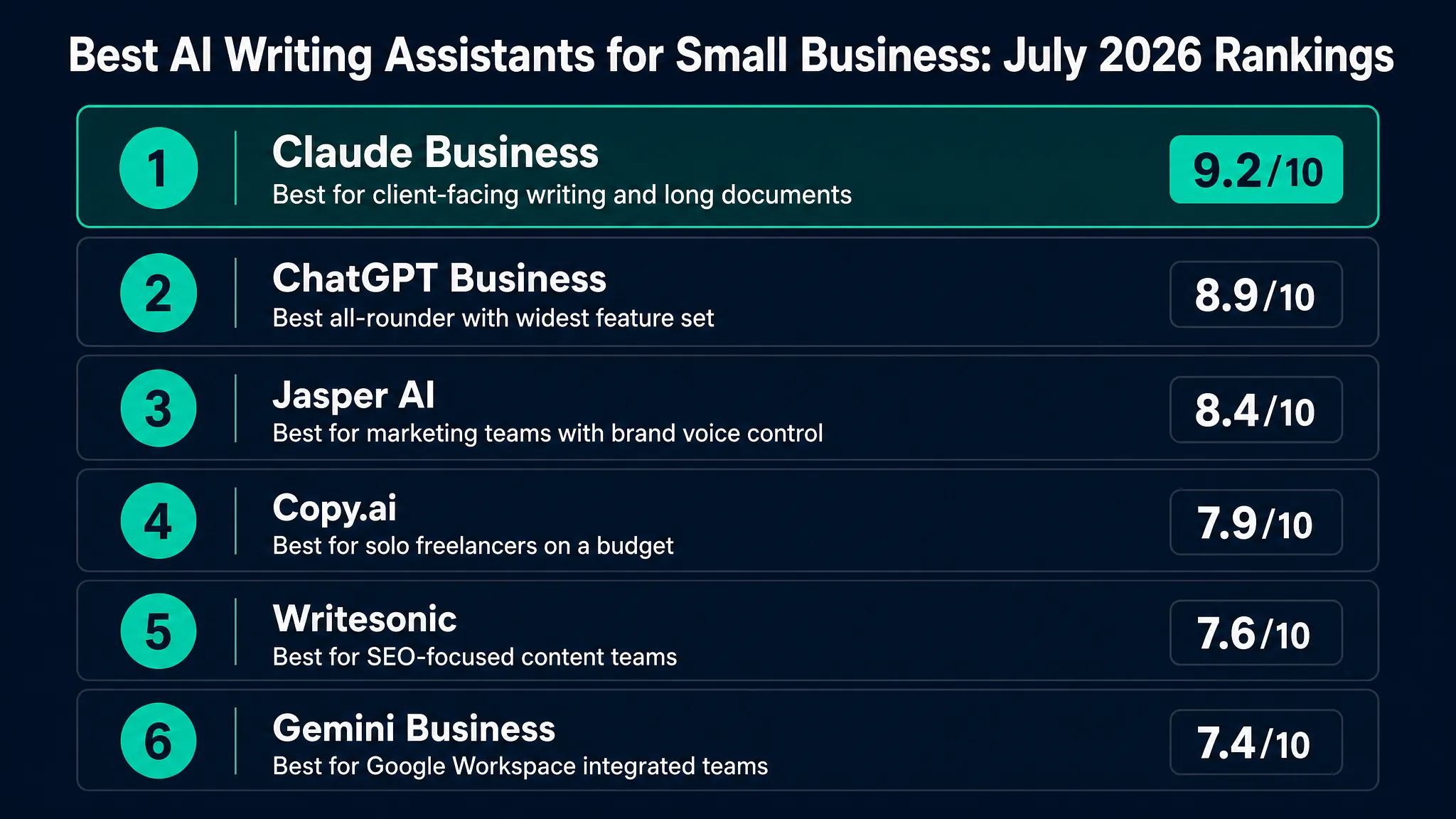
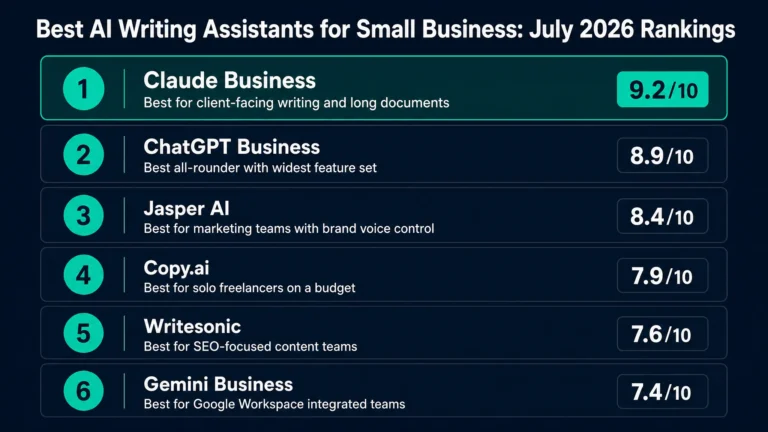
| Claude Business | $22 USD / £17 GBP | 9.2 / 10 | Professional and client-facing writing, long documents | Limited | Via custom instructions | Basic | Via API |
| ChatGPT Business | $25 USD / £20 GBP | 8.9 / 10 | All-round writing plus image creation | Yes, DALL-E built in | Via custom GPTs | Basic | Via plugins |
| Jasper AI | $49 USD / £39 GBP | 8.4 / 10 | Marketing teams with brand voice requirements | Yes, Jasper Art | Yes, dedicated feature | Strong | Via integration |
| Copy.ai | $36 USD / £29 GBP | 7.9 / 10 | Short-form marketing content and social copy | No | Basic | Moderate | Limited |
| Writesonic | $33 USD / £26 GBP | 7.6 / 10 | SEO content and blog production | Yes, Photosonic | Basic | Strong, Surfer SEO integration | Limited |
| Gemini Business | $24 USD / £19 GBP | 7.4 / 10 | Google Workspace users | Yes, Google image tools | Via Gems feature | Basic | Native, deepest integration |
Real World Example: How a Three-Person Consultancy Chose Its AI Writing Stack
A useful illustration of how small businesses make this decision in practice comes from a pattern seen consistently among professional services firms. A three-person management consultancy whose primary deliverables are client proposals, project reports, and strategy presentations was spending approximately 14 hours per week collectively on first-draft writing for these documents before AI adoption.
The team evaluated Claude Business and ChatGPT Business side by side on their actual client proposal format over a four-week period. Claude produced proposal executive summaries and section drafts that required an average of 11 minutes of editing before being client-ready. ChatGPT produced comparable drafts that required an average of 19 minutes of editing. The quality difference was most visible in the precision of language and the absence of generic management consulting clichés in Claude’s output compared to ChatGPT’s.
The consultancy chose Claude Business for all proposal and report writing at 22 US dollars per user per month. Total monthly cost for three users was 66 US dollars. Weekly time saved across the team was estimated at nine hours, representing approximately 675 US dollars in recovered time at their internal cost rate. The monthly return on the tool investment was over ten times the monthly cost within the first steady-state month after the initial learning period.
They supplemented this with ChatGPT Business for one team member whose role included marketing content and LinkedIn posting, where ChatGPT’s stronger short-form social output and image generation capability justified the additional 25 US dollars per month. Total AI writing tool investment across the three-person team was 91 US dollars per month producing an estimated monthly time value of over 700 US dollars.
US and UK Difference: All six tools tested in this guide are available in the United Kingdom at pricing broadly equivalent to the US dollar amounts converted to GBP at current exchange rates. UK business users should be aware that several of these tools, particularly Jasper and Copy.ai, were developed primarily with US marketing conventions and US English idioms as defaults. For UK businesses producing client-facing content, specifying UK English, UK market context, and explicitly requesting avoidance of American idioms in your prompts consistently produces better results for UK audiences. UK businesses in regulated sectors including financial services, legal, and healthcare should also verify that any AI writing tool’s data processing meets UK GDPR requirements before using it for content that involves client or customer data. Claude and ChatGPT Business plans include data processing agreements suitable for UK GDPR compliance. Verify current data processing terms directly with each provider before adoption in regulated contexts.
Recommendations by Business Type and Use Case
The right AI writing tool depends on what you actually write most, your budget constraints, and your existing tool ecosystem. Rather than a single winner, the practical recommendation depends on your specific situation.
For professional services firms including consultancies, law firms, accounting practices, and financial advisors, Claude Business is the recommendation. The quality of output on professional documents, the nuanced handling of complex topics, and the reduced editing time on client-facing content make it the strongest choice for businesses where writing quality directly affects client relationships and professional reputation. For UK regulated financial services firms, verify data processing compliance before adoption as noted above.
For marketing agencies and in-house marketing teams where brand voice consistency and volume of content output are the primary concerns, Jasper AI justifies its higher price point through the brand voice training feature and content planning capabilities that general-purpose AI assistants lack. For agencies managing multiple client brands with distinct voices, Jasper’s ability to maintain voice separation across accounts adds real operational value.
For solo freelancers and small businesses with mixed writing needs and budget sensitivity, Claude Business at 22 US dollars per user represents the best quality-to-cost ratio in this comparison. For freelancers whose work is primarily short-form social and marketing content, Copy.ai at 36 US dollars is worth evaluating against Claude for the specific task fit.
For businesses already embedded in Google Workspace whose primary goal is workflow integration rather than maximum writing quality, Gemini Business at 24 US dollars per user eliminates the friction of switching between tools and integrates directly into the applications the team already uses every day. The writing quality difference versus Claude and ChatGPT is real but may be acceptable given the workflow benefit for teams where the integration advantage translates to daily time savings.
For content teams and agencies whose primary goal is SEO-optimized content production, Writesonic’s direct integration with Surfer SEO and its content optimization features provide specific value that the general-purpose AI assistants do not deliver without additional tool integrations. For a comprehensive look at how AI writing tools compare to other AI tool categories for business use, see our detailed comparison of ChatGPT, Claude, and Gemini for business.
How to Evaluate Any AI Writing Tool Before Committing
Before committing to a paid plan on any AI writing tool, the most reliable evaluation method is testing the tool on two or three of your actual most common writing tasks during a free trial period. Generic marketing demonstrations on a vendor’s website tell you almost nothing about how a tool will perform on the specific writing your business actually produces. The time required for this evaluation is typically four to six hours spread across two weeks, which is a worthwhile investment before committing to an annual subscription.
When testing, measure two things specifically: the quality of the output on your specific tasks judged against your own editing standards, and the time from starting a prompt to having a draft ready for final review. Both metrics matter. A tool that produces excellent output in 45 minutes is less useful for daily business writing than a tool that produces good enough output in eight minutes, because the bottleneck in most business writing is not the final quality standard but the time available for the task.
Use the Biveron AI Tool ROI Calculator to translate your trial results into a monthly value estimate before deciding whether the subscription cost is justified. For most small businesses doing regular client communications and document production, the calculation typically shows strong positive ROI at the prices of all the tools in this comparison.
Frequently Asked Questions
Can AI writing tools completely replace a human copywriter or content writer?
Not in 2026 for most business writing contexts. AI writing tools in July 2026 are best described as capable first-draft generators that require human review, editing, and judgment before the output is ready for use. For businesses with established brand voices, complex client relationships, or regulatory requirements around their written communications, the human element remains essential. What AI tools do reliably is reduce the time that skilled writers spend on the mechanical and structural aspects of first drafts, freeing that time for the strategic and relational aspects of writing that actually require human judgment. Whether that restructuring justifies replacing a human writer depends entirely on the specific role, the writing volume, and the quality standards required.
How long does it take to get good results from an AI writing tool?
Most business users report seeing meaningful time savings within two to three weeks of consistent use. The first week typically involves developing effective prompting habits, understanding the tool’s specific strengths, and calibrating your expectations for what requires editing versus what is immediately usable. By week three to four in steady-state use, the time savings on familiar task types become consistent and predictable. Evaluating an AI writing tool on the basis of first-week results significantly underestimates the actual productivity benefit of consistent use.
Is it safe to use AI writing tools for client-facing content in regulated industries?
With appropriate oversight, yes. The key requirements are that all AI-generated content in regulated contexts is reviewed by a qualified professional before use, that the review process is documented, and that the AI tool’s data processing meets your applicable regulatory requirements including UK GDPR, FCA guidance on AI use, and any sector-specific rules. Several regulated industry firms in the UK and US have developed explicit AI content policies that specify these oversight requirements, and following this model is advisable for any regulated business using AI writing tools for client-facing content.
What is the difference between a general AI assistant like Claude and a dedicated writing tool like Jasper?
General AI assistants like Claude and ChatGPT are designed for a wide range of tasks including writing, analysis, coding, research, and conversation. Dedicated writing tools like Jasper and Copy.ai are built specifically for content and marketing use cases with features like brand voice training, content templates organized by format, team collaboration workflows, and integrations with marketing and SEO tools that general AI assistants do not have built in. For businesses whose primary AI use case is content and marketing writing at scale, the dedicated tools offer features that justify their often higher price. For businesses with mixed AI needs including significant non-writing tasks, a general AI assistant typically offers better overall value.
Do AI writing tools work for languages other than English?
All six tools tested in this guide support multiple languages, but performance in languages other than English varies significantly. English language output remains the strongest across all tools as of July 2026, reflecting the language composition of training data. For US and UK businesses producing content primarily in English, language performance is not a significant differentiator. For businesses producing content in multiple languages, testing your specific language requirements thoroughly during the trial period is essential before committing to a plan.
Disclaimer: This article is for informational purposes only. Pricing, features, and performance characteristics of AI tools change frequently. All pricing referenced in this article reflects publicly available information as of July 2026 and should be verified directly with each provider before making purchasing decisions. Performance scores reflect Biveron Research Team testing on specific tasks and may not reflect performance on tasks different from those tested. Some links in this article may be affiliate links. See our Affiliate Disclosure for details.
Latest Research
Recently Published
Keep Reading