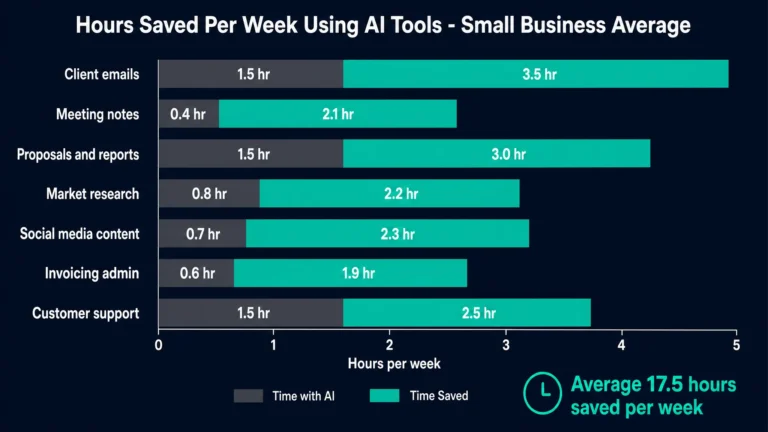
The administrative overhead of running a freelance business has always been disproportionate to its revenue scale. A freelancer earning 80,000 US dollars per year from client work routinely spends 12 to 18 hours per month on tasks that generate zero direct income: writing proposals, drafting contracts, creating and sending invoices, following up on late payments, onboarding new clients, and tracking time across projects. In 2026, AI-integrated client management and invoicing tools have restructured this workload significantly. The same administrative tasks that previously consumed a quarter of a working week now take under two hours per month when the right tools are in place and configured well. The time recovered is either redirected to billable work, which at typical freelancer rates represents meaningful additional annual revenue, or returned as genuine free time. This guide covers the tools that are delivering that outcome in 2026 and which type of freelance business each one suits best.
What This Guide Covers
This article is written for freelancers, independent consultants, and self-employed professionals in the United States and United Kingdom who want to reduce the time spent on client administration without sacrificing the professional quality of their client-facing documents and communications. It covers six leading client management and invoicing platforms with AI features evaluated in 2026, with specific recommendations by freelance business type, revenue level, and whether the priority is invoicing, contracts, CRM, or a combination. For related guidance on the financial side of freelancing, see our guide on how to calculate your true hourly rate as a freelancer and our article on how AI is changing tax preparation for freelancers in the US.
The Specific Problems AI Solves in Freelance Client Management
Understanding where AI tools add the most value in a freelance business requires identifying the specific administrative bottlenecks that consume the most time and create the most friction in the client relationship cycle.
Invoice creation and delivery is the first bottleneck. Most freelancers create invoices manually, often in Word or Google Docs, and send them by email without payment links or automated follow-up. This approach is slow to create, relies on clients actively remembering to pay, and provides no automated mechanism for chasing late payments. AI-integrated invoicing tools generate invoices automatically from time tracking data or project records, send them with embedded payment links, and trigger automated reminder sequences when payment is overdue without requiring any manual action from the freelancer.
Proposal and contract creation is the second bottleneck. Writing a proposal from scratch for each new client opportunity is time-consuming and inconsistent, producing documents of varying quality depending on how much time the freelancer has available at the time. Drafting individual contracts involves either expensive legal fees or using generic templates that may not reflect the specific terms of the engagement. AI-integrated platforms provide proposal templates that auto-populate from project information, contracts with legally reviewed clauses that can be customized without legal expertise, and e-signature collection that eliminates the paper and PDF sending cycle.
Client onboarding is the third bottleneck. New client onboarding typically involves a series of similar communications and information gathering activities: welcome email, questionnaire for project brief, contract sending and execution, invoice for deposit payment, and project kickoff scheduling. Each of these steps is handled manually by most freelancers, consuming time that could be automated. Platforms with automated workflow features handle the entire onboarding sequence automatically once a new client accepts a proposal, triggering each step in the correct order without manual intervention.
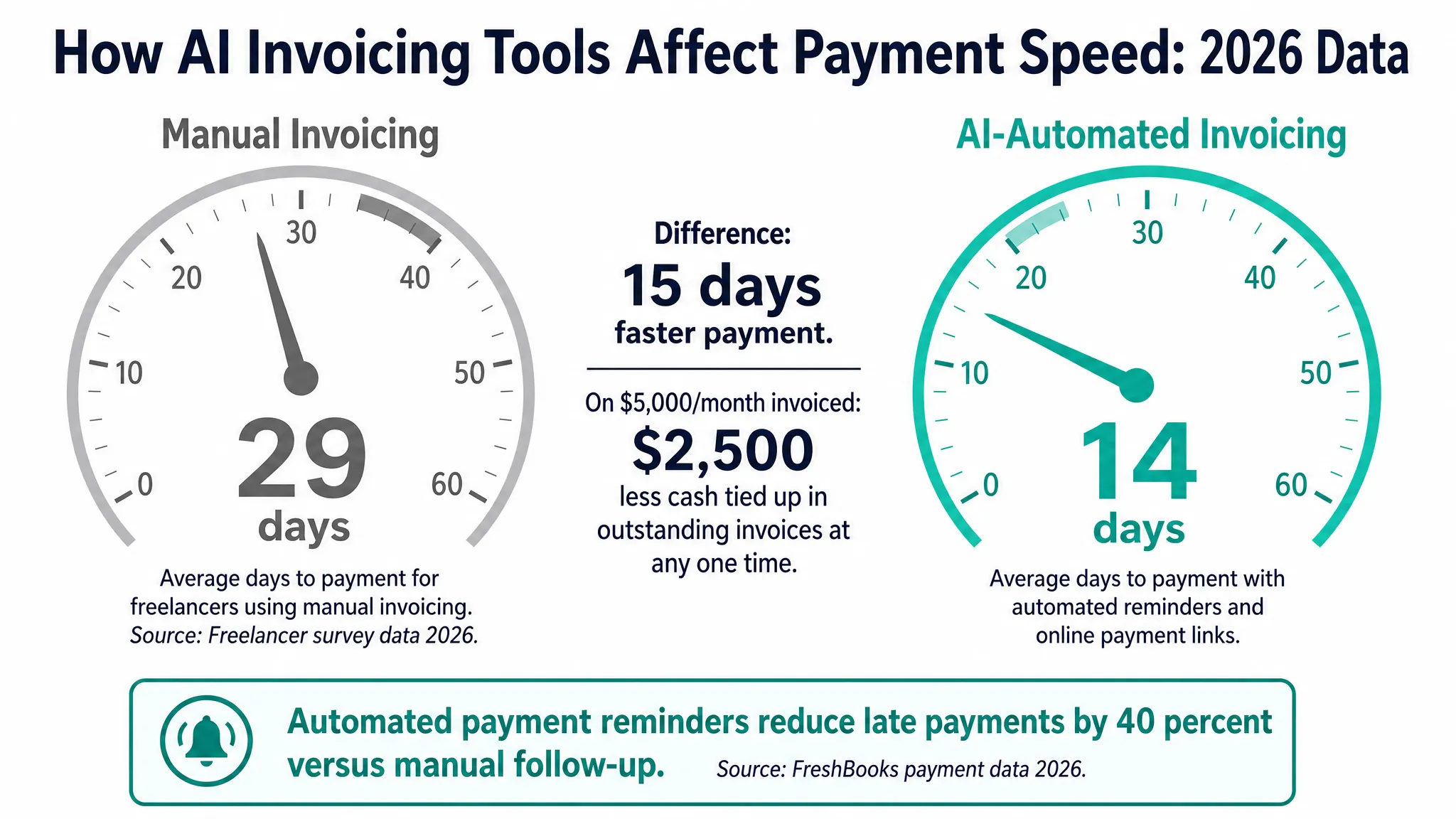
Late payment follow-up is the fourth bottleneck and the one with the most direct financial impact. The average freelancer in the United States and United Kingdom waits 29 days for invoice payment. Automated payment reminder sequences that trigger at defined intervals after the invoice due date, sent from the freelancer’s email address with a direct payment link, consistently reduce this average to approximately 14 days for freelancers using automated follow-up tools. The improvement in cash flow from faster payment is often more financially significant than the time saving from automated administration.
The Six Platforms We Evaluated
HoneyBook
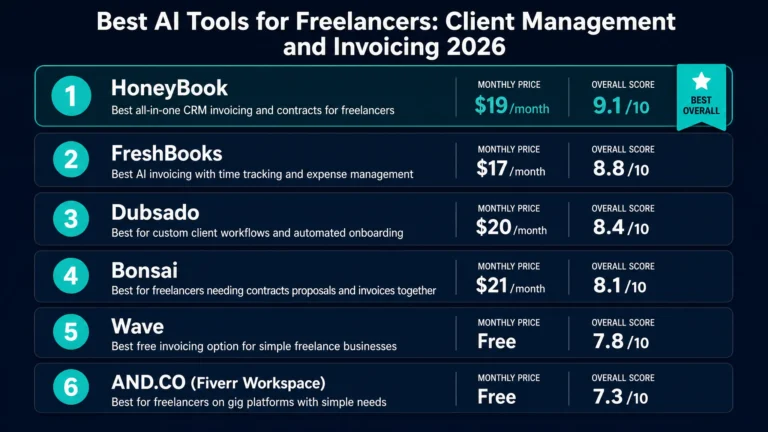
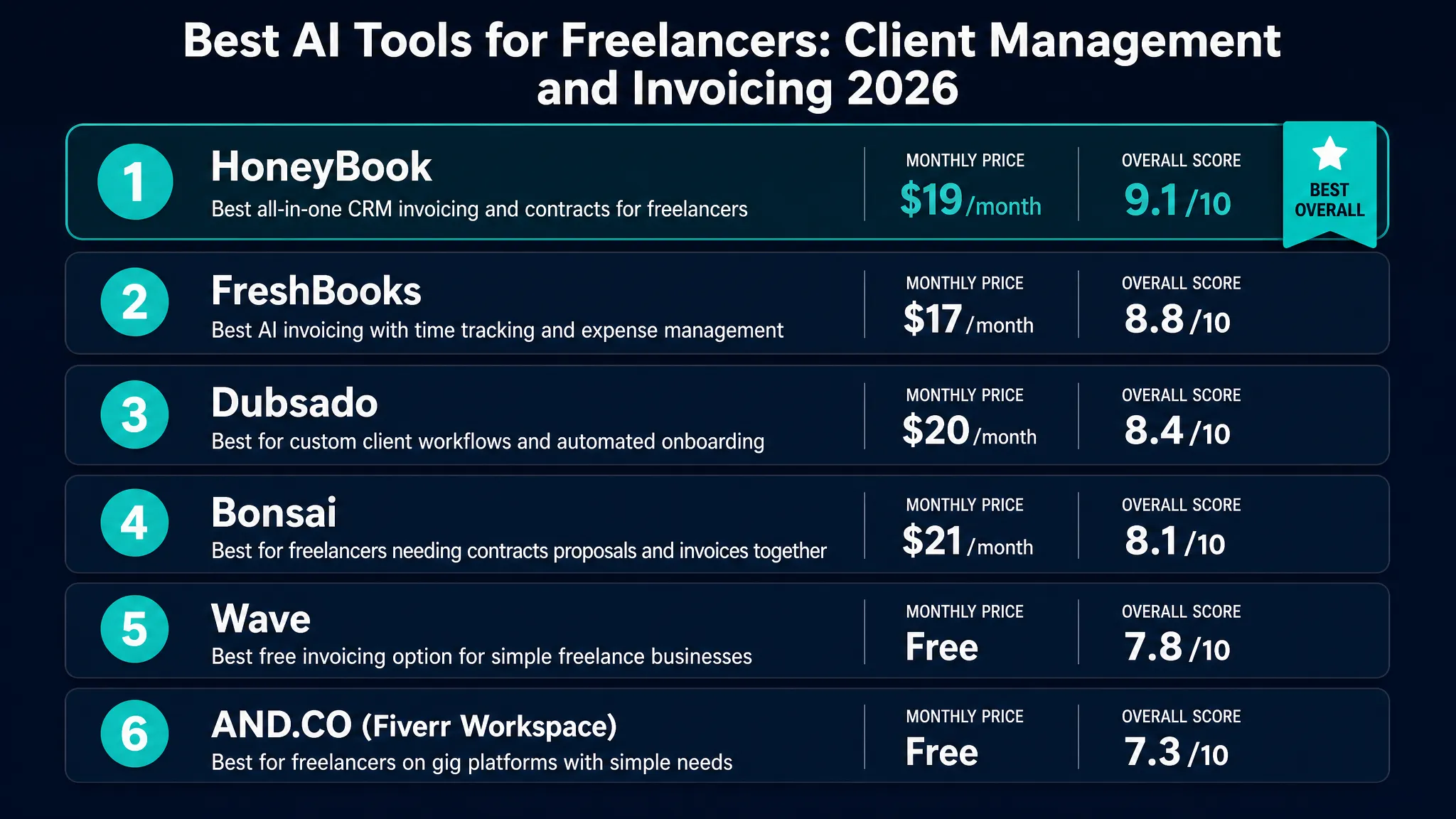
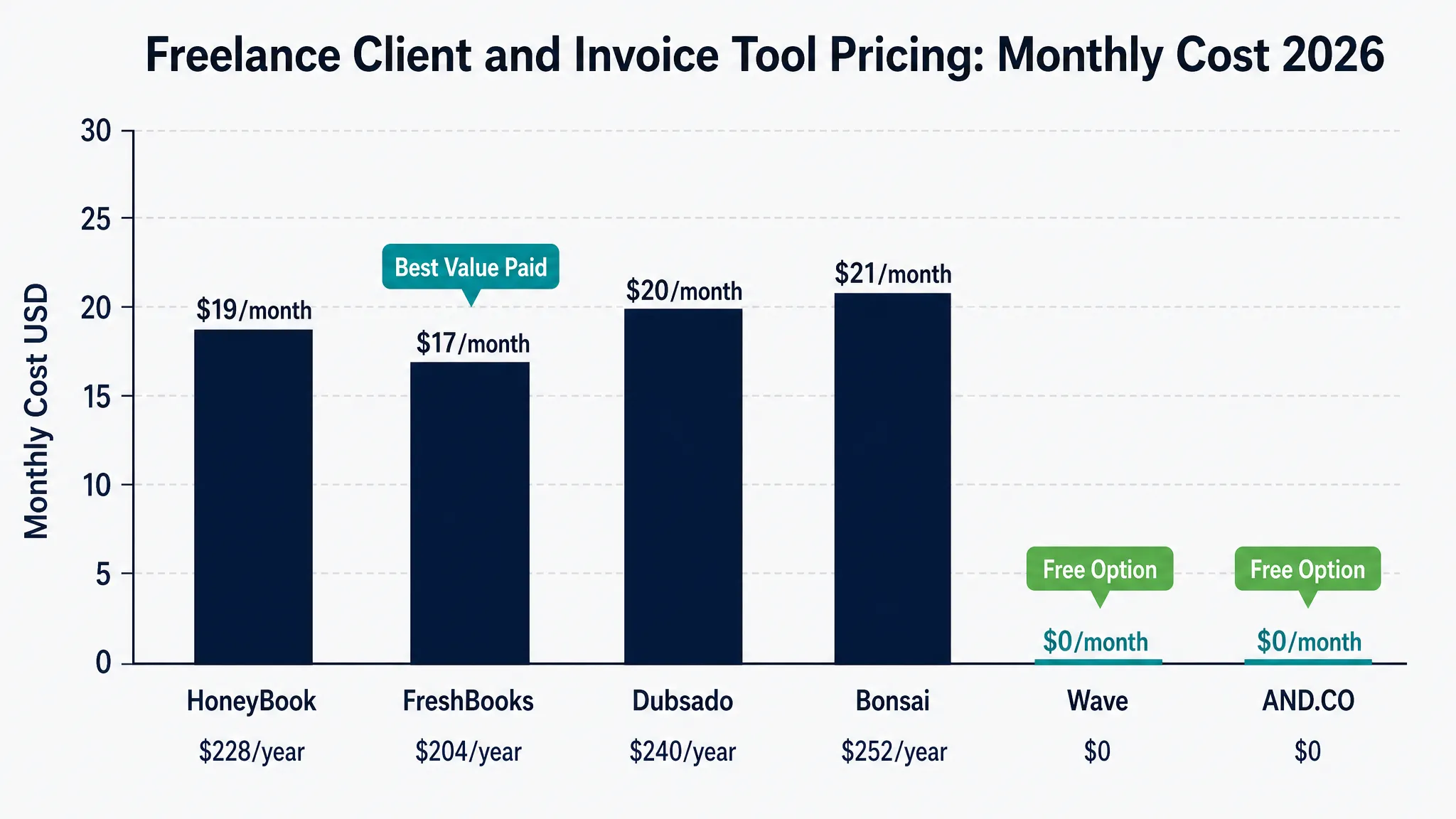
HoneyBook is the most fully featured all-in-one client management platform specifically designed for freelancers and creative professionals in 2026. It combines CRM, proposal creation, contract management, invoicing, payment collection, and automated workflow sequences in a single platform at a starting price of approximately 19 US dollars per month. The AI features in HoneyBook in 2026 include AI-generated proposal content from project briefs, smart scheduling through calendar integration, and automated client communication sequences that trigger based on project milestones.
The workflow automation capability is HoneyBook’s strongest differentiator. Once a client accepts a proposal, HoneyBook automatically sends the contract for e-signature, triggers the deposit invoice, and initiates the onboarding questionnaire in sequence without any manual action from the freelancer. For freelancers who handle a consistent type of client work, this automation eliminates the repetitive communication that is one of the most time-consuming aspects of client administration. The setup of these automated workflows takes approximately two to three hours initially but produces ongoing time savings from the first client who goes through the process.
HoneyBook’s payment processing handles credit and debit cards and ACH bank transfers, with processing fees of approximately 3 percent for card payments and 1.5 percent for ACH. The platform also handles payment schedules for projects invoiced in multiple installments, which is relevant for freelancers working on longer projects with milestone-based payment terms.
HoneyBook is available in the United States and Canada. UK freelancers will find that the platform’s payment processing and some contract templates are less well-adapted to UK market specifics, and should evaluate Dubsado or Bonsai as alternatives with more relevant UK functionality.
FreshBooks
FreshBooks is the strongest recommendation for freelancers who want excellent invoicing and time tracking with solid AI expense management at a competitive price point, without the full client management complexity of HoneyBook or Dubsado. Its Lite plan at approximately 17 US dollars per month covers up to five billable clients with invoicing, expense tracking from bank feeds, time tracking, and basic reporting. The AI expense categorization from connected bank accounts and the automated payment reminder sequences are the features that deliver the most immediate time saving for most freelancers adopting FreshBooks.
The time tracking feature in FreshBooks integrates directly with invoicing: hours logged against a project are automatically pulled into the invoice for that project at the agreed hourly rate, eliminating the manual calculation step of converting time records into invoice amounts. For freelancers billing by the hour, this integration alone saves significant time each billing cycle and reduces the risk of billing calculation errors.
FreshBooks is available in both the US and UK with GBP invoicing and basic VAT support for UK freelancers. The platform does not offer native Making Tax Digital compliance for VAT returns, which is a limitation for UK VAT-registered freelancers who need MTD-compatible software. For UK freelancers above the VAT threshold, Xero or QuickBooks UK provides better MTD integration, potentially alongside FreshBooks for invoicing if the combination is preferable to a single platform solution.
Dubsado
Dubsado is the strongest choice for freelancers who want maximum customization of their client workflows and client-facing documents. Its form builder, contract editor, and workflow automation engine allow freelancers to create precisely configured client journeys that reflect their specific process and brand rather than the platform’s default templates. For freelancers with a distinctive brand or a highly structured client process, Dubsado’s flexibility provides a level of customization that more opinionated platforms like HoneyBook do not match.
The AI features in Dubsado in 2026 are less developed than those of HoneyBook or FreshBooks, with AI assistance available for some document drafting but less integrated into the core workflow than the market leaders. The strength of Dubsado is in workflow automation powered by conditional logic rather than AI generation: the ability to create automated sequences that branch based on client responses and project characteristics, producing sophisticated client management systems without requiring AI content generation.
Dubsado’s pricing at approximately 20 US dollars per month provides unlimited clients and projects, making it cost-effective for freelancers managing higher client volumes. It is available globally and is used by significant numbers of UK freelancers for client management, with the caveat that invoicing currency and some contract clause templates may require customization for UK market specifics.
Bonsai
Bonsai is the most comprehensive platform specifically designed around the legal and contractual side of freelancing, and its combination of contract templates, proposal generation, invoicing, and time tracking addresses the full cycle from new client agreement to payment in a single workflow. The contract templates in Bonsai have been reviewed by legal professionals and cover the most common freelance engagement types, providing protection against common disputes around scope creep, payment terms, and intellectual property ownership without requiring individual legal advice for each client engagement.
The AI proposal generation in Bonsai in 2026 allows freelancers to input a project brief and receive a structured proposal draft that includes scope, deliverables, timeline, and pricing sections. The draft requires review and customization but provides a faster starting point than writing from scratch, particularly useful for freelancers who write proposals less frequently and find the blank page difficult to start from.
Bonsai supports PayPal alongside card and ACH payment processing, which provides an additional payment option that some international clients prefer. Bonsai is available globally and supports GBP invoicing for UK freelancers. The contract templates require review for UK legal context as they are primarily drafted for US law, which is a limitation for UK freelancers relying on the contracts for dispute resolution.
Wave
Wave remains the strongest free invoicing option for freelancers in 2026, providing genuinely capable invoicing, expense tracking, and basic reporting at no monthly cost. The free tier includes unlimited invoices, automated payment reminders, and online payment collection through Wave’s payment processing (at per-transaction fees rather than a monthly subscription). For freelancers in the early stages of their business, those with very low invoice volumes, or those testing invoicing software before committing to a paid platform, Wave provides full invoicing functionality without any fixed monthly cost.
Wave’s limitations relative to paid platforms are the absence of contract management, limited CRM features, less developed AI categorization than the paid alternatives, and no client portal for document sharing and communication. For freelancers who need only invoicing and basic expense tracking and are comfortable managing contracts and client communication through other channels, Wave’s free tier meets those needs adequately.
AND.CO (Fiverr Workspace)
AND.CO, rebranded as Fiverr Workspace, provides a free tier covering proposals, contracts, invoicing, and time tracking for freelancers, with a particular strength in integration with the Fiverr platform for freelancers who source work through that marketplace. The free tier is more feature-complete than Wave’s in terms of covering the proposal-to-invoice workflow, though the AI features are basic compared to the paid platforms.
AND.CO is best suited to freelancers who primarily work through Fiverr or who want a simple free tool covering the basics of proposal, contract, and invoice management without the sophistication or monthly cost of the paid alternatives. For freelancers with growing client volumes, more complex project types, or a need for automated client workflows, the limitations of the free tier become apparent relatively quickly and one of the paid platforms provides better value for the monthly investment.
Full Feature and Pricing Comparison
| Tool | Monthly Price | AI Proposals | Contract Templates | Automated Invoicing | Payment Reminders | Time Tracking | Client Portal | UK Support | Best For |
|---|---|---|---|---|---|---|---|---|---|
| HoneyBook | $19/month | Yes, AI assisted | Yes, strong | Yes, from project data | Yes, automated sequences | Yes | Yes | Limited, US and Canada focus | Full client lifecycle automation US |
| FreshBooks | $17/month Lite | No | No | Yes, from time tracking | Yes, automated | Yes, strong | Basic | Yes, GBP and basic VAT | Time-based billing freelancers US and UK |
| Dubsado | $20/month | Basic | Yes, highly customizable | Yes | Yes, automated | Yes | Yes, strong | Yes, global | Custom workflow freelancers |
| Bonsai | $21/month | Yes, AI drafted | Yes, legal reviewed US focus | Yes | Yes, automated | Yes | Yes | Yes, GBP but US law contracts | Contract-focused freelancers |
| Wave | Free | No | No | Yes, manual creation | Yes, automated | No | No | Limited | Early-stage freelancers wanting free invoicing |
| AND.CO | Free | Basic | Yes, basic templates | Yes | Yes | Yes, basic | No | Limited | Fiverr freelancers and simple needs |
Real World Example: How a Freelance Designer Cut Admin From 16 Hours to 90 Minutes Per Month
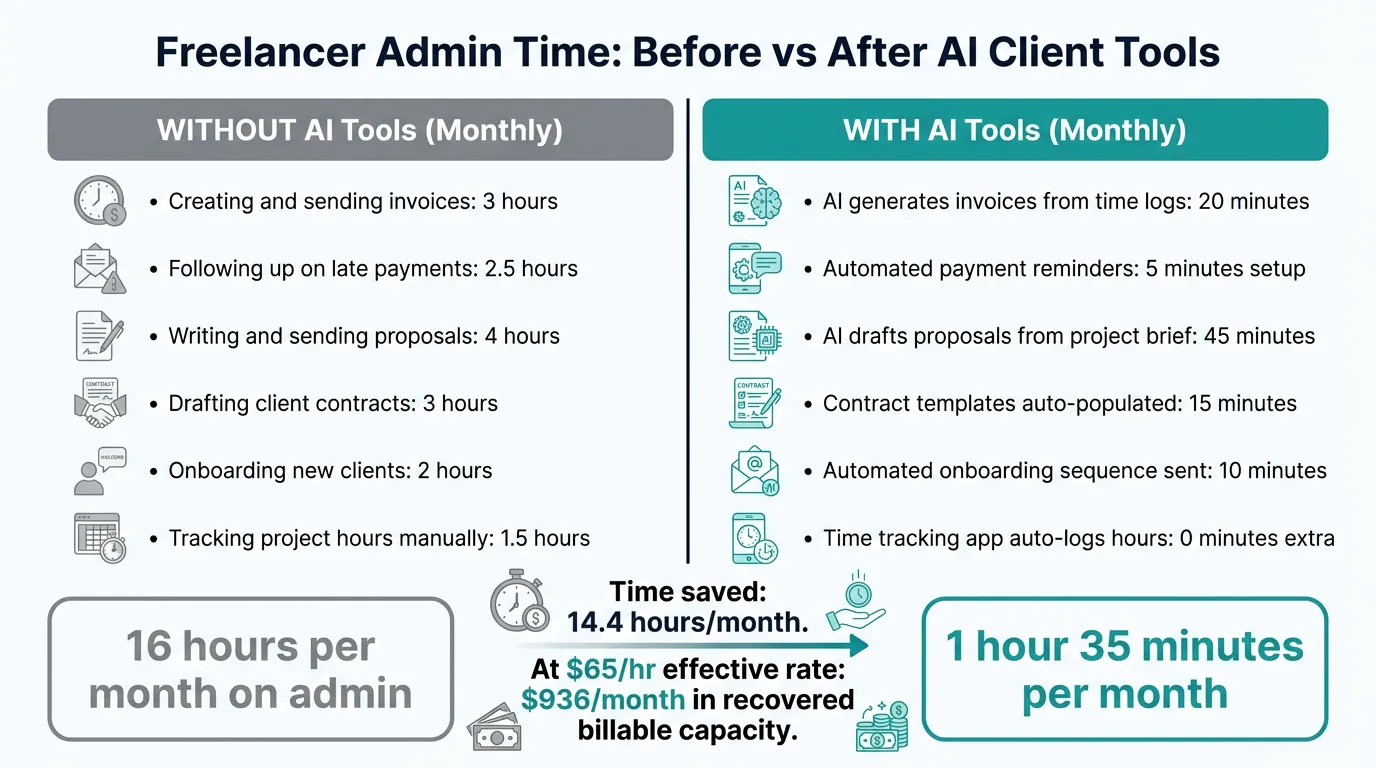
A freelance brand designer based in the United Kingdom with eight active clients at any one time illustrates how AI client management tools restructure freelance administration. Before adopting any dedicated client management platform, the designer was spending approximately 16 hours per month on administrative tasks: creating invoices in InDesign which matched the brand quality but took 30 to 45 minutes each, following up on late payments by email, writing proposals from scratch for each new inquiry, sending PDF contracts and waiting for signed scans to be returned, and tracking project hours in a spreadsheet that required manual calculation to convert to invoice amounts.
After implementing Dubsado for client management and FreshBooks for invoicing and time tracking, the workflow changed substantially. New client inquiries now trigger an automated proposal sequence that uses Dubsado’s template to generate a proposal pre-populated with the standard pricing and deliverable structure, requiring 20 to 30 minutes of customisation rather than 2 to 3 hours of creation from scratch. Accepted proposals automatically trigger the contract for e-signature and the deposit invoice, with payment reminders sent automatically if the deposit is not received within five business days.
Time tracking through FreshBooks logs hours automatically and feeds directly into invoice generation at the end of each project phase, eliminating the spreadsheet calculation step. Automated payment reminder sequences in FreshBooks send follow-up emails at day 7, day 14, and day 21 after each invoice due date, which reduced the designer’s average invoice-to-payment cycle from 31 days to 13 days. The reduction in outstanding invoices at any one time improved cash flow meaningfully and eliminated the uncomfortable manual late payment conversations that had previously been a regular feature of the month.
Total monthly administrative time reduced from 16 hours to approximately 90 minutes. The combined cost of Dubsado at 20 US dollars and FreshBooks Lite at 17 US dollars is 37 US dollars per month. At the designer’s effective hourly rate of 65 GBP, recovering 14 hours per month represents approximately 910 GBP in additional monthly capacity at no additional cost beyond the tool subscription.
How to Choose the Right Platform for Your Freelance Business
The right client management platform depends on four questions that reflect the specific nature of your freelance work and the administrative bottlenecks that cost you the most time.
The first question is whether you bill primarily by the hour or by the project. Freelancers who bill by the hour gain the most from platforms with strong time tracking integration with invoicing, where FreshBooks is the strongest recommendation. Freelancers who bill by project or deliverable gain more from platforms with strong proposal and contract workflows, where HoneyBook or Bonsai are better fits.
The second question is whether client onboarding is a significant time cost in your business. Freelancers who onboard one or two new clients per month gain disproportionate benefit from automated onboarding workflows, making HoneyBook or Dubsado the stronger recommendation. Freelancers with a small number of long-term retainer clients who rarely onboard new ones gain less from the onboarding automation features and may find FreshBooks simpler and more appropriate.
The third question is whether you are based in the US or UK. As covered above, HoneyBook is US and Canada only. Bonsai’s contracts are US law focused. For UK freelancers, FreshBooks and Dubsado are the most practical recommendations with the specific VAT considerations noted above.
The fourth question is your current revenue and whether the monthly platform cost is proportionate. For freelancers earning under 30,000 US dollars per year, the free tiers of Wave or AND.CO provide basic invoicing functionality at no cost, with an upgrade path to paid platforms as revenue grows. For freelancers earning above this level, the time saving from paid platforms typically justifies the monthly cost many times over. Use the Biveron Freelancer True Rate Calculator to understand your effective hourly rate and the true value of recovered admin time before deciding whether a paid platform investment is justified at your current revenue level.
Frequently Asked Questions
Can I use these tools to create legally binding contracts with clients?
The e-signed contracts generated through platforms like HoneyBook, Dubsado, and Bonsai are generally considered legally binding in the United States under the Electronic Signatures in Global and National Commerce Act, and in the United Kingdom under the Electronic Communications Act 2000, provided the signature process meets the requirements for a valid electronic signature. However, the legal validity depends on the specific circumstances and the governing law specified in the contract. More importantly, the contract content itself must accurately reflect the agreed terms and comply with the applicable law for the jurisdiction in which it will be enforced. Pre-built contract templates are a reasonable starting point but have not been reviewed for your specific type of work or jurisdiction. For high-value client relationships or work with significant legal complexity, having a solicitor or attorney review your standard contract terms is a worthwhile one-time investment that protects all subsequent client relationships using those terms.
How do automated payment reminders work and will they damage my client relationships?
Automated payment reminders are pre-written email sequences that send automatically at defined intervals after an invoice due date without requiring manual action from the freelancer. Most platforms allow you to customize the reminder text, timing, and frequency. A typical sequence might send a friendly reminder on the due date, a follow-up after seven days, and a firmer reminder after 14 days, each with a direct payment link. Research consistently shows that the majority of late payments are not deliberate non-payment but result from the invoice being overlooked in a busy inbox. Automated reminders that make payment easy through embedded payment links consistently improve collection rates without damaging client relationships, particularly when the reminder tone remains professional and helpful rather than aggressive. Clients who have a genuine reason for late payment typically respond to the first automated reminder with an explanation, at which point the conversation can move to manual handling.
What is the difference between a client portal and a regular client email workflow?
A client portal is a dedicated online space where clients can access all documents related to their project: proposals, signed contracts, invoices, project briefs, deliverables, and communication history. Rather than searching through email threads to find a specific document, clients access everything through a single URL with their login credentials. Platforms that offer client portals including HoneyBook, Dubsado, and Bonsai typically see higher client satisfaction scores than those relying purely on email because the portal reduces the friction of document retrieval and provides a more professional client experience. The portal also benefits the freelancer by centralizing all client-related documents and communications in a single location rather than dispersed across email threads, file storage, and document editing tools.
Can I migrate from one invoicing platform to another without losing my invoice history?
Most platforms allow export of invoice history and client data in CSV format that can be imported into competing platforms, though the completeness of the export and the ease of import varies. Invoice history, client contact data, and payment records are typically exportable. Custom workflow configurations, automated sequence setups, and platform-specific integrations generally do not transfer and require rebuilding in the new platform. The most practical approach to migration is to continue processing existing client invoices through the old platform until they are paid while setting up new clients in the new platform, allowing a gradual transition rather than an immediate switch that requires historical data migration. Before committing to any platform, verify the data export capabilities specifically so that your invoice history is not locked into the platform if you choose to move to an alternative in future.
Do these platforms handle recurring invoices for retainer clients?
Yes. All six platforms in this comparison support recurring invoice creation for retainer clients where the same amount is invoiced on a defined schedule, typically monthly. The recurring invoice feature creates and sends the invoice automatically on the scheduled date without requiring any action from the freelancer, with payment reminders triggered automatically if payment is not received by the due date. For freelancers with significant retainer revenue, the recurring invoice automation is one of the highest-value features because it completely removes the monthly invoicing task for those clients. Some platforms also support variable recurring invoices where the base amount is consistent but specific line items can be added to reflect additional work completed in a given period, which suits retainer relationships with variable scope alongside the fixed monthly fee.
Latest Research