For most small business owners in the United States, tax compliance is not just one task on a long list. It is a recurring source of stress that comes around four times a year for quarterly estimated payments, consumes unpredictable chunks of time during filing season, and carries the persistent anxiety of not being entirely sure whether everything is being done correctly. AI tools have changed this picture meaningfully in 2026, not by replacing the need for qualified tax professionals on complex matters, but by handling the data gathering, calculation, categorization, and reminder functions that previously consumed hours of a business owner’s time and introduced most of the errors that created problems later. This guide explains what AI tax compliance tools actually do, which ones are worth using for small US businesses, and where the line is between what AI can handle reliably and what still requires a qualified professional.
What This Guide Covers
This article is written for small business owners, freelancers, and self-employed individuals operating in the United States who want to understand how AI tools can reduce the time and complexity of tax compliance without creating new risks. It covers the specific compliance tasks where AI delivers the most value, the tools that handle those tasks best in 2026, and the situations where professional guidance remains essential. A critical note: nothing in this guide constitutes tax advice. Tax obligations vary significantly based on business structure, state, industry, and individual circumstances. Always work with a qualified tax professional for guidance specific to your situation, particularly for anything involving IRS correspondence, amended returns, or audit response.
Why Tax Compliance Is a Bigger Problem for Small Businesses Than Most Realize
Large businesses have dedicated accounting departments, tax teams, and external advisors whose entire job is staying current with tax obligations. Small businesses typically have none of these resources. A sole proprietor or small LLC owner is simultaneously responsible for running their business, managing clients, handling operations, and staying compliant with federal, state, and sometimes local tax requirements that change regularly and interact with each other in ways that are not always intuitive.
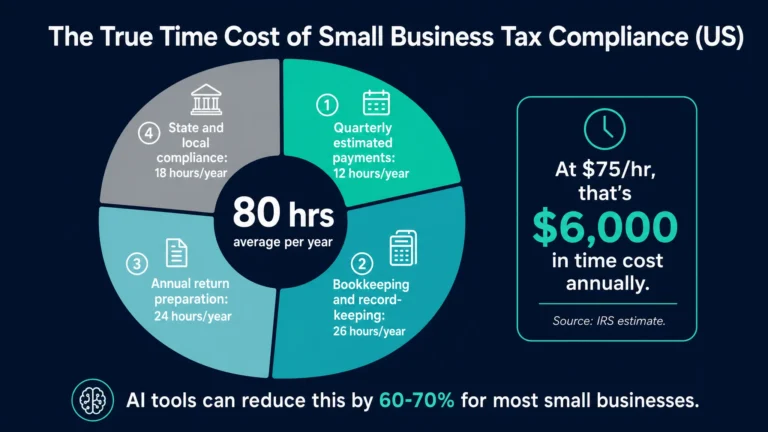
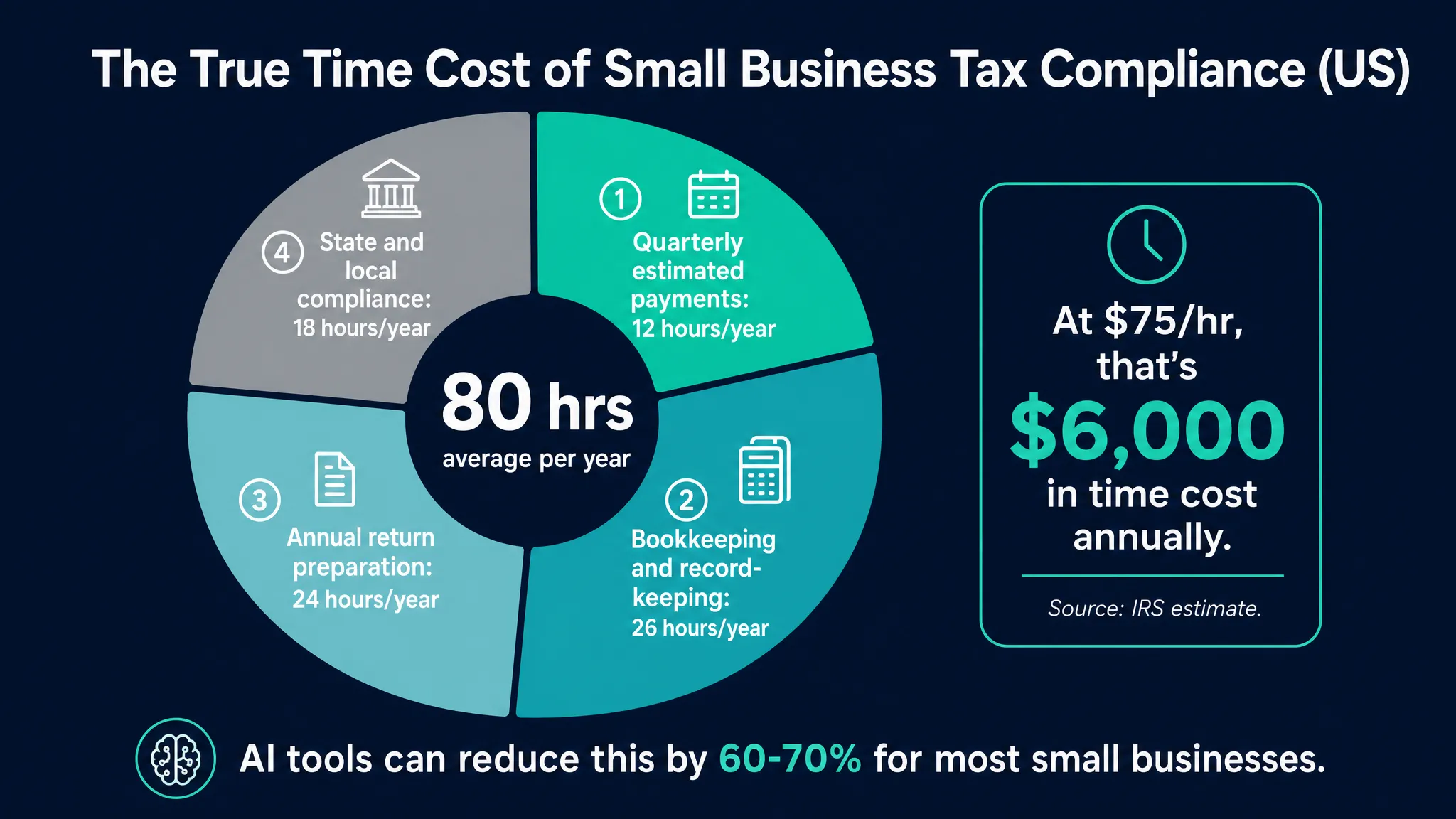
The IRS estimates that small businesses spend an average of 80 hours per year on federal tax compliance activities alone. For a business owner billing 75 US dollars per hour, that represents 6,000 US dollars in time cost annually before considering state tax obligations, payroll tax compliance if the business has employees, or sales tax requirements in states where the business has nexus. The financial cost of getting compliance wrong is also significant. IRS penalties for failure to pay estimated quarterly taxes can range from a few hundred to several thousand dollars depending on the amount underpaid and the duration of the underpayment.
The challenge is compounded by the fact that tax rules for small businesses are genuinely complex. The distinction between a deductible business expense and a personal expense, the correct treatment of home office deductions, the rules around vehicle use, the self-employment tax calculation, and the quarterly estimated payment schedule all require ongoing attention and accurate record-keeping throughout the year rather than a single filing effort in April.
What AI Tax Compliance Tools Actually Do
The term AI tax compliance covers a range of different tools and capabilities, and it is worth being specific about what each category of tool does rather than treating them as a single category.
Automated Bookkeeping and Expense Categorization
The most foundational category of AI tax tool is automated bookkeeping software that connects to your bank accounts and credit cards, pulls in transaction data, and categorizes expenses using machine learning trained on large datasets of business transactions. Tools in this category learn your specific spending patterns over time and improve their categorization accuracy, reducing the manual review time required to keep your books tax-ready throughout the year.
The tax compliance value of this category is significant because the most common source of errors and missed deductions in small business tax returns is not deliberate misreporting but inadequate record-keeping. Business owners who are not tracking expenses consistently throughout the year spend enormous amounts of time reconstructing records at tax time, often missing legitimate deductions in the process. Automated bookkeeping tools that keep records current in real time eliminate this problem at the source.
Quarterly Estimated Tax Calculators and Reminders
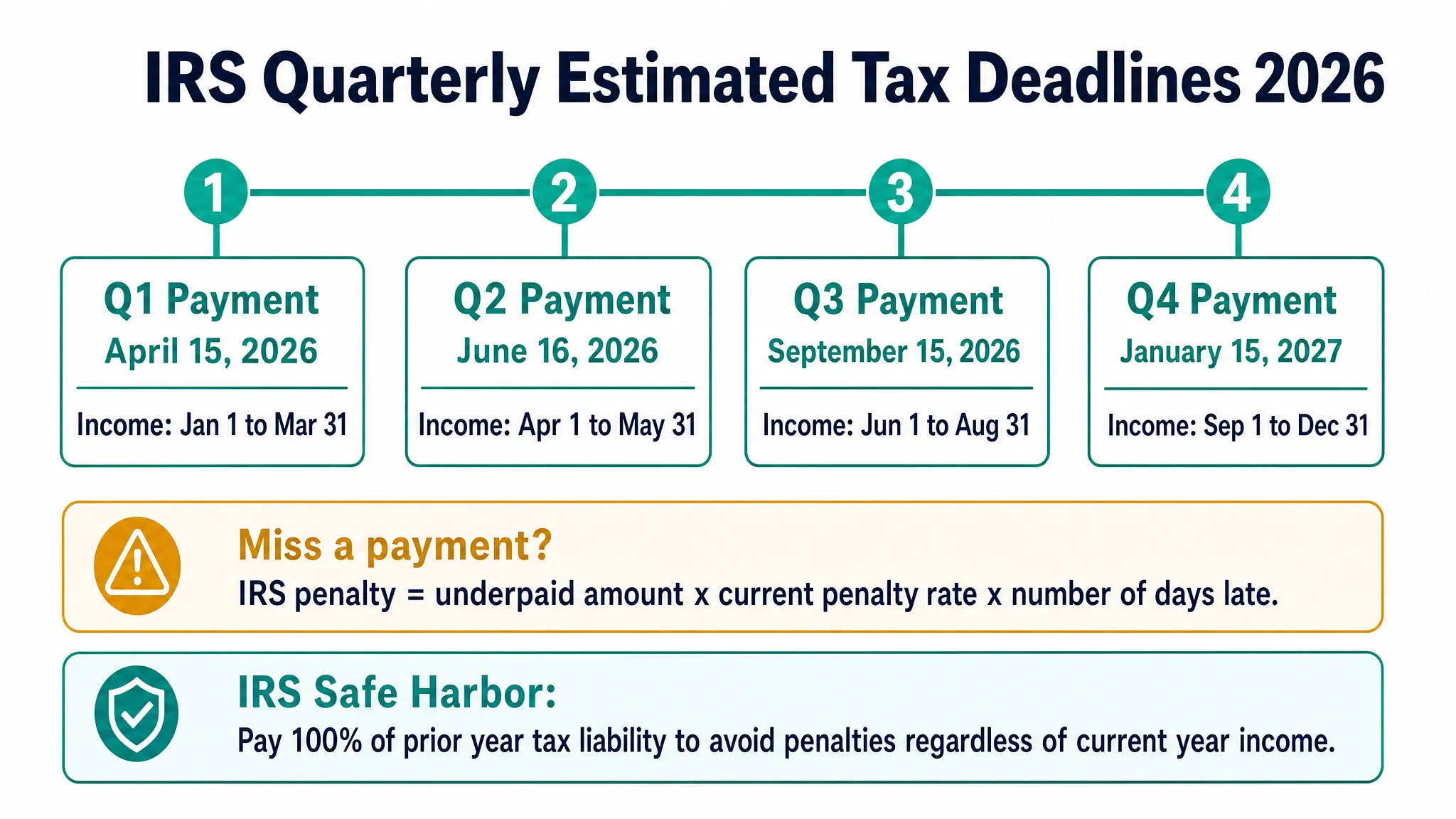
Self-employed individuals and business owners who expect to owe more than 1,000 US dollars in federal taxes are generally required to make quarterly estimated tax payments to the IRS. The four payment deadlines fall in April, June, September, and January of each year. Missing these payments or underpaying results in penalties calculated on the underpaid amount and the duration of the underpayment.
AI tools in this category connect to your income and expense data, apply current tax rates and your estimated deductions, and calculate what your quarterly payment should be to avoid underpayment penalties. The better tools also send reminders ahead of each deadline and update their estimates as your income changes throughout the year. Our free Quarterly Tax Estimator Calculator on the Biveron calculators page provides a starting estimate based on your expected annual income and filing status, which you can use to check whether your current payment amounts are in the right range.
Mileage and Asset Tracking
Vehicle use for business purposes is a legitimate deduction but requires documentation that many small business owners find tedious to maintain. AI-powered mileage tracking apps use GPS data to automatically log business trips, distinguish them from personal travel based on patterns and user confirmation, and produce IRS-compliant mileage logs that can be exported directly for use at tax time. The standard mileage rate for 2026 means that even a moderate amount of business driving produces meaningful deductions for business owners who track it correctly.
Tax Document Organization and Filing Preparation
More sophisticated AI tax tools handle the preparation of tax documents by pulling categorized income and expense data from connected bookkeeping software, applying the correct tax forms and schedules based on your business structure, and producing a draft return or a package of organized information that can be handed to a tax professional for review and filing. These tools reduce the preparation time and cost involved in working with a CPA by handling the data organization work that previously took hours of either the business owner’s time or the accountant’s billable time.
Comparison of AI Tax Compliance Tools for Small US Businesses
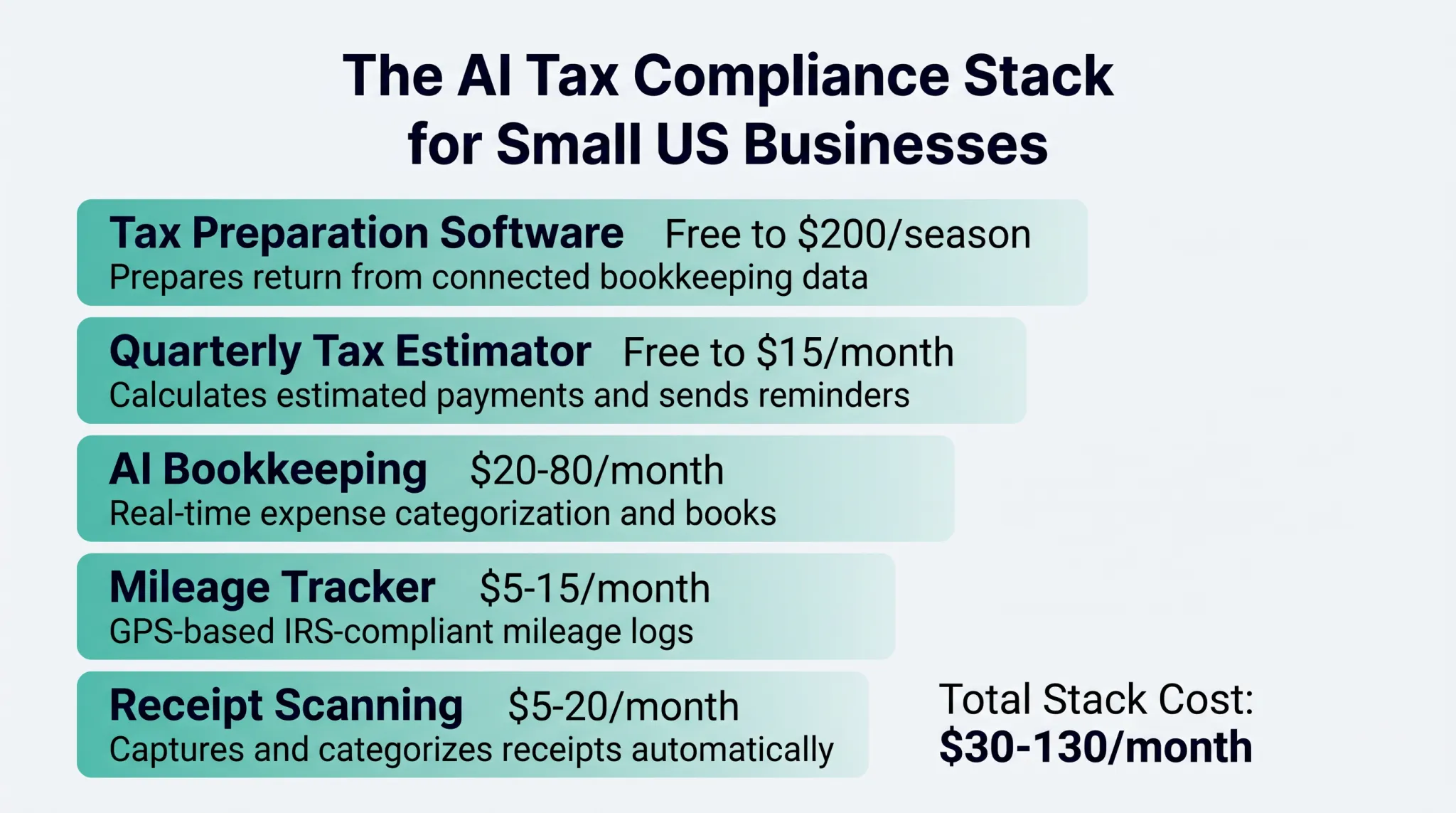
The table below compares the main categories of AI-powered tax compliance tools available to small US businesses in 2026. Specific product names and pricing change frequently, so verify current details directly with each provider before subscribing.
| Tool Category | Primary Function | Typical Monthly Cost | Best For | Limitation |
|---|---|---|---|---|
| AI bookkeeping software | Automated expense categorization and real-time books | 20 to 80 USD per month | Any small business with regular transactions needing clean records year-round | Requires review of categorizations, especially for unusual transactions |
| Quarterly tax estimators | Estimated payment calculation and deadline reminders | Free to 15 USD per month | Self-employed individuals and sole proprietors managing their own estimated payments | Estimates only, not a substitute for professional review on complex income situations |
| Mileage tracking apps | Automated business mileage logging via GPS | 5 to 15 USD per month | Any business owner with regular business driving who wants IRS-compliant records without manual logging | Requires occasional manual trip classification to maintain accuracy |
| AI tax preparation software | Return preparation using connected financial data | Free to 200 USD per filing season | Straightforward returns for sole proprietors and single-member LLCs with clean books | More complex situations including S-corps, partnerships, and multi-state filing often require professional review |
| Integrated accounting and tax platforms | End-to-end bookkeeping, payroll, and tax preparation in one platform | 50 to 150 USD per month | Growing small businesses wanting a single platform for all financial compliance | Higher cost and more setup time, may be more than a solo operator needs |
| AI receipt scanning tools | Automated receipt capture and expense categorization from photos | 5 to 20 USD per month | Business owners with frequent cash or card expenses who need to capture receipts reliably | OCR accuracy varies, periodic manual verification recommended |
Where AI Tax Tools Fall Short and Professional Help Remains Essential
AI tax compliance tools are most effective for the systematic, data-driven tasks in the compliance process: tracking, categorizing, calculating, and organizing. They are significantly less reliable for the judgment-intensive aspects of tax compliance that depend on specific knowledge of tax law, understanding of how rules apply to your particular situation, and professional accountability for the advice given.
There are specific situations where working with a qualified CPA or enrolled agent is not optional. If your business received IRS correspondence, including notices about discrepancies, audit notifications, or requests for documentation, engaging a professional immediately is the appropriate response. AI tools are not equipped to handle IRS communications or audit responses and attempting to manage these situations without professional guidance is a significant risk.
S-corporation elections and the reasonable salary requirement for S-corp shareholders involve judgment calls and ongoing compliance obligations that AI tools handle inconsistently at best. Partnership returns, multi-state tax obligations, international income or payments, and significant asset purchases or disposals involving depreciation elections are all areas where professional guidance is worth the cost relative to the potential consequences of getting it wrong.
The appropriate way to think about AI tax tools is as a system that keeps your records accurate, your estimates current, and your documentation complete throughout the year, which then makes your annual engagement with a tax professional faster, less expensive, and more focused on the judgment-intensive questions where their expertise actually matters rather than on reconstructing records that should have been maintained all along.
Real World Example: How AI Compliance Tools Changed a Freelancer’s Tax Season
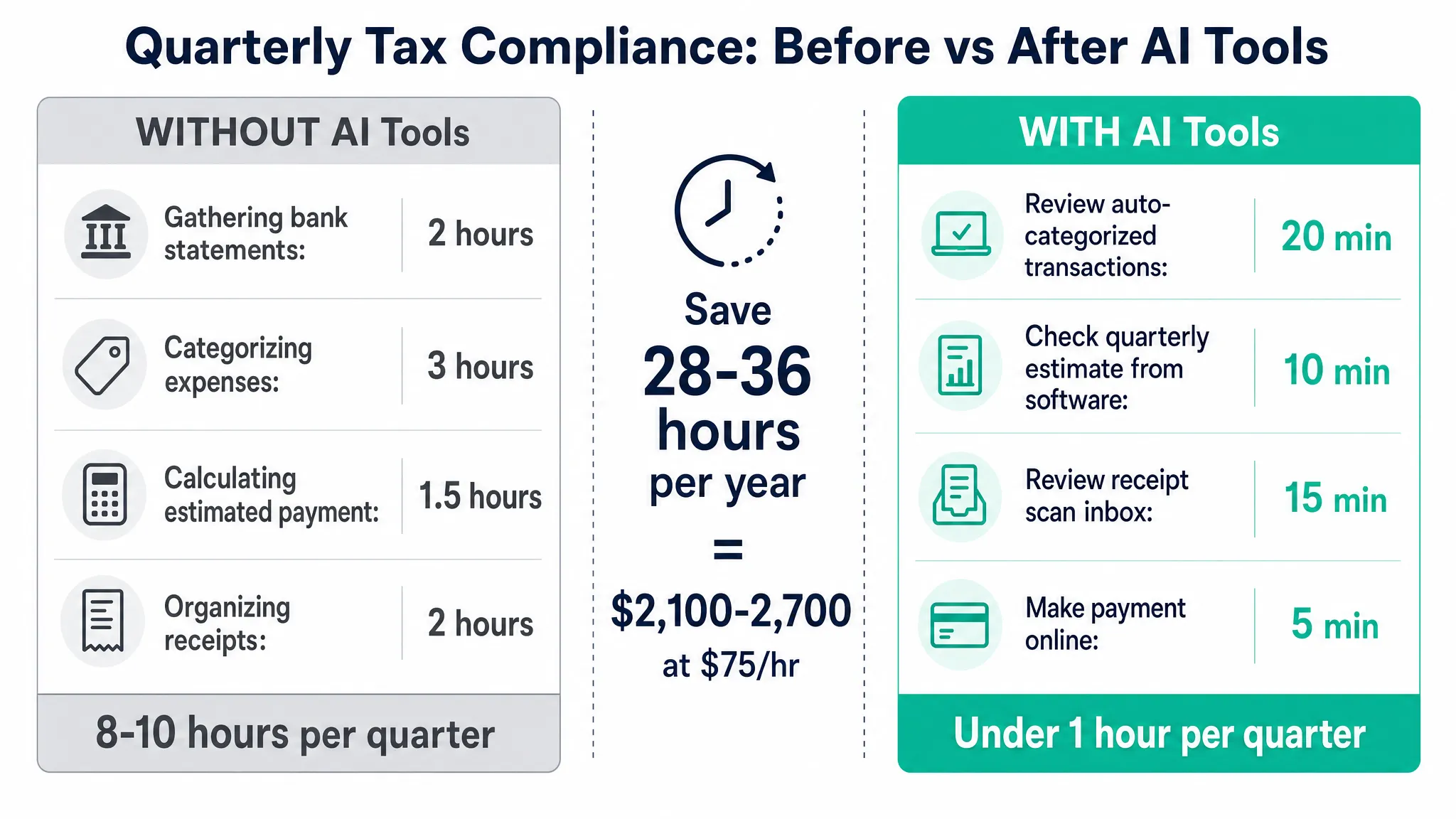
A pattern reported consistently by independent consultants and freelancers who have adopted AI bookkeeping and tax tools illustrates the practical value of this approach. A freelance marketing consultant billing 8,000 to 12,000 US dollars per month previously spent the two weeks before each quarterly tax deadline pulling together bank statements, categorizing expenses in a spreadsheet, calculating an estimated payment amount, and then spending another four to six hours in March and April preparing information for their accountant.
After connecting an AI bookkeeping tool to their business accounts and setting up quarterly tax reminders, the same consultant reports that the quarterly compliance process now takes less than an hour per quarter for review and payment rather than the previous eight to ten hours. Their annual accountant engagement, which previously involved considerable time spent on data organization, is now focused almost entirely on strategy questions including which deductions to prioritize, how to structure the business for tax efficiency, and whether an S-corp election makes sense at their current income level.
The time saving of roughly 35 to 40 hours per year, valued at a modest 60 US dollar equivalent hourly rate, represents over 2,000 US dollars in recovered time annually from tools costing less than 100 US dollars per month combined. The reduction in anxiety around quarterly deadlines and the confidence of knowing records are accurate throughout the year are harder to quantify but consistently mentioned as significant benefits by business owners who have made this transition.
US and UK Difference: This guide focuses specifically on US federal tax compliance including IRS quarterly estimated payments, self-employment tax, and federal filing requirements. UK small business owners face a different compliance framework under HMRC, including Self Assessment filing for self-employed individuals, Corporation Tax for limited companies, VAT registration requirements for businesses above the annual turnover threshold, and Making Tax Digital requirements that are being progressively extended to smaller businesses. UK readers should see our dedicated guide on UK small business tax compliance for 2026 for HMRC-specific guidance. The AI tools landscape for UK tax compliance includes both UK-specific platforms and international platforms with strong UK compliance features, and the selection criteria differ from the US market in several important ways.
Setting Up an AI-Assisted Tax Compliance System for Your Small Business
For business owners ready to implement a more systematic approach to tax compliance using AI tools, the setup process is more straightforward than most expect. The starting point is connecting an AI bookkeeping tool to your business bank accounts and credit cards, which typically takes 20 to 30 minutes and produces immediate value by beginning to categorize past transactions automatically.
The next step is reviewing the initial categorizations and training the tool on any business-specific categories or recurring transactions that it has miscategorized. Most AI bookkeeping tools improve significantly after the first few weeks of use as they learn your specific spending patterns. Setting aside 15 minutes per week to review and correct categorizations during the first month builds the accuracy that makes the tool reliable for the rest of the year.
Once bookkeeping is running cleanly, adding a quarterly tax estimator that pulls from your bookkeeping data provides automatic updates to your estimated payment amounts as income changes. Setting up calendar reminders for the four quarterly deadlines, April 15, June 16, September 15, and January 15 of the following year, ensures that even if the tool’s reminders are missed, the deadlines are not. For more detail on calculating your specific quarterly payment amounts, see our dedicated guide on how to estimate quarterly tax payments as a self-employed person.
The final piece of the system is a document storage habit for receipts and any paper documentation related to deductions. AI receipt scanning tools make this significantly easier by allowing you to photograph receipts immediately and have them automatically categorized and stored. For business owners who want to understand how this connects to the broader picture of AI tools for business compliance, see our guide on the best AI tools for tax compliance and reporting for small businesses.
Frequently Asked Questions
Can AI tools completely replace a tax professional for a small business?
For very straightforward situations, particularly sole proprietors with simple income and expense structures and no employees, AI tax preparation software has become capable enough that many business owners file their own returns reliably using these tools. However, for any situation involving complexity, including S-corporation status, significant asset purchases, multi-state operations, IRS notices, or significant changes in business structure or income, a qualified CPA or enrolled agent provides expertise and professional accountability that AI tools cannot replicate. The most effective approach for most small businesses is using AI tools to handle the systematic compliance work throughout the year and engaging a professional for annual return review and any complex judgment calls.
How do I know if I am making the right quarterly estimated tax payments?
The IRS safe harbor rules provide one reliable method: if you pay at least 100 percent of your prior year’s tax liability in quarterly installments, you will generally avoid underpayment penalties regardless of what you ultimately owe for the current year. Business owners with incomes above 150,000 US dollars must pay 110 percent of the prior year’s liability to qualify for the safe harbor. AI tax tools that calculate estimated payments based on your current year income may be more accurate for predicting your actual liability, but the safe harbor method provides certainty about avoiding penalties. Use our Quarterly Tax Estimator as a starting point and verify the calculation with your tax professional.
What records does the IRS require small businesses to keep for tax purposes?
The IRS generally recommends keeping tax records for at least three years from the date you filed the original return, or two years from the date you paid the tax, whichever is later. Records related to property should be kept until the period of limitations expires for the year in which you dispose of the property. In practice, many tax professionals recommend keeping all business financial records for at least seven years to cover the statute of limitations period in cases where income was substantially underreported. AI bookkeeping tools that maintain digital records and allow export of complete transaction histories make meeting this requirement straightforward.
What is the self-employment tax and how does AI help manage it?
Self-employment tax is the mechanism by which self-employed individuals pay both the employee and employer portions of Social Security and Medicare taxes, totaling 15.3 percent on net self-employment income up to the Social Security wage base, with an additional 2.9 percent on income above that threshold. For a business owner netting 80,000 US dollars in self-employment income, the self-employment tax alone is approximately 11,300 US dollars before income tax is calculated. AI tax tools that incorporate self-employment tax into quarterly estimated payment calculations prevent the common and costly surprise of discovering a large self-employment tax bill at filing time that was not accounted for in quarterly payments.
Do I need AI tax compliance tools if I already use a bookkeeper or accountant?
AI bookkeeping tools and human bookkeepers or accountants are not mutually exclusive. Many business owners use AI tools to handle real-time transaction categorization and receipt capture throughout the year, then have their bookkeeper or accountant review and finalize records quarterly or annually. This hybrid approach typically reduces the bookkeeper’s time and therefore cost while maintaining professional oversight of the records. If your accountant currently spends significant time reconstructing or organizing your records at filing time, AI bookkeeping tools that keep those records clean throughout the year will reduce your annual accounting bill, often by more than the monthly cost of the tools themselves.
Disclaimer: This article is for informational and educational purposes only and does not constitute tax or legal advice. Tax rules, rates, and requirements referenced in this article reflect US federal tax law as of June 2026 and are subject to change. State tax obligations vary significantly and are not covered comprehensively in this guide. Always consult a qualified CPA, enrolled agent, or tax attorney for advice specific to your business situation before making decisions about your tax compliance approach. Some links in this article may be affiliate links. See our Affiliate Disclosure for details.
Latest Research