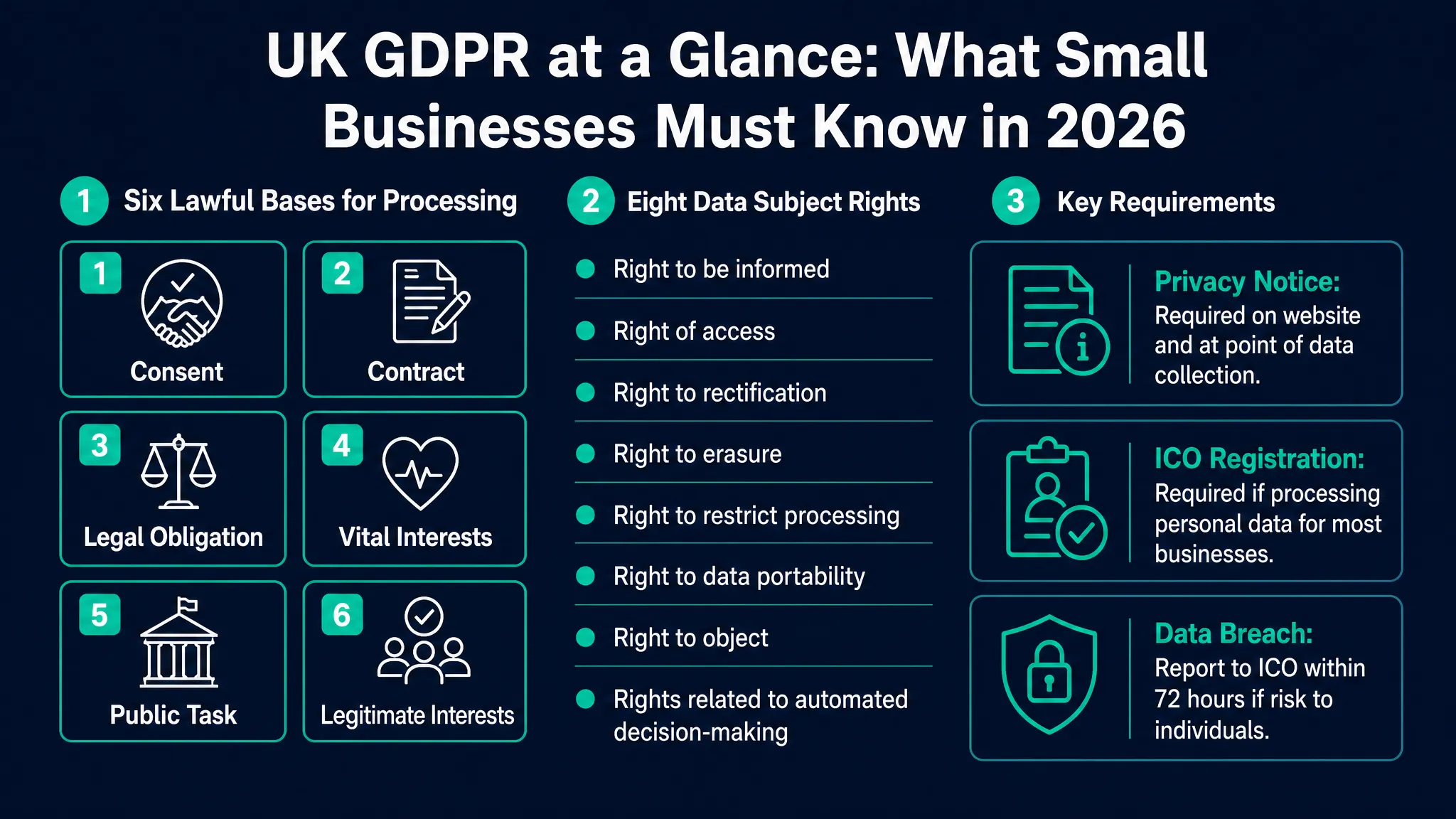
UK GDPR compliance is not optional for small businesses in 2026, and the Information Commissioner’s Office has demonstrated consistently through its enforcement activity that it pursues small businesses as well as large ones for data protection violations. The most common small business compliance failures are not sophisticated technical breaches but basic omissions: no privacy notice on the website, sending marketing emails without valid consent, failing to respond to data subject access requests within the required timeframe, and not registering with the ICO. These failures are straightforward to avoid once a business understands what is actually required, and the cost of getting compliance right is a fraction of the cost of an ICO enforcement action. This guide explains exactly what UK GDPR requires from small businesses in 2026, which requirements are most commonly missed, and how to build a compliant data protection framework without expensive specialist consultancy.
What This Guide Covers
This article is a practical compliance guide for small business owners, sole traders, and self-employed professionals in the United Kingdom who process personal data in the course of their business and need to understand their obligations under UK GDPR and the Data Protection Act 2018. It covers the core requirements that apply to most small businesses, the enforcement landscape and what the ICO actually fines small businesses for, a practical data mapping approach, and the specific compliance actions required to address the most common small business compliance gaps. This article is not a substitute for legal advice on specific compliance questions and the guidance provided here is general in nature. For context on compliance obligations more broadly, see our guide on using AI to automate compliance for small businesses and our overview of how AI is changing business operations in 2026.
This article provides general educational information about UK GDPR requirements. It does not constitute legal advice. Data protection obligations depend on the specific nature of your business and data processing activities. Always consult a qualified solicitor or data protection specialist for advice specific to your circumstances.
What UK GDPR Actually Requires From Small Businesses
UK GDPR is the United Kingdom’s post-Brexit data protection framework, which retained the substance of the EU General Data Protection Regulation following the UK’s departure from the European Union. It is given legal effect alongside the Data Protection Act 2018 and applies to any organisation that processes the personal data of individuals in the United Kingdom, regardless of the size of the organisation or whether it is based in the UK.
The six core principles of UK GDPR require that personal data is processed lawfully, fairly, and transparently; collected for specified, explicit, and legitimate purposes; limited to what is necessary for those purposes; accurate and kept up to date; stored no longer than necessary; and processed with appropriate security. For small businesses, translating these principles into practical compliance means understanding what personal data you hold, why you hold it, what justification you have for processing it, and how you protect and eventually delete it.
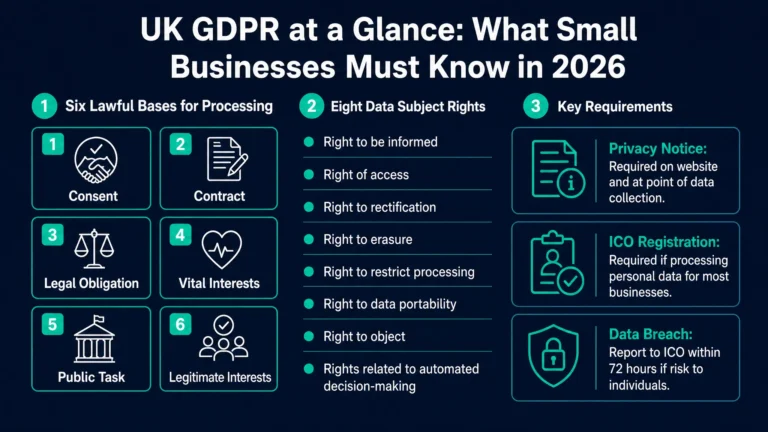
The six lawful bases for processing personal data are consent, contract, legal obligation, vital interests, public task, and legitimate interests. Most small businesses process personal data under a combination of the contract basis for customer and supplier data, the legal obligation basis for employee data subject to statutory requirements, and the legitimate interests basis for certain marketing and operational activities. Consent, despite being the most commonly understood lawful basis, is often the least appropriate for small businesses because it requires freely given, specific, informed, and unambiguous agreement that can be withdrawn at any time, which creates significant ongoing management requirements.
The ICO Registration Requirement
Most businesses that process personal data are required to pay a data protection fee to the ICO and register their processing activities. This registration, formerly known as notification, applies to the vast majority of businesses that process any personal data at all, including holding customer contact details, employee records, or prospect databases. The exemptions to the registration requirement are narrow and include some non-profit organisations and specific limited processing activities that are unlikely to apply to most commercial small businesses.
The fee for ICO registration in 2026 is either 40 GBP per year for micro-organisations with a maximum turnover of 632,000 GBP and no more than ten staff, or 60 GBP per year for small and medium organisations. The registration process is completed online through the ICO website and takes approximately 20 minutes. Operating without registration when registration is required is itself a violation that can result in an ICO monetary penalty notice, separate from any other compliance failures.
Checking whether your business is registered and ensuring the registration is current and accurately describes your processing activities is one of the simplest compliance steps and one of the most commonly overlooked by small businesses that have never completed the process or have not updated their registration following changes to their business activities.
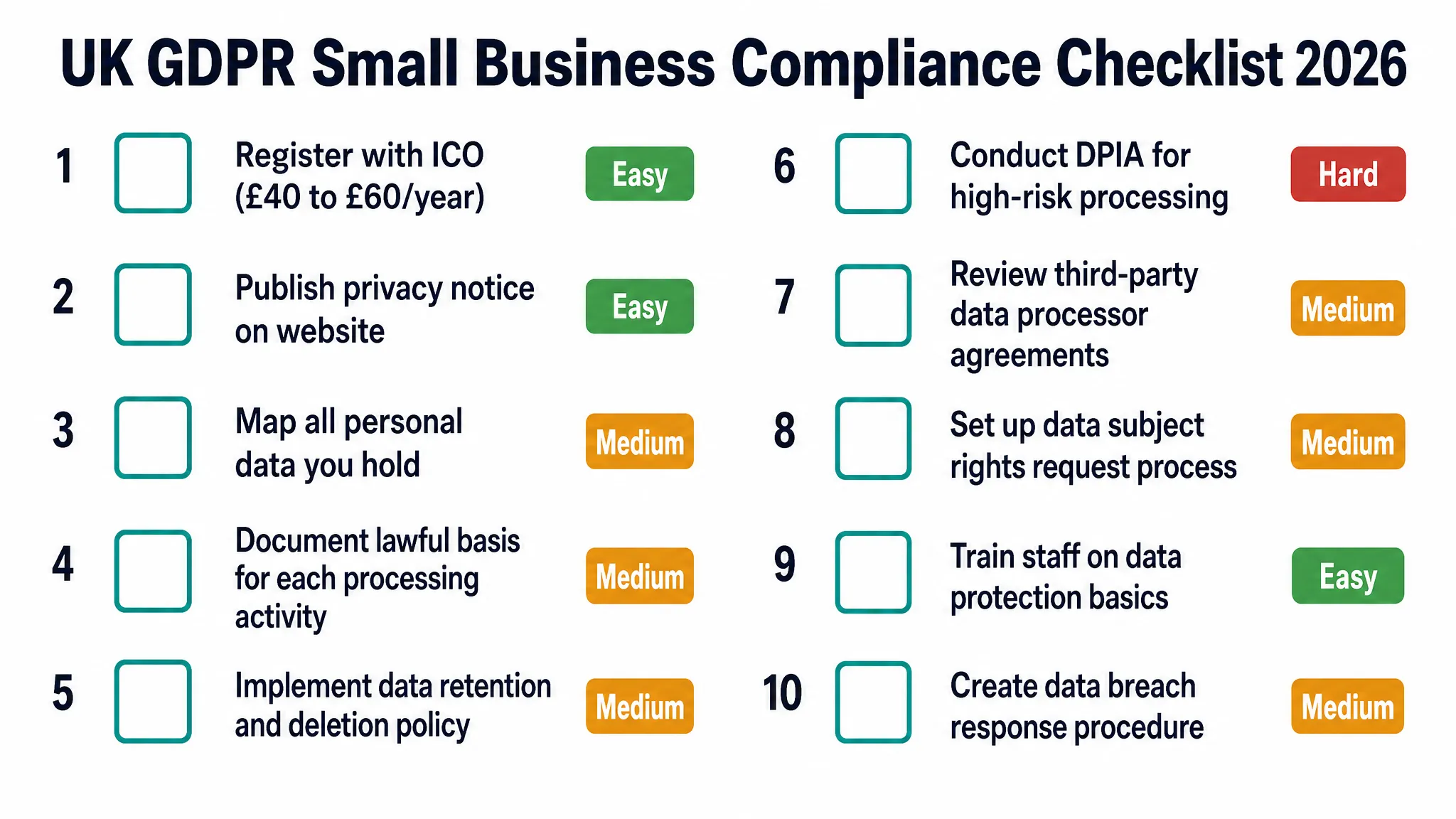
Privacy Notice Requirements
A privacy notice, sometimes called a privacy policy, is a transparency document that explains to individuals what personal data your organisation collects about them, why you collect it, what you do with it, who you share it with, how long you keep it, and what their rights are under UK GDPR. UK GDPR requires that you provide this information to individuals at the point when you collect their data.
For most small businesses, this means a privacy notice published on the website that covers the personal data collected through the website including contact forms, newsletter sign-ups, and website analytics. It also means providing privacy information at other points of data collection including when collecting customer information by phone, at a point of sale, or during an employment application process.
The ICO publishes a privacy notice generator and template that small businesses can use as a starting point. A compliant privacy notice for a typical small service business can be drafted in two to three hours using these resources. The notice must be written in plain English rather than legal jargon, which the ICO specifically requires as part of the transparency obligation. A privacy notice that is technically comprehensive but incomprehensible to a typical member of the public does not meet the transparency requirement.
Privacy notices must be kept current. If you change the purposes for which you process data, add new data categories, change retention periods, or change third-party processors, the privacy notice must be updated to reflect these changes. A common small business compliance failure is having a privacy notice that was created several years ago and has never been reviewed or updated despite changes to the business’s data processing activities in the meantime.
Data Mapping: Understanding What Personal Data You Hold
Data mapping, also called a Record of Processing Activities or ROPA, is a structured inventory of all the personal data your business holds, covering what data you collect, where it comes from, why you process it, what lawful basis justifies the processing, who you share it with, and how long you retain it. UK GDPR requires organisations with more than 250 employees to maintain a formal ROPA. For smaller businesses, a formal ROPA is not legally required but is strongly recommended by the ICO because it is the foundation of effective data protection management.
For a typical small service business, a data map covering four to six data categories is sufficient to capture the main personal data processing activities: customer contact and transaction data, prospect and marketing data, supplier and contractor data, employee and HR data, and website visitor data. The data mapping exercise for a small business of this type typically takes two to four hours and produces a document that serves as the reference point for all other compliance activities including privacy notice drafting, lawful basis documentation, retention policy development, and third-party processor review.
UK GDPR Compliance Requirements for Small Businesses
| Requirement | Applies To | What Is Required | ICO Resource Available | Priority |
|---|---|---|---|---|
| ICO registration | Almost all businesses processing personal data | Annual registration and fee payment of £40 to £60 | Yes, online registration portal | High, immediate |
| Privacy notice | All businesses collecting personal data | Plain English notice covering data collected, purposes, lawful basis, retention, rights, and contact details | Yes, privacy notice generator | High, immediate |
| Lawful basis documentation | All businesses processing personal data | Written record of which lawful basis applies to each processing activity | Yes, lawful basis guidance | High |
| Data subject rights process | All businesses | Process to respond to access requests, erasure requests, and other rights within statutory timeframes (generally one month) | Yes, rights guidance and templates | High |
| Marketing consent | Businesses sending electronic direct marketing | Valid consent or soft opt-in for existing customers under PECR rules for email and SMS marketing | Yes, direct marketing guidance | High |
| Data retention policy | All businesses | Documented retention periods for each data category and process to delete data when retention period expires | Basic guidance available | Medium |
| Data processor agreements | Businesses using third-party processors | Written contract with each processor covering the required Article 28 terms | Yes, template clauses available | Medium |
| Data breach procedure | All businesses | Internal procedure to identify, contain, and report breaches. Report to ICO within 72 hours if risk to individuals. | Yes, breach notification guidance | Medium |
| Cookie consent | Businesses with websites using non-essential cookies | Cookie consent banner for analytics, advertising, and other non-essential cookies. Strictly necessary cookies exempt. | Yes, cookie guidance | Medium |
| Data Protection Impact Assessment | Businesses conducting high-risk processing | Formal risk assessment before undertaking processing likely to result in high risk to individuals | Yes, DPIA guidance and screening tool | Required where applicable |
Real World Example: How a Small Marketing Agency Built Its Compliance Framework
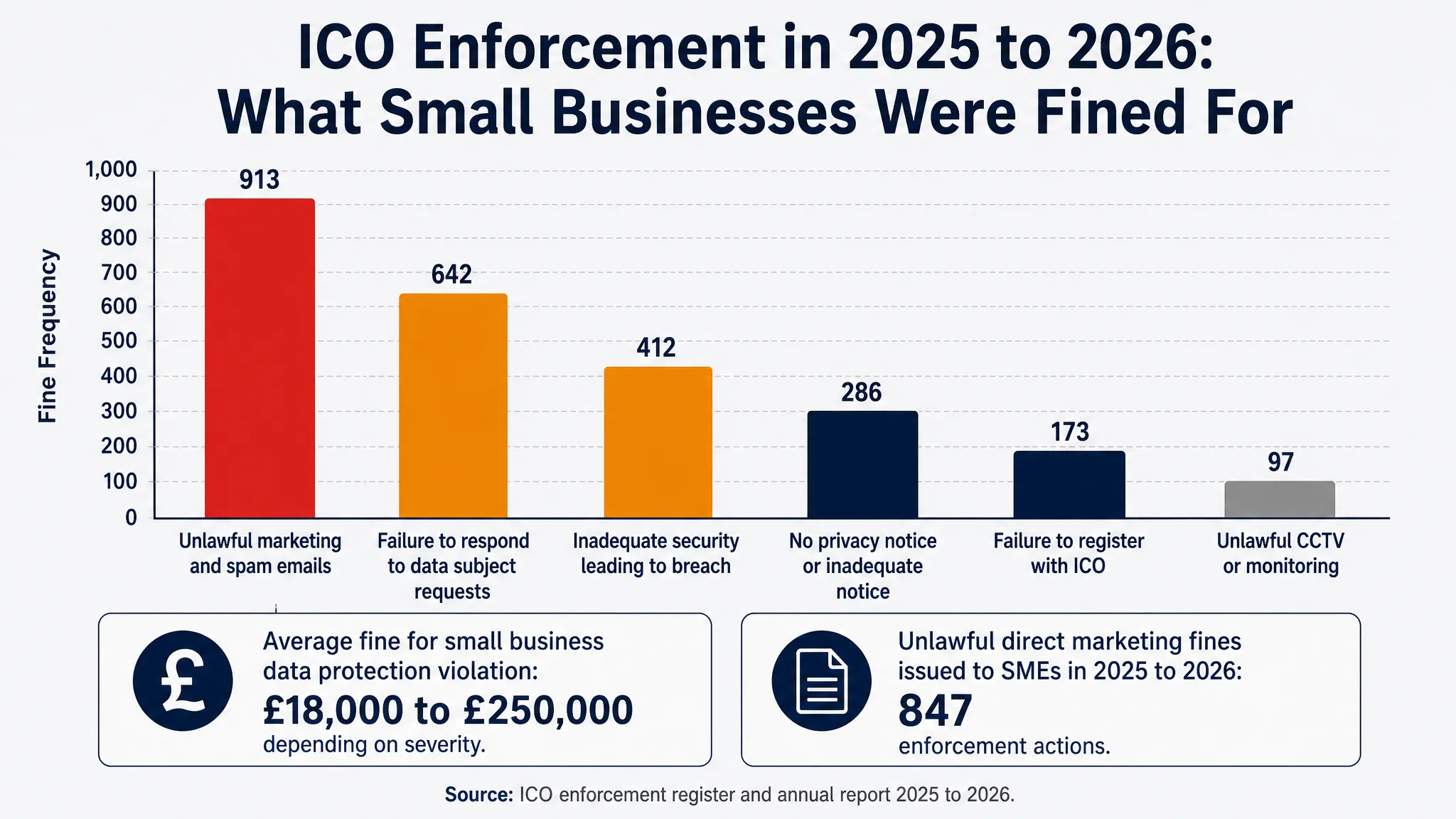
A five-person digital marketing agency illustrates how a small business can build a practical UK GDPR compliance framework without specialist consultancy. The agency was processing personal data across several activities: client contact and project data, prospect CRM data from outbound sales activity, employee HR data, freelancer contact and payment data, and website visitor analytics.
The compliance process started with a data mapping exercise that took approximately three hours across two sessions. The exercise identified six data categories, the sources of each, the purposes for which the data was used, the lawful basis that applied to each, and the third-party systems the data was stored in or shared with. The mapping revealed two specific compliance gaps: the prospect CRM data was being retained indefinitely without a documented retention period or deletion process, and the agency had never completed an ICO registration despite having operated for four years.
The ICO registration was completed online in 25 minutes at the 60 GBP tier. A privacy notice was drafted using the ICO’s privacy notice generator as a starting point, customised to reflect the specific data processing activities identified in the mapping exercise, and reviewed by a solicitor for an hour of their time before being published on the website. The total solicitor cost for the review was approximately 200 GBP.
A data retention schedule was created setting out specific retention periods for each data category: active client data retained for the duration of the relationship plus six years for contractual and tax purposes, prospect data retained for 12 months from last engagement before deletion, employee data retained for the duration of employment plus six years, and website analytics data retained for 26 months consistent with Google Analytics default settings.
A simple data subject rights request process was documented: any individual requesting access to their data, erasure of their data, or correction of inaccurate data would receive a written acknowledgement within five business days and a substantive response within one calendar month, delivered by the agency principal. A data breach response checklist was created identifying who to notify internally, the ICO’s online reporting portal for breaches requiring notification, and the template communication to affected individuals.
The total time investment was approximately eight hours across the principal and one other team member. The total cost excluding staff time was approximately 260 GBP including ICO registration and solicitor review. The agency now has a documented compliance framework, an updated privacy notice, a data retention policy being actively implemented, and the confidence that the most common small business compliance failures have been addressed.
Marketing Compliance: PECR and UK GDPR Together
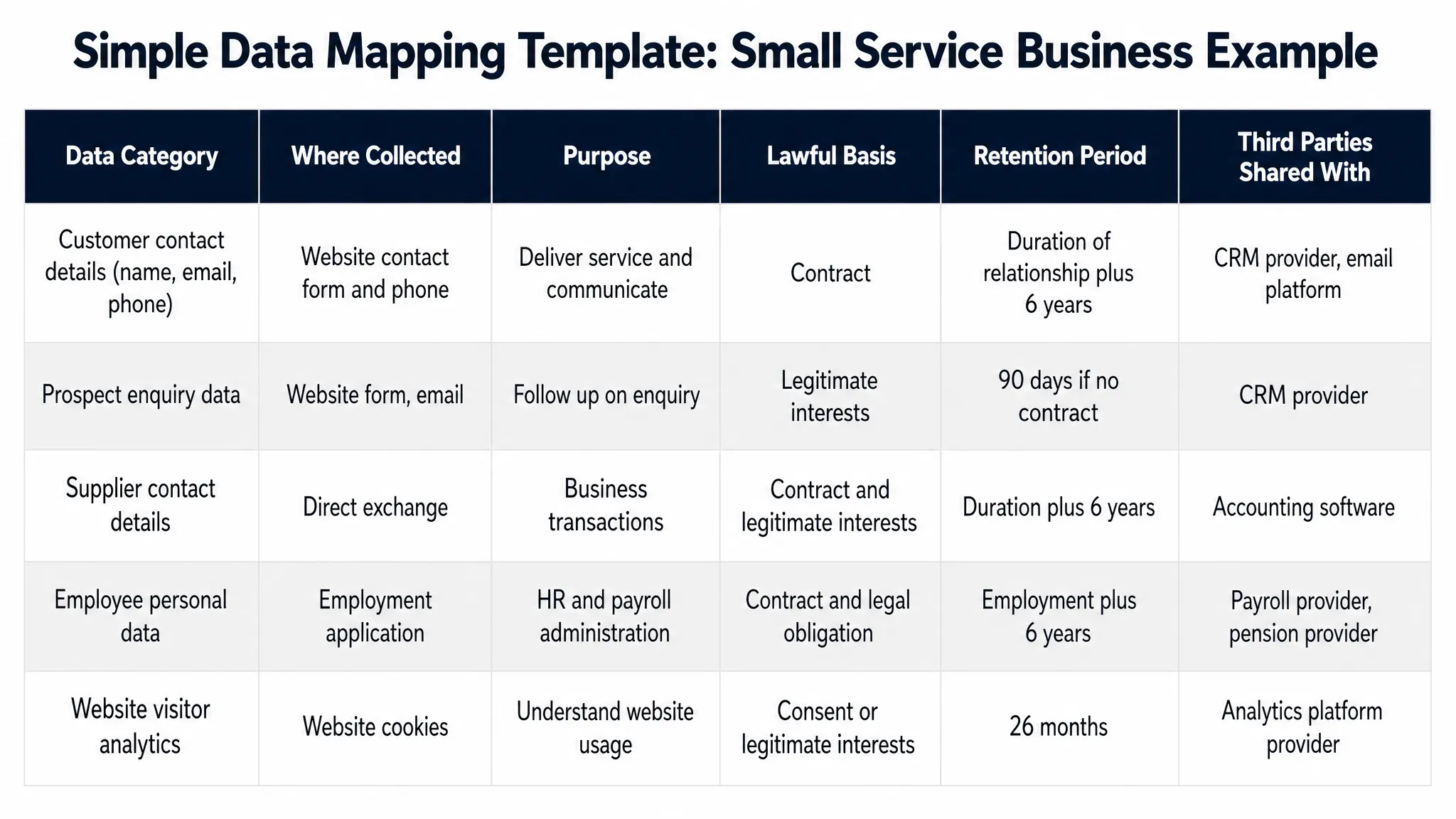
Electronic marketing is one of the highest-risk areas for small business data protection compliance in the UK because it is governed by two overlapping frameworks: UK GDPR and the Privacy and Electronic Communications Regulations 2003, known as PECR. The combination of these two frameworks means that sending marketing emails or text messages to individuals without appropriate consent is one of the most common sources of ICO enforcement action against small businesses.
PECR requires that you have valid consent before sending unsolicited direct marketing emails or text messages to individuals. The soft opt-in exemption under PECR allows you to email existing customers about similar products or services without fresh consent, provided they were given the opportunity to opt out when their details were collected and the option to opt out is included in every subsequent marketing communication. This soft opt-in exemption applies only to existing customers and only for similar products or services, not to prospects or contacts who have not previously purchased from you.
Bought email lists are almost always non-compliant under UK GDPR and PECR because the individuals on the list have not consented to receive marketing from your specific organisation. The original consent given to the list provider does not transfer to your business. Sending marketing emails to a purchased list is one of the most reliably identified routes to an ICO enforcement action and should be avoided entirely.
Consent for marketing purposes must be freely given, specific, informed, and unambiguous under UK GDPR. Pre-ticked consent boxes, bundled consent that includes agreement to multiple purposes, and consent obtained as a condition of accessing a service do not meet this standard. Maintaining records of when consent was obtained, through what mechanism, and what information was provided at the time of consent is essential for demonstrating compliance if consent is challenged.
Third-Party Data Processors
A data processor is any organisation that processes personal data on your behalf under your instructions. For most small businesses, third-party processors include their CRM provider, email marketing platform, payroll software, cloud storage provider, accounting software, website hosting provider, and any other software or service that stores or processes personal data relating to their customers, employees, or other individuals.
UK GDPR requires that every relationship with a data processor is governed by a written contract that includes specific terms covering what processing the processor can carry out, the security measures they must implement, their obligations in the event of a data breach, and the rights of the data controller to audit and oversee the processor’s activities. Most reputable software and cloud service providers include these terms in their standard service agreements or provide a Data Processing Agreement on request. For less established providers, requesting a formal DPA before sharing personal data with them is appropriate.
The practical compliance action for most small businesses is to audit their current third-party processors, verify that appropriate DPAs are in place with each of them, and document this in their data map. For any processor where no DPA exists, either requesting one from the provider or considering whether an alternative provider with appropriate terms is preferable are the two options.
Frequently Asked Questions
Does UK GDPR apply to my small business if I only have a handful of customers?
Yes. UK GDPR applies to any organisation that processes the personal data of individuals in the United Kingdom regardless of the size of the organisation or the volume of data processed. There is no small business exemption to the core requirements. The scale of your processing may affect the proportionality of the compliance measures required, and some specific requirements such as appointing a Data Protection Officer and maintaining a formal Record of Processing Activities apply only above certain thresholds, but the fundamental obligations including having a lawful basis for processing, providing privacy information, responding to data subject rights requests, and registering with the ICO apply to businesses of all sizes.
What is the maximum fine the ICO can issue to a small business for UK GDPR violations?
The ICO has the power to issue fines of up to 17.5 million GBP or 4 percent of global annual turnover, whichever is higher, for the most serious violations of UK GDPR. For less serious violations, the maximum fine is 8.7 million GBP or 2 percent of global annual turnover. In practice, fines issued to small businesses are significantly lower than these maximums, with the typical small business enforcement action resulting in fines ranging from a few thousand pounds to a few hundred thousand pounds depending on the seriousness of the violation, the harm caused, and the business’s cooperation with the investigation. The ICO also issues warnings, reprimands, and enforcement notices that require specific remediation actions without a financial penalty, particularly for first-time violations by businesses that cooperate fully with the investigation.
Do I need to appoint a Data Protection Officer?
Most small businesses do not need to appoint a formal Data Protection Officer under UK GDPR. The DPO requirement applies to public authorities, organisations whose core activities consist of large-scale systematic monitoring of individuals, and organisations whose core activities consist of large-scale processing of special category data. For most small commercial businesses processing routine customer, employee, and supplier data, a formal DPO is not required, though designating a specific individual within the business as responsible for data protection compliance is good practice regardless of the formal legal requirement.
How do I respond to a data subject access request?
When an individual submits a Subject Access Request asking to see the personal data you hold about them, you have one calendar month from the date of receipt to provide a full response. The response must include a copy of all personal data you hold about the individual, an explanation of the purposes for which it is processed, the categories of data involved, any third parties the data has been shared with, the retention period or criteria used to determine it, and the individual’s rights under UK GDPR. The response must be provided free of charge in most circumstances. If the request is complex or you receive a high volume of requests, you can extend the response period by a further two months, provided you notify the individual within the initial one-month period and explain why the extension is needed.
What counts as a personal data breach and when do I need to report it to the ICO?
A personal data breach is any security incident that leads to the accidental or unlawful destruction, loss, alteration, unauthorised disclosure of, or access to personal data. This includes incidents such as sending an email containing customer data to the wrong recipient, losing a laptop or USB drive containing unencrypted personal data, a cyber attack resulting in unauthorised access to customer records, and inadvertently making personal data publicly accessible online. Not all breaches need to be reported to the ICO. You are required to report a breach to the ICO within 72 hours of becoming aware of it only when the breach is likely to result in a risk to the rights and freedoms of individuals. Breaches that are unlikely to result in any risk to individuals must be documented internally but do not require ICO notification. When in doubt about whether a breach requires notification, the ICO’s online guidance and self-assessment tools are useful starting points, and taking legal advice for significant breaches is advisable.
Latest Research