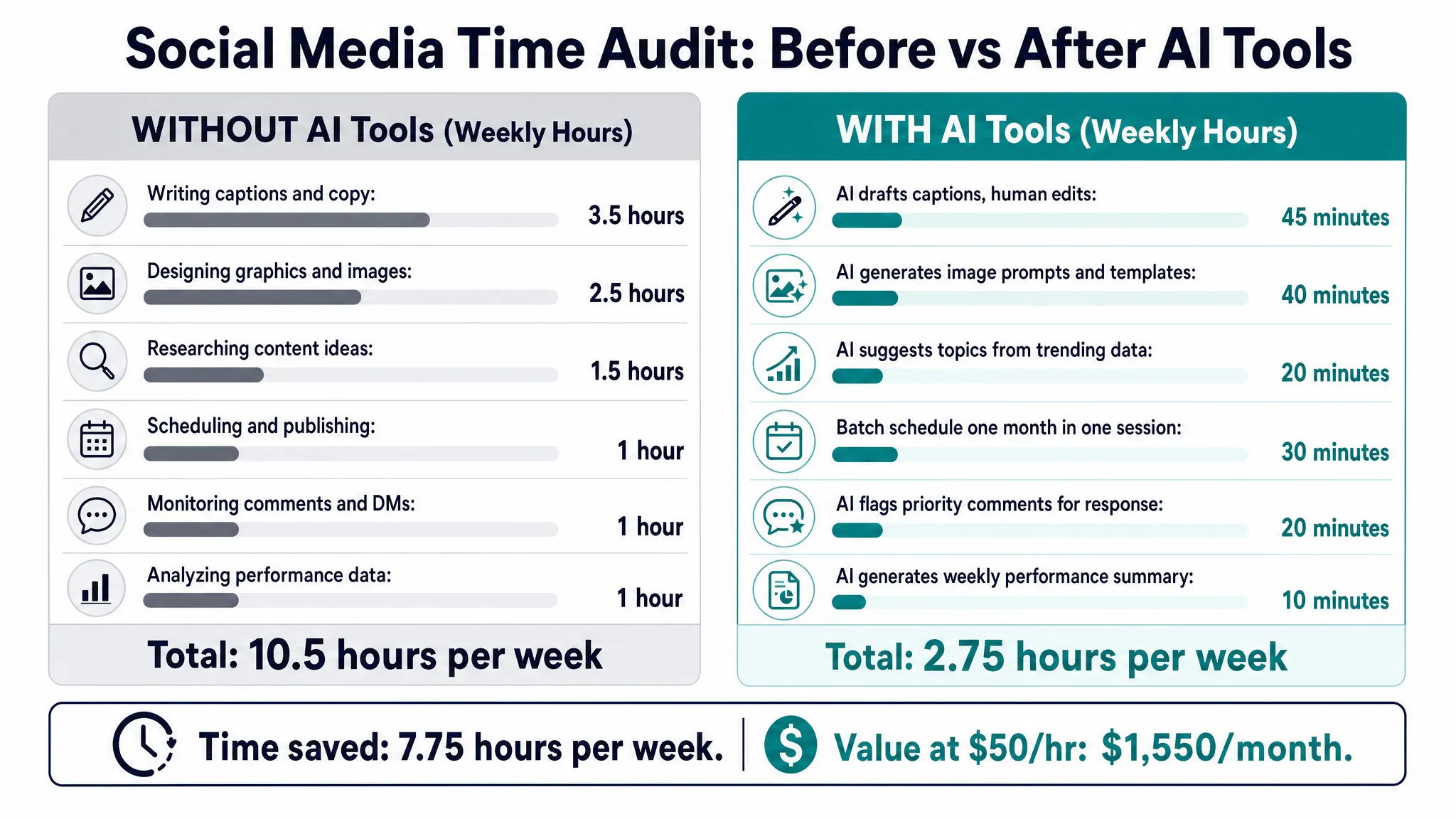
Social media management consumes a disproportionate amount of small business owner time relative to the return it delivers when done manually. Writing captions, designing graphics, researching trending topics, scheduling posts across multiple platforms, monitoring comments, and analyzing what worked all add up to eight to twelve hours per week for most small businesses managing their own social presence. In 2026, AI social media tools have restructured this workload significantly, not by removing the need for a human to understand their brand and audience, but by handling the mechanical and templatable portions of content creation and scheduling that consume most of that time. The result for businesses that have implemented these tools well is three to four hours per week replacing ten to twelve, with higher posting consistency and measurably better engagement rates. This guide covers which tools are delivering that outcome and which type of business each one suits best.
What This Guide Covers
This article is written for small business owners, marketing managers, and freelancers in the United States and United Kingdom who manage social media either for their own business or for clients. It covers six leading AI social media management platforms evaluated in 2026, with specific recommendations by business type, team size, and primary social channels. For context on how AI social media tools connect to broader content and productivity strategies, see our guide on best AI writing assistants for small business and our overview of how AI is changing business productivity in 2026.
What AI Is Actually Doing for Social Media Management in 2026
The AI capabilities embedded in social media management tools in 2026 operate across four distinct areas that together account for most of the time consumed by manual social media management.
AI caption and copy generation allows businesses to input a topic, product, or content brief and receive multiple caption options in different tones and lengths suitable for different platforms. The output quality in 2026 is significantly better than early AI writing tools for social content specifically, with leading platforms producing captions that match platform-appropriate voice, include relevant hashtag suggestions based on real performance data, and generate variations suited to different audiences. The human role shifts from writing from scratch to selecting and refining the best of several AI-generated options, which consistently takes less time and produces better variety than a single manual writing session.
AI content scheduling optimization uses historical performance data to recommend the best posting times for each platform and audience, removing the guesswork from scheduling decisions. Platforms that have accumulated performance data from millions of business accounts provide recommendations that are more statistically grounded than any individual business can derive from its own limited data, particularly for smaller accounts where the data set is not large enough to support confident conclusions from first principles.
AI image and graphic generation for social content has reached a level in 2026 where many small businesses are producing platform-ready visual content directly from AI tools rather than using design templates or commissioning custom graphics. The quality and consistency of AI-generated social visuals is now sufficient for most business social media purposes, though businesses with strict brand guidelines or premium positioning still typically require human design review before publishing.
AI performance analysis summarizes engagement data, identifies content types and topics that perform above and below average, and generates actionable recommendations rather than leaving the business owner to interpret raw analytics manually. The time saving from AI-generated performance summaries versus manual analytics review is significant for businesses that previously spent one to two hours per week reviewing platform dashboards.
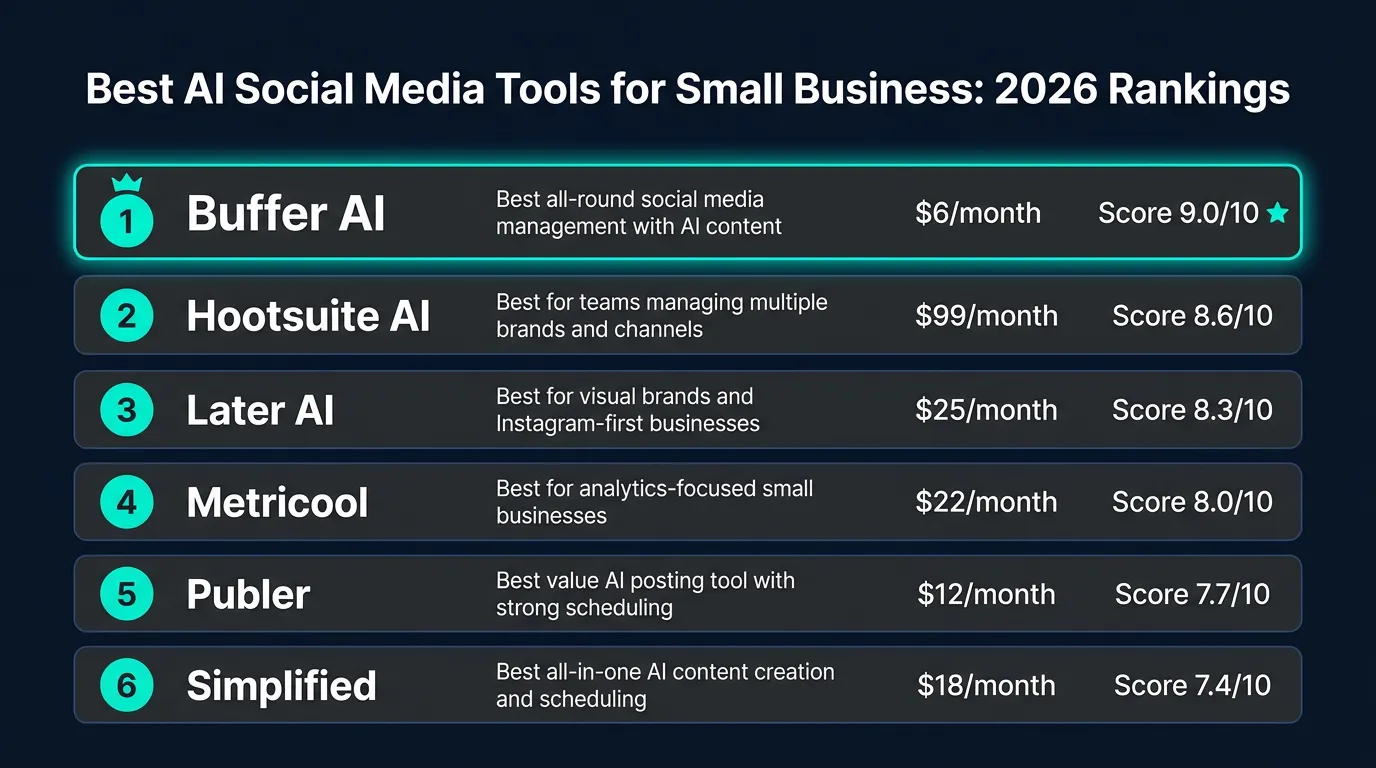
The Six Platforms We Evaluated
Buffer AI
Buffer has been the simplest and most accessible social media scheduling tool for small businesses for several years, and its AI feature additions in 2026 have maintained that positioning while adding meaningful content generation capability. Buffer AI in 2026 includes an AI assistant that generates captions from a brief, suggests hashtags based on content and platform, recommends posting times based on audience activity data, and produces a weekly performance summary in plain language rather than requiring interpretation of raw analytics.
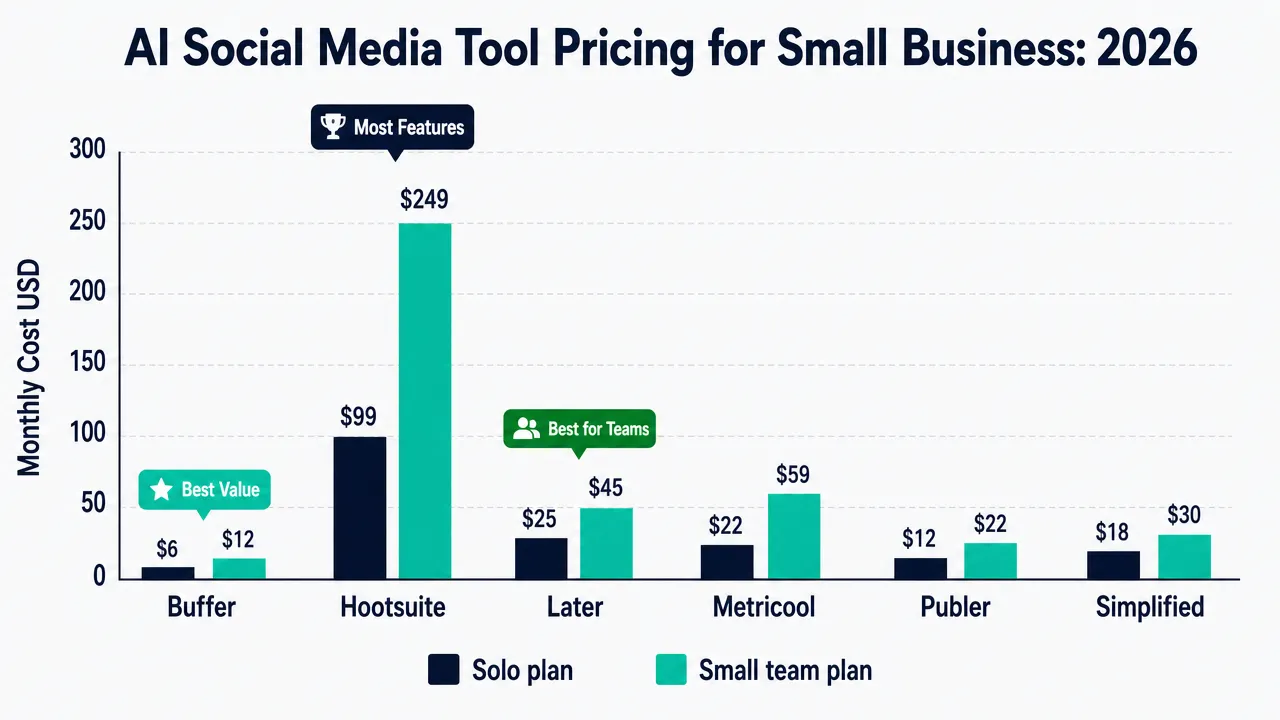
Buffer’s pricing remains the most accessible in this comparison at approximately 6 US dollars per month for the Essentials plan covering one user and up to six social channels, rising to approximately 12 US dollars per month for the Team plan. This price point makes Buffer the clearest recommendation for solo operators and very small businesses that want AI-assisted social media management without a significant monthly commitment. The AI features are included across all paid plans rather than gated behind a premium tier.
Buffer’s limitation relative to higher-priced competitors is feature depth. It handles scheduling, basic AI content generation, and performance analytics well. It does not offer the advanced team collaboration features, approval workflows, social listening, or competitor analysis that platforms like Hootsuite provide. For businesses with straightforward single-brand social media needs, this is not a limitation. For agencies managing multiple client accounts or teams requiring content approval workflows, Buffer is insufficient.
Buffer supports Instagram, Facebook, X (Twitter), LinkedIn, Pinterest, TikTok, and YouTube across its plans, covering the platforms relevant to most small businesses in both the US and UK markets.
Hootsuite AI
Hootsuite is the most feature-complete social media management platform in this comparison, and in 2026 its AI capabilities have expanded significantly to include AI content generation, automated posting suggestions, social listening powered by AI sentiment analysis, and a unified AI analytics dashboard that synthesizes performance data across all connected platforms. For marketing agencies, in-house teams managing multiple brand accounts, and businesses with complex social media operations requiring approval workflows and team coordination, Hootsuite’s feature breadth justifies its higher price point.
The AI content generation in Hootsuite in 2026 is particularly strong for adapting content across platforms: taking a single content brief and generating platform-appropriate variations for Instagram, LinkedIn, and X simultaneously, with appropriate length, tone, and format adjustments for each platform. This multi-platform adaptation capability saves meaningful time for businesses posting consistently across several channels.
Hootsuite’s pricing at approximately 99 US dollars per month for the Professional plan makes it the most expensive option in this comparison and difficult to justify for very small businesses with simple social media needs. For businesses posting consistently across five or more platforms, managing two or more brand accounts, or working with a team that needs coordination and approval features, the investment is typically recovered in time savings within the first month.
Later AI
Later has built its strongest positioning around visual-first social media management, particularly Instagram and Pinterest scheduling, and its AI features in 2026 reflect this focus. Later AI includes a visual content calendar that shows how scheduled posts will appear in an Instagram grid before they are published, AI-generated caption suggestions with a particular strength in the conversational and aspirational tone that performs well on Instagram, and an AI-powered best time to post feature that updates recommendations based on recent audience behavior data.
Later’s Starter plan at approximately 25 US dollars per month covers one user and one social set including Instagram, TikTok, Facebook, X, Pinterest, and LinkedIn. The Growth plan at approximately 45 US dollars per month adds additional social sets and team features. For businesses whose social media strategy is centred on Instagram and visual platforms, Later AI provides a more focused and purpose-built experience than general scheduling tools like Buffer at a slightly higher but still accessible price point.
For businesses whose primary social channels are LinkedIn and X rather than Instagram and Pinterest, Later’s visual-first design and AI feature set are less well-matched to the content types and tone that perform on text-dominant platforms.
Metricool
Metricool stands out in this comparison for the depth and quality of its analytics and competitor analysis features, which are more developed than those of the other platforms at a comparable price point. For businesses that want to understand not just their own performance but how they compare to competitors and what content strategies are working in their industry, Metricool’s AI-powered competitive intelligence features provide specific value that scheduling-focused tools do not deliver.
The AI features in Metricool in 2026 include automated performance reports that can be generated and scheduled for email delivery, AI caption generation integrated into the scheduling workflow, best time to post recommendations based on historical data, and a content planner that suggests content themes based on past performance patterns. The platform also includes Google Business Profile management, which is relevant for local businesses using social media alongside Google My Business as part of their local visibility strategy.
Metricool’s pricing starts at approximately 22 US dollars per month for the Starter plan and scales based on the number of brands managed. For agencies and businesses managing multiple social presences, the per-brand pricing model becomes more expensive than Buffer’s flat-rate approach but provides significantly richer analytics per brand.
Publer
Publer is the strongest value option in this comparison for businesses that primarily need capable AI scheduling and content tools without the analytics depth of Metricool or the team features of Hootsuite. Its AI assistant in 2026 generates captions, suggests hashtags, recommends posting times, and supports bulk content creation where businesses can generate and schedule a month of posts in a single session. The bulk scheduling capability is particularly useful for businesses that prefer to batch their social media content work into a single monthly session rather than creating content piecemeal throughout the month.
Publer supports all major social platforms including Instagram, TikTok, Facebook, X, LinkedIn, Pinterest, YouTube, and Google Business Profile. Its pricing at approximately 12 US dollars per month for one user and five social accounts makes it the second most affordable paid option in this comparison after Buffer, with a broader platform coverage than Buffer at a comparable price.
Simplified
Simplified positions itself as an all-in-one AI content creation and social media management platform, combining AI writing tools, AI image generation, video editing, and social media scheduling in a single subscription. For businesses that currently pay separately for an AI writing tool, a graphic design tool, and a social media scheduler, Simplified’s integrated approach can reduce total tool spend while maintaining capability across all three functions.
The trade-off of the all-in-one approach is that Simplified’s individual features are generally less deep than dedicated tools in each category. The AI writing quality is good but not as strong as Claude or ChatGPT for business writing. The image generation is useful but not as capable as Midjourney for high-quality visuals. The scheduling features are capable but lack the analytics depth of Metricool. For businesses that need each of these functions at a professional level, separate specialized tools will typically produce better outcomes. For businesses that need a functional level of each capability at a single, manageable subscription cost, Simplified represents strong value.
Full Feature and Pricing Comparison
| Tool | Starting Price | AI Caption Generation | AI Image Creation | Best Time to Post AI | Competitor Analysis | Team Collaboration | Platforms Supported | Best For |
|---|---|---|---|---|---|---|---|---|
| Buffer AI | $6/month | Yes | No | Yes | No | Basic | 8 platforms | Solo operators and very small businesses |
| Hootsuite AI | $99/month | Yes, multi-platform | Yes, via Canva integration | Yes | Yes, strong | Yes, advanced | 10 plus platforms | Agencies and teams managing multiple brands |
| Later AI | $25/month | Yes, visual tone focus | No | Yes | Basic | Yes, on higher plans | 6 platforms | Visual brands and Instagram-first businesses |
| Metricool | $22/month | Yes | No | Yes | Yes, strongest tested | Yes | 10 platforms including Google Business | Analytics-focused businesses and local businesses |
| Publer | $12/month | Yes | Yes, AI assisted | Yes | No | Basic | 9 platforms | Budget-conscious businesses wanting broad platform coverage |
| Simplified | $18/month | Yes | Yes, integrated | Yes | No | Basic | 7 platforms | Businesses wanting writing, design, and scheduling in one tool |
Real World Example: How a UK Food Business Tripled Its Social Output in Three Months
A pattern that illustrates the practical impact of AI social media tools for small consumer businesses comes from independent food and hospitality operators, where social media visibility directly affects foot traffic and reservation volume but the business owner has limited time to invest in content creation.
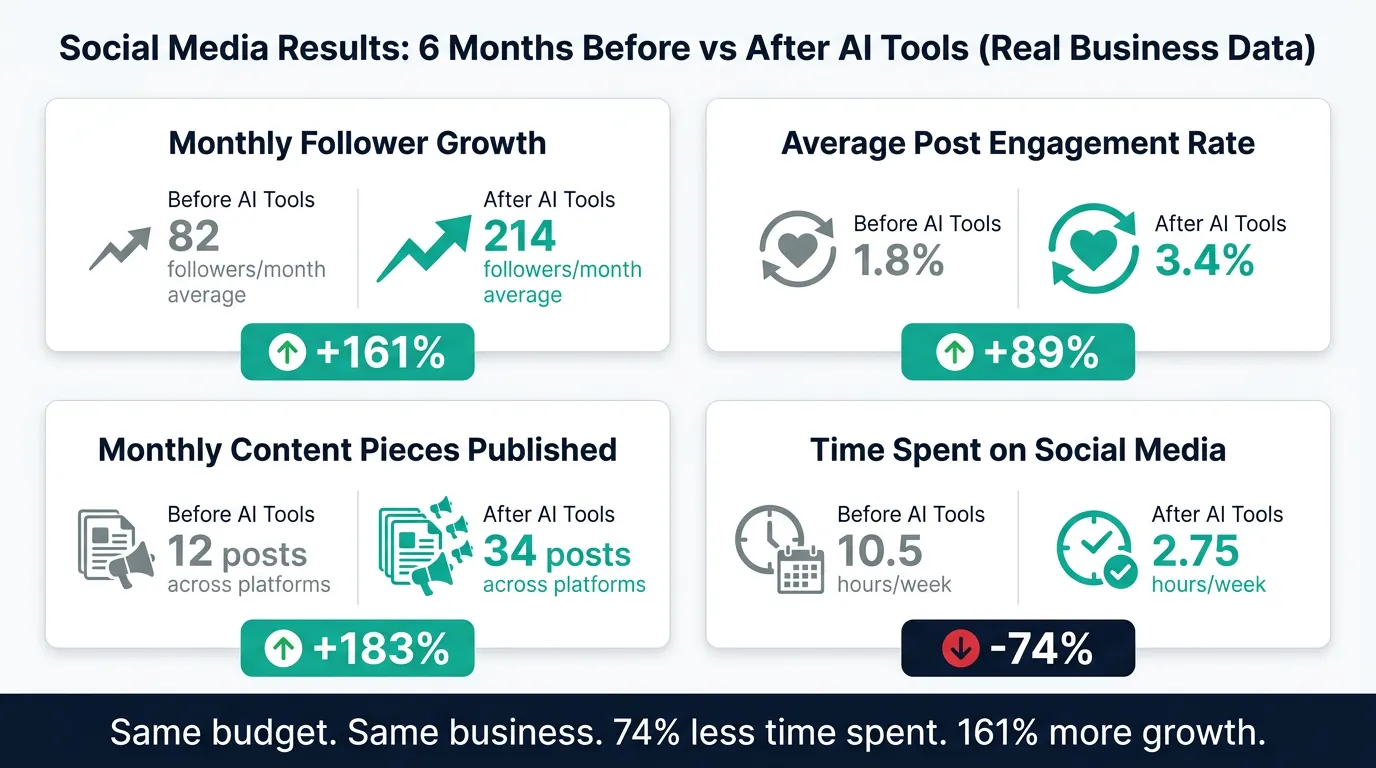
A UK-based artisan bakery with a single location was posting an average of twelve times per month across Instagram and Facebook before adopting AI social media tools, spending approximately ten hours per week on social media tasks including photography coordination, caption writing, and manual scheduling. The posting inconsistency, driven by time constraints, meant the account had grown by an average of 82 followers per month over the preceding six months with an average engagement rate of 1.8 percent.
After implementing Later AI for scheduling and visual planning at approximately 25 GBP per month, combined with Claude Business for caption writing at 22 US dollars per month, the bakery restructured its social media workflow into a monthly batch session of approximately three hours. In this session, the owner scheduled 34 posts across the month, with AI-generated captions reviewed and personalised for each post, optimal posting times set by Later’s AI recommendation engine, and hashtag sets generated by the AI based on past performance data.
Over the following six months, the account averaged 214 new followers per month, an improvement of 161 percent. The average engagement rate rose to 3.4 percent, nearly double the previous figure, attributed primarily to the increased posting consistency and the improvement in caption quality from using AI-drafted text as a starting point rather than rushed manual writing. The owner reduced time spent on social media from ten and a half hours to approximately two and three quarter hours per week while publishing nearly three times as much content.
How to Get the Most From AI Social Media Tools
The businesses that see the strongest results from AI social media tools in 2026 consistently share a specific approach to implementation that differs from simply installing the tool and using the AI to generate content automatically.
The first element is providing detailed brand context to the AI before using it for content generation. All six platforms allow some form of brand voice and tone configuration. Investing 30 to 60 minutes in setting up clear brand voice guidelines, example content in the preferred style, specific vocabulary to use and avoid, and target audience description produces AI-generated content that requires substantially less editing than content generated from minimal context. Businesses that skip this configuration step consistently report that AI-generated content sounds generic and requires heavy editing, which reduces the time saving significantly.
The second element is treating the AI output as a first draft rather than a final post. The businesses with the highest engagement rates from AI-assisted social media are those where a human adds specific details, personalises the content to the specific moment or product, and contributes the authentic voice elements that make business social media compelling. AI provides the structure and starting point. The human provides the specific knowledge and personality that makes content worth following.
The third element is using AI analytics to inform content decisions rather than simply reporting on past performance. The AI performance summaries provided by Metricool, Hootsuite, and Buffer identify which content types and topics are generating above-average engagement, which the business can then deliberately produce more of. Businesses that treat AI analytics as directional guidance for future content strategy rather than as retrospective reporting get significantly more value from the analytics features. Use the Biveron AI Tool ROI Calculator to calculate the specific monthly time value of adopting AI social media tools for your business before committing to a paid plan.
Frequently Asked Questions
Will AI-generated social media content hurt my brand authenticity?
Not if implemented correctly. The risk to brand authenticity comes from publishing AI-generated content without human review and personalisation, which produces generic-sounding posts that audiences increasingly recognise as automated. The businesses that maintain strong brand authenticity while using AI social media tools treat AI output as a starting draft that a human with specific brand knowledge refines before publishing. This hybrid approach consistently produces more authentic-sounding content than pure manual writing done under time pressure, because the AI handles the structural and formulaic elements while the human contributes the specific knowledge and voice that makes the content genuinely representative of the brand. The risk profile is much lower when AI is a writing assistant than when it is an autonomous publisher.
How many social media platforms should a small business actually be on?
For most small businesses, two to three platforms consistently executed produce better results than five or six platforms managed poorly. The platform selection should be driven by where your specific audience spends time rather than by a desire for comprehensive coverage. A B2B professional services business whose clients spend time on LinkedIn will see better returns from excellent LinkedIn content than from spreading effort across LinkedIn, Instagram, TikTok, and Pinterest simultaneously. AI social media tools reduce the marginal cost of adding an additional platform, but the quality of content and consistency of engagement still require a minimum time investment per platform that becomes diluted when spread too thin. Start with the two platforms most aligned with your audience and expand only when those are performing well consistently.
How long does it take to see results from AI-assisted social media management?
For businesses switching from inconsistent manual posting to consistent AI-assisted publishing, measurable improvements in follower growth and engagement rates typically become visible within six to eight weeks. The most immediate improvement is posting consistency itself, which algorithms on all major platforms reward with increased organic reach. Engagement rate improvements follow from consistency and from the improvement in caption quality that AI assistance produces when used well. The businesses that see results fastest are those that combine the increased posting frequency that AI tools enable with the human personalisation and brand voice that makes content worth engaging with.
Can I use the same AI-generated content across multiple social platforms?
Publishing identical content across multiple platforms is generally less effective than platform-adapted content even when the underlying topic is the same. Audiences on Instagram respond to visual-led content with conversational captions. LinkedIn audiences engage with professional insight and longer-form commentary. X audiences respond to concise, punchy statements and timely observations. TikTok content is fundamentally video-native. AI social media tools, particularly Hootsuite AI and Buffer AI, include platform adaptation features that take a single content brief and generate platform-appropriate variations simultaneously, which is a more effective approach than either publishing identical content everywhere or writing completely separate content for each platform from scratch.
Is there a free AI social media management tool that actually works?
Crisp and Buffer both offer free plans with basic scheduling functionality. Buffer’s free plan allows scheduling to three social channels with no AI features included. For AI-assisted content generation specifically, all of the tools with meaningful AI capability in this comparison require a paid subscription, starting at approximately 6 US dollars per month for Buffer’s AI-enabled paid tier. For businesses not yet ready to commit to a paid social media tool, using a general AI writing assistant like Claude or ChatGPT to draft captions and a free scheduling tool for distribution is a lower-cost alternative that captures some of the time saving from AI writing assistance without the integrated scheduling and analytics features of the dedicated social media platforms.
Latest Research