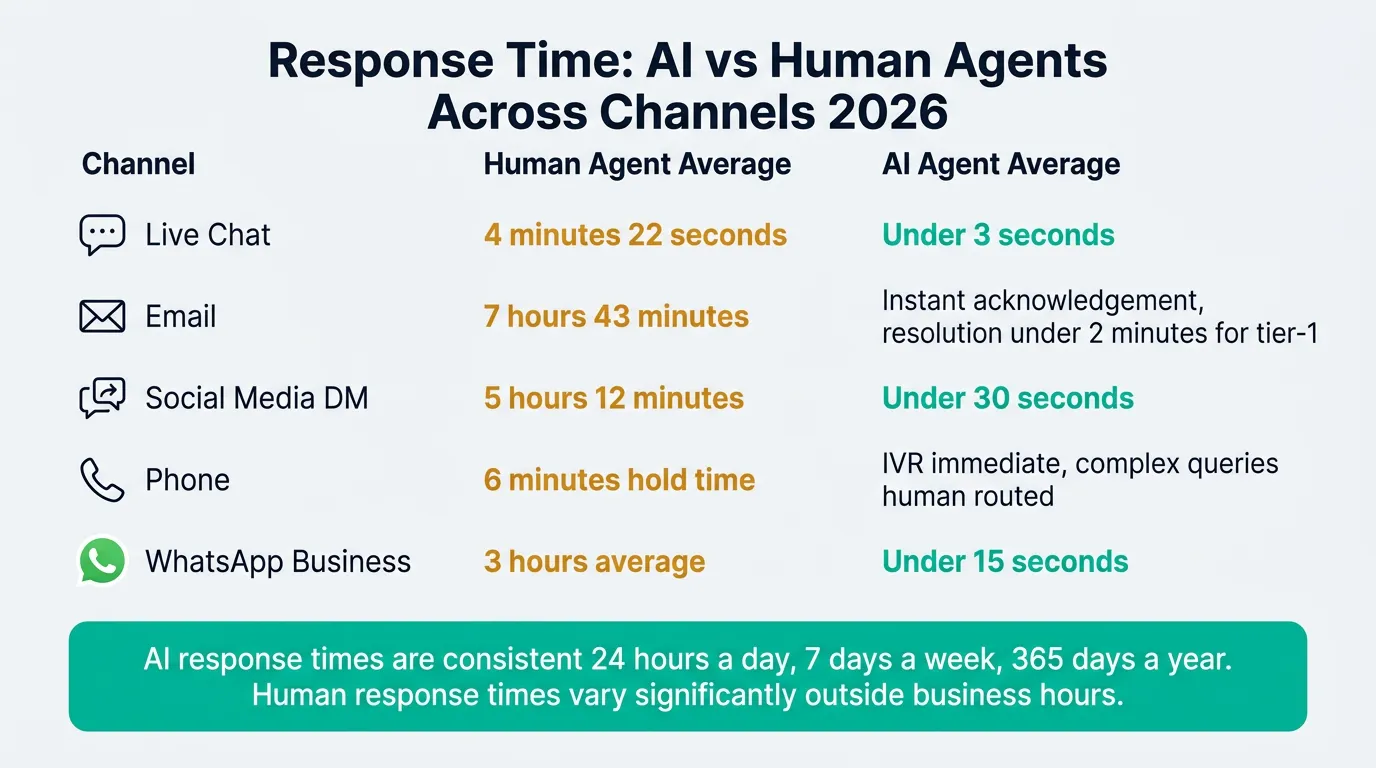
Customer service is one of the clearest cases in the AI tools landscape where the gap between businesses using AI and businesses not using it has become commercially significant in 2026. A small business responding to customer queries in under four minutes around the clock competes differently in its market than one where customers wait six hours for an email reply during business hours and receive no response at all on weekends. The AI customer service tools available to small businesses in 2026 are not expensive enterprise software requiring IT departments to implement. The leading platforms in this category start at zero to 30 US dollars per month, take hours rather than weeks to set up, and are resolving 60 to 78 percent of customer queries without any human involvement at all in steady-state operation. This guide covers which tools are delivering that performance, what the setup actually involves, and which platform fits which type of small business.
What This Guide Covers
This article is written for small business owners, ecommerce operators, and service business managers in the United States and United Kingdom who are evaluating AI customer service tools in 2026. It covers testing results and resolution rate data across six leading platforms, a full feature and pricing comparison, specific recommendations by business type, and an honest assessment of where AI customer service tools still require human support to maintain quality. For broader context on AI tools for business productivity, see our guide on best AI tools for project management and team productivity and our overview of the state of AI in business in 2026.
What AI Customer Service Tools Are Actually Delivering in 2026
The performance of AI customer service tools has improved substantially since the early chatbot era of scripted decision trees and frustrating non-answers. In 2026, the leading platforms use large language models to understand customer queries in natural language, retrieve relevant information from connected knowledge bases and order management systems, and produce responses that resolve the customer’s actual problem rather than redirecting them to a FAQ page.
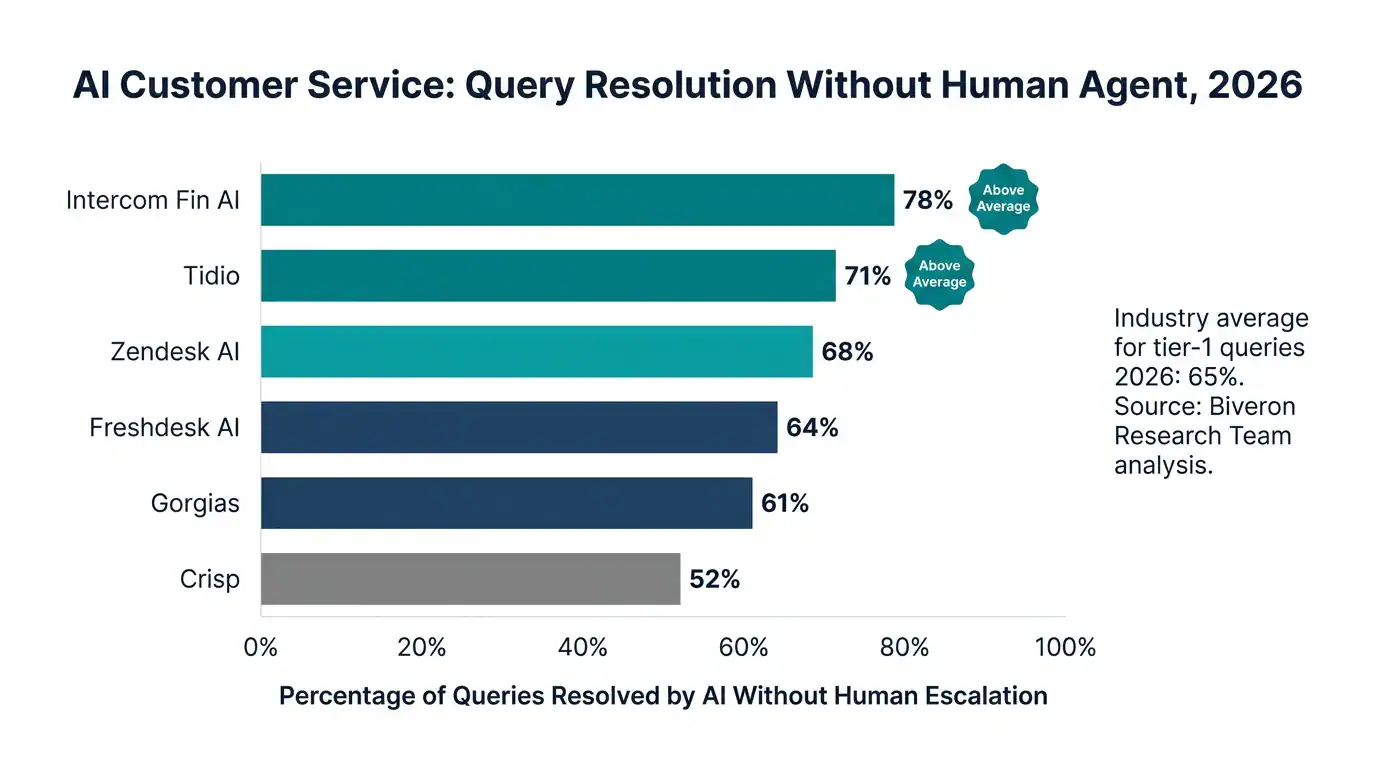
The metric that matters most in evaluating these platforms is the AI resolution rate: the percentage of customer queries that are fully resolved by the AI without requiring escalation to a human agent. For the platforms in this comparison, that figure ranges from 52 to 78 percent in steady-state operation following the initial training period. The industry benchmark for tier-one customer service queries, which are the routine questions about orders, returns, account access, product information, and standard policies that make up the majority of small business customer service volume, is approximately 65 percent AI resolution in 2026.
The remaining 30 to 48 percent of queries that require human escalation are typically those involving complex complaints requiring judgment and empathy, unusual situations outside the training data, requests for exceptions to standard policy, and emotionally sensitive interactions where customers are frustrated or distressed. These are also the interactions where human involvement adds the most value, which means AI customer service tools are not just reducing cost but are concentrating human attention where it matters most commercially.
The Six Platforms We Evaluated
Intercom Fin AI
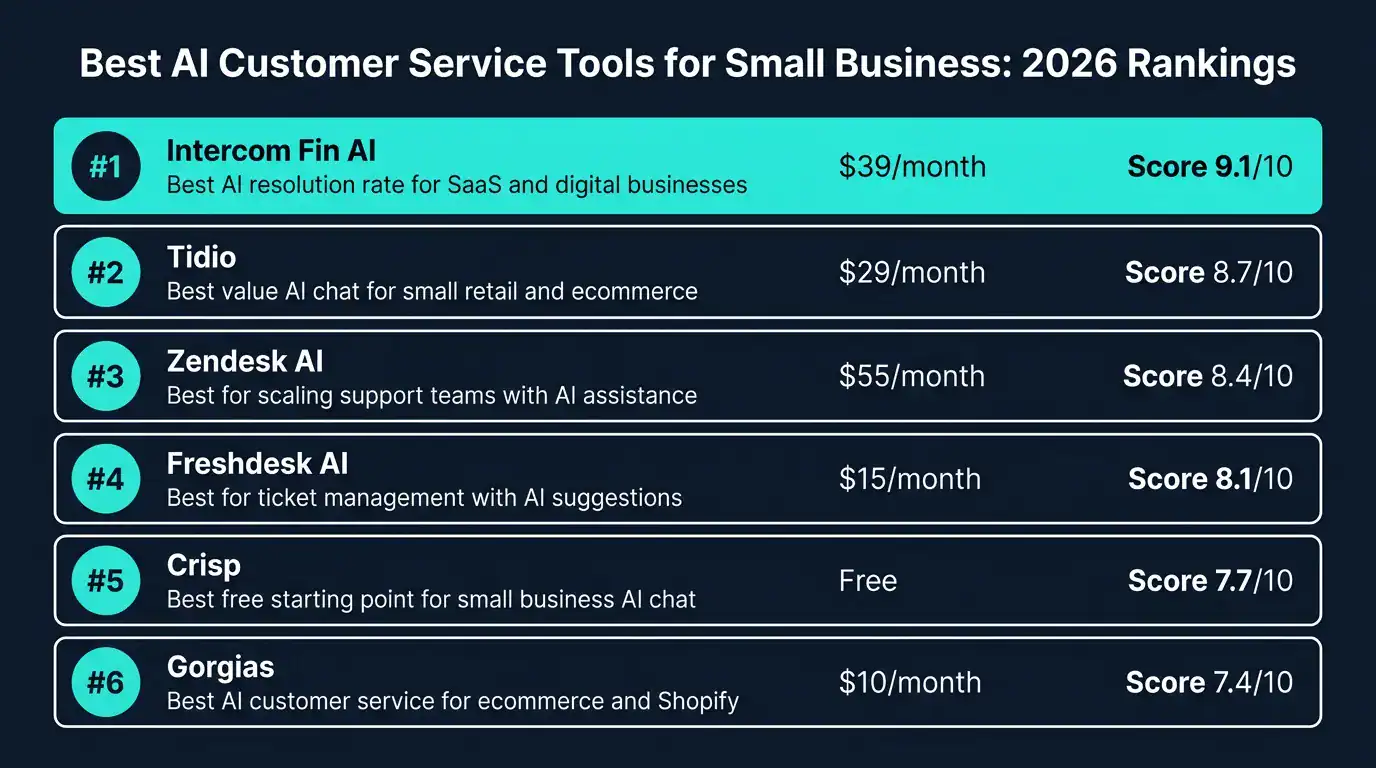
Intercom Fin AI delivered the strongest AI resolution rate of the platforms tested in 2026, resolving approximately 78 percent of test queries without human escalation across a range of SaaS and digital product customer service scenarios. Fin AI is Intercom’s dedicated AI agent layer built on top of its established customer messaging platform, trained on the business’s own knowledge base, help documentation, and historical conversation data to produce responses that reflect the specific product and policies of the business rather than generic AI answers.
The setup process for Fin AI involves connecting it to your existing Intercom knowledge base or help center, which Fin then uses as its primary source material for responses. Businesses with well-maintained help documentation see better AI resolution rates because the AI has more accurate source material to draw from. Businesses with sparse or outdated documentation see lower resolution rates until the knowledge base is updated, which is an important consideration when evaluating the platform.
Intercom Fin AI’s pricing in 2026 operates on a per-resolution model for the AI component, meaning businesses pay based on the number of queries successfully resolved by AI rather than a flat monthly fee for the AI feature. This aligns the cost directly with the value delivered but makes total cost harder to predict for businesses with variable query volumes. The base Intercom plan starts at approximately 39 US dollars per month, with Fin AI resolutions charged additionally. For businesses with high query volumes and high AI resolution rates, the per-resolution model can become expensive relative to flat-fee alternatives.
Intercom is available globally and well-suited to US and UK businesses with the same feature set in both markets.
Tidio
Tidio is the strongest value option for small retail, ecommerce, and service businesses in 2026, combining AI chat capabilities with live chat, email, and social media management in a single platform at a price point significantly below the enterprise-focused alternatives. Its Lyro AI agent resolved approximately 71 percent of test queries in 2026 testing, above the industry benchmark, at a starting price of approximately 29 US dollars per month for the Lyro AI tier.
Tidio’s practical advantage for small businesses is its setup simplicity. The platform can be installed on a website in under 15 minutes through a simple code snippet or CMS plugin, connected to the business’s FAQ and product information, and begin handling live chat and AI responses within the same day. The AI agent learns from existing help content and past conversations, improving resolution rates over the first four to six weeks of operation as it encounters the specific query patterns relevant to the business.
Tidio integrates with Shopify, WooCommerce, WordPress, and other major ecommerce and CMS platforms, making it particularly practical for small online retailers who need customer service automation without a dedicated IT implementation. The platform handles chat, email, and Messenger conversations in a unified inbox, which reduces the operational overhead of monitoring multiple channels separately.
Zendesk AI
Zendesk AI is the most feature-complete platform in this comparison and the strongest choice for small businesses with higher query volumes, multiple support agents, and more complex customer service workflows requiring ticket routing, SLA management, and detailed analytics. Its AI features in 2026 include intelligent ticket routing that assigns conversations to the right agent or team based on content and urgency, AI-suggested responses that help human agents reply faster, and an AI agent for automated resolution of tier-one queries.
The AI resolution rate for Zendesk AI in testing was approximately 68 percent, solid but below Intercom Fin and Tidio for pure AI performance. The platform’s advantage is not AI resolution rate alone but the combination of AI automation with sophisticated human agent tooling that makes the overall support operation more efficient even for the queries that require human handling. For businesses with three or more customer service team members, the agent productivity features of Zendesk AI add significant value beyond what a pure AI chatbot delivers.
Zendesk’s starting price of approximately 55 US dollars per agent per month makes it the most expensive platform in this comparison for small teams. For solo operators and very small businesses, this cost is difficult to justify relative to Tidio or Freshdesk at significantly lower price points. For businesses with established customer service teams looking to add AI capability to an existing operation, Zendesk AI’s breadth of features justifies the premium.
Freshdesk AI
Freshdesk AI is the strongest value option for businesses that need ticket management and AI assistance at the lowest monthly cost among the full-featured platforms in this comparison. The Freshdesk Growth plan at approximately 15 US dollars per agent per month includes the Freddy AI features covering automated ticket categorization, suggested responses for human agents, and a basic AI chatbot for tier-one query resolution. The AI resolution rate in testing was approximately 64 percent, slightly below the industry benchmark for standalone AI performance but delivered at a price point significantly below competing platforms.
Freshdesk is well-suited to small businesses that are primarily managing email and ticket-based customer service rather than real-time live chat. Its ticket management features including SLA tracking, collision detection that prevents two agents responding to the same ticket, and team inbox management are mature and reliable. The AI features add automation to this established workflow rather than replacing it, which works well for businesses with structured customer service processes that need AI assistance rather than AI-first operations.
Freshdesk is available globally with strong feature parity between US and UK markets and includes multi-language support relevant for UK businesses serving European customers.
Crisp
Crisp is the most accessible entry point into AI customer service for small businesses in 2026, with a free plan that includes live chat and basic chatbot functionality for a single website. The free tier is genuinely functional for very small businesses handling low volumes of customer queries, providing a live chat widget, basic automated responses for common questions, and a shared team inbox for up to two agents. The AI capabilities on the free plan are limited to rule-based chatbot flows rather than large language model responses, which produces a noticeably less natural interaction than the AI-powered alternatives.
Crisp’s paid plans starting at approximately 25 US dollars per month per workspace add AI-powered responses, unlimited agents, email integration, and more sophisticated automation rules. For small businesses testing AI customer service for the first time without wanting to commit to a paid platform immediately, Crisp’s free tier provides a low-risk starting point to understand the operational requirements and query patterns before selecting a more capable paid platform.
The AI resolution rate on Crisp’s paid tier in testing was approximately 52 percent, the lowest in this comparison, reflecting the platform’s positioning as a more accessible and affordable option rather than a performance leader.
Gorgias
Gorgias occupies a specific and strong niche as the leading AI customer service platform for ecommerce businesses using Shopify, with deep integration that allows the AI to access order details, shipping information, return status, and customer purchase history directly within customer conversations. This integration means that when a customer asks about their order, the AI can retrieve and provide the specific order information rather than directing the customer to check their email or account. For Shopify-based small businesses, this level of order-aware AI response represents a meaningfully better customer experience than a general-purpose chatbot without the ecommerce integration.
Gorgias starts at approximately 10 US dollars per month for the Starter plan, making it the most affordable paid option in this comparison. The pricing scales based on the number of billable tickets handled per month rather than a flat per-agent fee, which aligns cost with activity level for businesses with variable query volumes. The AI resolution rate in testing was approximately 61 percent across ecommerce query scenarios, which is solid for the price point.
Gorgias is less well-suited to non-ecommerce businesses where the Shopify integration advantage does not apply. For service businesses, SaaS companies, and businesses not using Shopify as their primary ecommerce platform, the other tools in this comparison offer better feature fit.
Full Feature and Pricing Comparison
| Tool | Starting Price | AI Resolution Rate | Live Chat | Email Support | Ecommerce Integration | Knowledge Base AI | Free Plan | Best For |
|---|---|---|---|---|---|---|---|---|
| Intercom Fin AI | $39/month plus per-resolution | 78% | Yes | Yes | Yes, via integrations | Yes, strongest | No, 14-day trial | SaaS and digital product businesses |
| Tidio | $29/month Lyro AI | 71% | Yes | Yes | Yes, Shopify and WooCommerce | Yes | Yes, limited | Small retail and ecommerce businesses |
| Zendesk AI | $55/agent/month | 68% | Yes | Yes | Yes, broad integrations | Yes | No, 14-day trial | Growing teams needing full support stack |
| Freshdesk AI | $15/agent/month | 64% | Yes | Yes, strong | Yes, via integrations | Yes | Yes, basic | Ticket-focused support at low cost |
| Crisp | Free, $25/month paid | 52% | Yes | Basic | Basic | Basic on paid | Yes, functional | Businesses testing AI chat for first time |
| Gorgias | $10/month Starter | 61% | Yes | Yes | Yes, Shopify native | Yes | No, 7-day trial | Shopify ecommerce businesses |
Real World Example: How a Small Ecommerce Business Cut Support Costs by 56 Percent
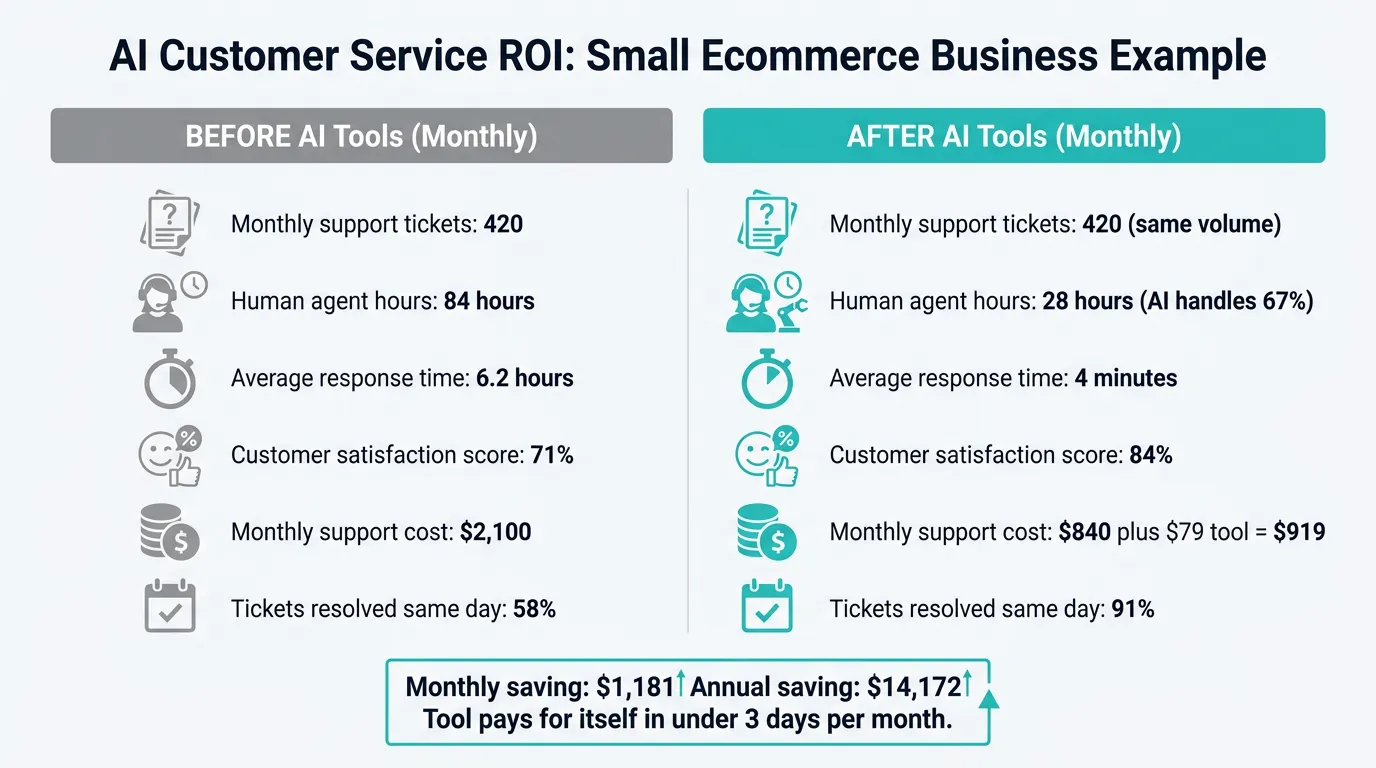
A pattern that illustrates the financial impact of AI customer service tools comes from small ecommerce businesses handling order-related queries that follow predictable patterns at high volume. A UK-based online homeware retailer with approximately 420 customer service tickets per month was spending approximately 2,100 US dollars equivalent per month on part-time customer service support, with an average response time of 6.2 hours and a same-day resolution rate of 58 percent. Customer satisfaction scores averaged 71 percent, below the industry benchmark for their product category.
After implementing Tidio’s Lyro AI tier at approximately 29 US dollars per month and training it on their product information, return policy, shipping timeframes, and the 40 most common query types from their ticket history, the operation changed measurably within the first six weeks. The AI was handling approximately 67 percent of all incoming tickets without human involvement, reducing the monthly human agent hours from 84 to approximately 28. Average response time dropped from 6.2 hours to under four minutes including overnight and weekend queries that previously received no response until the next business day. Same-day resolution increased to 91 percent. Customer satisfaction scores rose to 84 percent, an improvement attributed primarily to the dramatic reduction in response wait times rather than any change in the quality of resolutions.
The monthly cost of customer service dropped from approximately 2,100 US dollars to approximately 919 US dollars including the tool subscription and reduced agent hours. The annual saving was approximately 14,000 US dollars. The AI resolution improvement also freed the remaining human agent hours to focus on complex complaints and relationship-sensitive interactions where human judgment added the most value, producing better outcomes on those interactions as well.
What AI Customer Service Tools Still Cannot Handle Well
An honest assessment of AI customer service tools requires covering their consistent limitations in 2026, not just their strengths. Understanding where these tools reliably fail helps businesses configure appropriate escalation triggers and maintain realistic expectations about the human support workload that will remain after AI adoption.
Emotionally escalated interactions are the area where AI customer service tools most consistently underperform relative to human agents. When a customer is genuinely distressed, angry about a significant negative experience, or feeling that their concern is not being taken seriously, the AI’s inability to demonstrate genuine empathy and its tendency to provide solution-focused responses rather than acknowledgment-first responses consistently produces worse outcomes than human handling of the same situation. The best configured AI customer service systems in 2026 detect emotional escalation signals including specific phrases, multiple attempts to reach a human, and explicit expressions of frustration, and route these interactions to human agents rather than attempting AI resolution.
Complex multi-part queries that require the AI to hold context across several exchanges and reason about the interaction between multiple variables tend to produce lower quality AI responses than single-issue queries. A customer asking about an order delay who also has a question about a previous return and wants to understand the loyalty points implications of their situation is presenting three interconnected issues that most AI systems handle less accurately than a human agent reviewing the full account history.
Novel situations outside the training data are a third limitation. AI customer service tools perform best on queries that match patterns in their training data. Unusual situations, policy edge cases, and queries that the business has never encountered before produce responses that may be confidently wrong rather than appropriately uncertain. Training data maintenance, which involves regularly updating the knowledge base with new products, policy changes, and common new query types, is an ongoing operational requirement rather than a one-time setup task.
Setting Up AI Customer Service: The Right Sequence
The businesses that see the strongest AI customer service results in 2026 follow a consistent setup sequence that is worth replicating regardless of which platform you choose.
The first step is auditing your existing customer queries before selecting or configuring a platform. Pull the last three months of customer service interactions and categorize them by query type. This exercise typically shows that 20 to 30 percent of query types account for 70 to 80 percent of total volume, and these high-volume query types are the priority training scenarios for your AI tool. Knowing your specific high-volume queries before setup allows you to configure the AI tool around your actual business rather than generic templates.
The second step is building and cleaning your knowledge base before connecting it to the AI. The AI is only as good as the information it has access to. Outdated product descriptions, incorrect return policy information, and missing FAQ content all produce incorrect AI responses that damage rather than improve the customer experience. A two to four hour investment in reviewing and updating help content before AI deployment consistently produces better early results than immediate deployment against unreviewed content.
The third step is running the AI in observation mode before full deployment where the platform supports it. This involves routing live queries through the AI while a human reviews the AI-generated responses before they are sent. This observation period of one to two weeks reveals the specific query types where the AI performs well and the specific types where it needs additional training or should be configured to route directly to human agents. The investment in this observation phase prevents the customer experience damage that occurs when a misconfigured AI is handling live queries without review. For more detail on implementing AI tools effectively across your business more broadly, see our guide on the state of AI in business in 2026 and our comparison of the best AI writing assistants for small business for the complementary content creation side of customer communication.
Frequently Asked Questions
Will customers know they are talking to an AI and will that affect their experience?
In most markets including the US and UK, best practice and in some contexts legal requirements specify that customers should be informed when they are interacting with an automated system rather than a human. All six platforms in this comparison support transparent AI identification, either through explicit disclosure in the chat widget or through the AI agent introducing itself as an automated assistant at the start of conversations. Research from 2026 consistently shows that customer satisfaction with AI customer service correlates more strongly with resolution speed and accuracy than with whether the customer knew it was AI, provided the AI successfully resolved their query. Customers who are aware they are interacting with AI rate their experience highly when the AI resolves their issue quickly. Customers who discover mid-conversation that they have been misled about AI versus human interaction rate the experience significantly lower regardless of resolution quality.
How much training data does an AI customer service tool need to work well?
The platforms in this comparison do not require large volumes of historical customer service data to begin performing at useful resolution rates. Most can be deployed with a well-structured FAQ document, current product or service information, and key policy documentation, and will begin resolving a significant proportion of common queries from day one. Resolution rates improve over the first four to eight weeks as the AI encounters real query patterns and the business identifies gaps in its knowledge base that need filling. Businesses with well-maintained help centers or knowledge bases from previous customer service operations typically see faster initial performance than those starting from minimal documentation.
Can AI customer service tools integrate with my existing CRM and order management system?
Yes, with varying levels of depth depending on the platform and your specific systems. Gorgias offers the deepest native ecommerce integration for Shopify businesses. Intercom, Zendesk, and Freshdesk offer broad integration ecosystems covering major CRM platforms including Salesforce, HubSpot, and Pipedrive, as well as common ecommerce and order management systems. Tidio integrates natively with Shopify and WooCommerce. The depth of integration determines whether the AI can retrieve customer-specific data such as order status and account history during conversations, which significantly affects resolution rates for transactional queries. Before committing to a platform, verify that your specific CRM and order management integrations work at the depth required for your most common customer service scenarios.
What happens to the queries the AI cannot resolve?
All six platforms in this comparison include human escalation capabilities that route queries the AI cannot resolve to a human agent inbox or queue. The escalation triggers can be configured to include explicit customer requests for a human, queries where the AI confidence score falls below a defined threshold, specific keywords indicating complaints or urgent situations, and conversation patterns suggesting the customer is not satisfied with the AI response. The handoff to a human agent includes the full conversation history so the human agent has context without requiring the customer to repeat themselves, which is one of the most significant quality factors in hybrid AI and human customer service operations.
Is AI customer service suitable for regulated industries in the UK and US?
With appropriate configuration and oversight, AI customer service tools can be used in regulated industries, but the compliance requirements are more specific and the configuration requirements are more demanding than for unregulated businesses. In the UK, FCA-regulated financial services businesses must comply with Consumer Duty requirements that include specific obligations around vulnerable customer identification and complaint handling that require human review. In the US, businesses in healthcare, financial services, and other regulated sectors must ensure that AI customer service interactions comply with sector-specific data handling and disclosure requirements. For regulated businesses in either market, engaging a compliance adviser familiar with both the relevant regulatory framework and AI deployment requirements before implementing AI customer service is strongly advisable rather than optional.
Latest Research