Three years ago, suggesting that a small business should bank with a fintech app rather than a traditional bank raised legitimate questions about reliability, deposit protection, and platform maturity. In 2026, those questions are answered. Revolut, Wise, and Chime have each processed hundreds of billions in transactions, hold regulatory licences across multiple jurisdictions, and offer FDIC-equivalent deposit protection through partner bank arrangements. The question is no longer whether fintech banking is safe for small businesses. The question is which platform fits your specific business model, transaction patterns, and the markets you operate in.
What This Guide Covers
This article is written for small business owners, freelancers, and self-employed professionals in the United States and United Kingdom who are evaluating fintech banking alternatives to traditional business bank accounts in 2026. It covers the real fees, international transfer costs, features, and limitations of Revolut Business, Wise Business, and Chime Business, with specific recommendations based on business type and transaction patterns. For broader context on small business finance, see our guide on best high-yield savings accounts in the US in 2026 and our overview of how AI is transforming personal finance in the US and UK.
Why Fintech Banking Is Now Serious for Small Business
The shift toward fintech banking among small businesses in 2026 is being driven by three converging factors. The first is regulatory maturity and deposit protection. All three platforms in this comparison now offer FDIC-insured deposit protection through partner bank arrangements in the United States, and both Revolut and Wise are FCA regulated in the United Kingdom. The safety concern that was legitimate five years ago is now resolved within standard deposit protection limits.
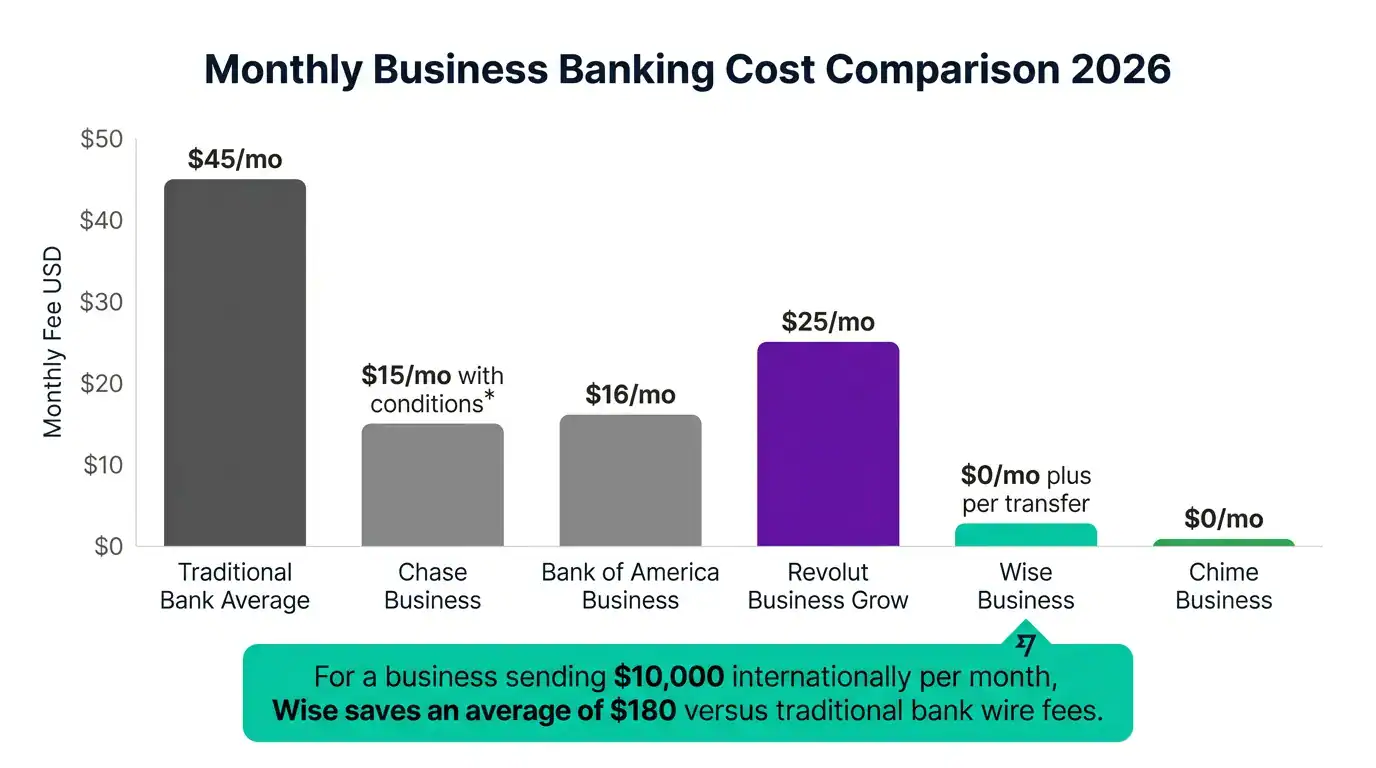
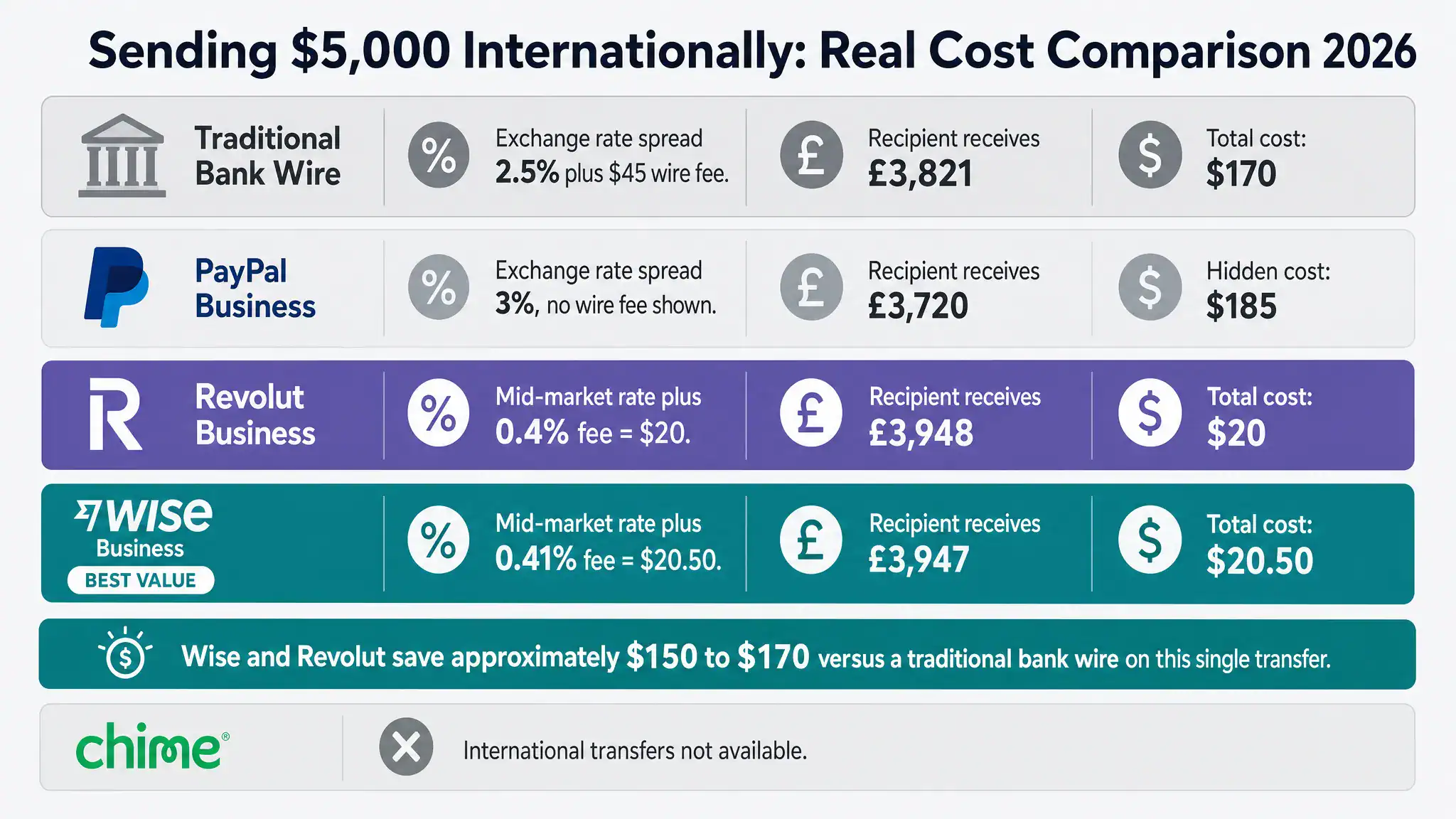
The second is the growth of international business activity among small businesses. Remote work, digital services, and cross-border commerce have made international payments routine for businesses that previously operated entirely domestically. Traditional bank wire fees of 25 to 45 US dollars per transaction, combined with exchange rate spreads of two to three percent above the mid-market rate, add significant cost for businesses making regular international transfers. The fintech platforms built specifically to address this have taken substantial market share as a result.
The third factor is feature maturity. Expense categorization, team access controls, multi-currency account holding, and accounting software integrations have all reached a level where fintech business accounts serve the operational needs of most small businesses rather than just providing cheaper transactions. For small businesses that previously maintained traditional accounts primarily for their accounting integrations, those integrations are now available through the leading fintech platforms as well.
Revolut Business: The Multi-Currency Powerhouse
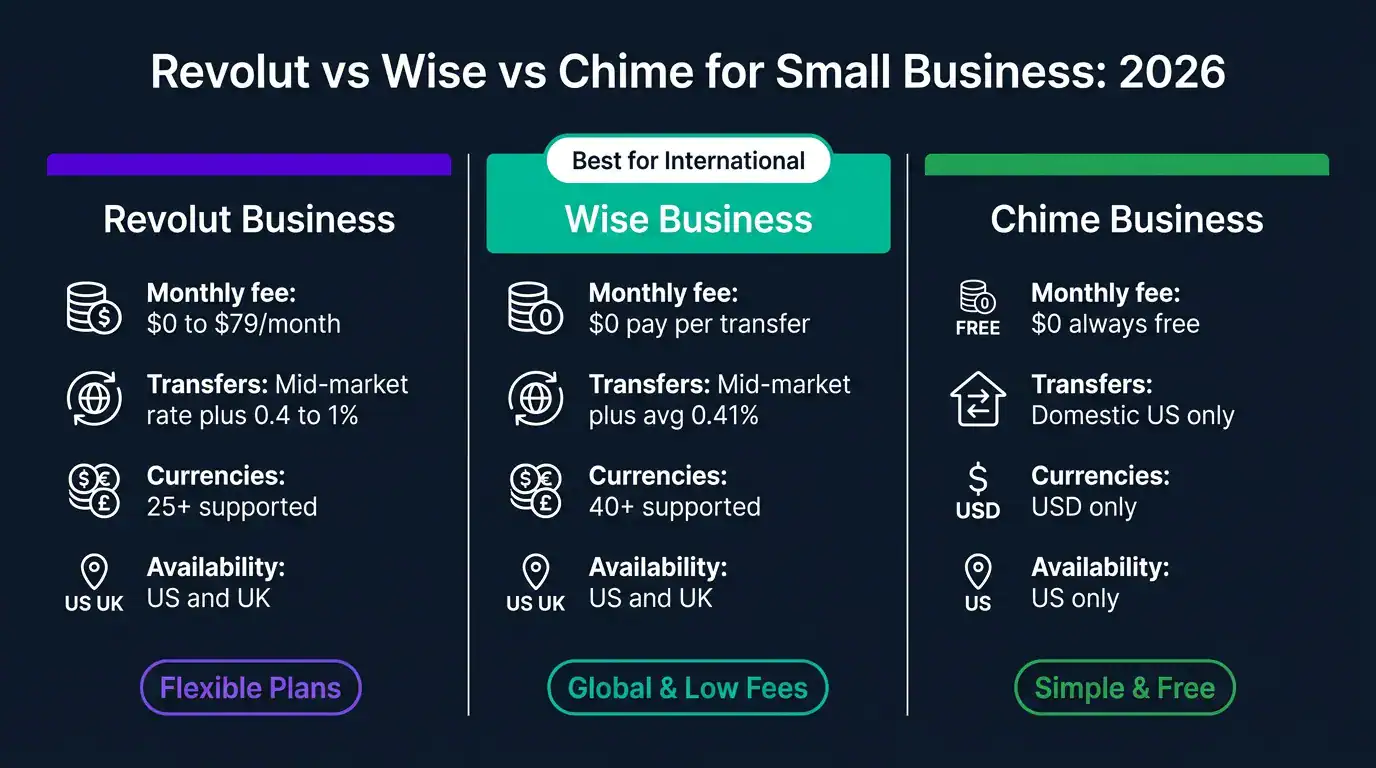
Revolut Business in 2026 is the most feature-rich of the three platforms and the strongest choice for businesses with significant international activity across multiple currencies. Its core advantage is the ability to hold balances in over 25 currencies simultaneously, exchange between them at the mid-market rate during standard market hours, and make international payments to over 160 countries with fees significantly below traditional bank rates.
Revolut Business operates on a tiered model. The free tier provides a limited monthly allowance of fee-free transactions and currency exchanges, adequate for very low volume international activity. The Grow plan at approximately 25 US dollars per month and the Scale plan at approximately 79 US dollars per month provide higher transaction allowances, expanded team features, and additional capabilities including expense management, team spending controls, and API access for higher volume operations.
Revolut’s strongest differentiator versus Wise is the breadth of its business banking features beyond international transfers. Multi-user access with granular permissions, physical and virtual card management, expense policy enforcement, and direct integrations with Xero, QuickBooks, FreeAgent, and Sage make Revolut Business closer to a complete business banking solution. For businesses wanting a single platform handling international payments, team expense management, and accounting integration, Revolut Business is the most complete solution in this comparison.
One important limitation: the mid-market exchange rate applies during standard weekday trading hours. Exchanges on weekends or outside market hours incur a markup of approximately 0.5 to 1 percent above the mid-market rate. Still competitive versus traditional banks, but worth factoring in if your business regularly needs to exchange currency outside weekday hours.
Revolut Business is available in both the United States and the United Kingdom with comparable feature sets in both markets.
Wise Business: The International Transfer Specialist
Wise Business has maintained its position as the most transparent and cost-effective platform specifically for international money transfers in 2026. Its core proposition is consistent: mid-market exchange rates on all transfers with a clearly disclosed fee averaging 0.41 percent of the transfer amount, and no monthly account fee. For businesses whose primary fintech banking need is sending or receiving money internationally at competitive rates, Wise Business remains the benchmark.
Wise charges per transfer rather than a monthly subscription. This makes Wise more cost-effective than Revolut for low and moderate transfer volumes, where the monthly subscription cost of Revolut’s paid tiers exceeds the per-transfer fees Wise would charge for the same activity. For businesses making one to five international transfers per month, the pay-per-transfer model typically produces a lower total cost than Revolut’s subscription model at equivalent volumes.
Wise Business in 2026 supports holding balances in over 40 currencies, issuing physical and virtual debit cards linked to the multi-currency account, and receiving payments with local account details in ten currencies including USD, GBP, EUR, AUD, and CAD. The local account details feature is particularly valuable for businesses invoicing clients in multiple countries, allowing clients to pay in their local currency without incurring international transfer fees.
Where Wise falls short relative to Revolut is in expense management and team features. These exist in Wise Business but are less developed than Revolut’s equivalent features. For businesses whose needs extend beyond international transfers to include team spending controls and advanced accounting integrations, Revolut Business offers a more complete feature set at comparable cost for higher volume users.
Wise Business is available in both the United States and the United Kingdom with consistent feature sets across both markets.
Chime Business: The Zero-Fee US Domestic Option
Chime Business occupies a fundamentally different position from Revolut and Wise. Rather than competing on international transfer capability, Chime is built for US-based small businesses and freelancers whose banking needs are primarily domestic and who want to eliminate monthly banking fees entirely. Chime Business charges no monthly fees, no minimum balance requirements, no overdraft fees within SpotMe limits, and provides fee-free access to over 60,000 ATMs through the Allpoint and MoneyPass networks.
For US-based sole proprietors, freelancers, and very small businesses with straightforward domestic cash flows, Chime Business is genuinely compelling in 2026. Zero monthly fees means the account costs nothing during slow months. SpotMe provides a useful buffer for businesses with variable income. The mobile app handles the core banking functions most small domestic businesses need daily.
The significant limitation is international capability, which is essentially absent. Chime is a US-only platform that does not support international transfers, foreign currency transactions, or accounts outside the United States. For any business with international suppliers, clients, or contractors, Chime is not a viable primary banking solution. It works as a zero-cost domestic account alongside a dedicated international platform, but not as a single solution for internationally active businesses.
Full Feature and Pricing Comparison
| Feature | Revolut Business | Wise Business | Chime Business |
|---|---|---|---|
| Monthly fee | $0 free, $25 Grow, $79 Scale | $0 no monthly fee | $0 always free |
| International transfers | Mid-market rate plus 0.4 to 1%, 160+ countries | Mid-market rate plus avg 0.41%, 80+ countries | Not available |
| Currencies supported | 25+ hold and exchange | 40+ hold and convert | USD only |
| Local account details | USD, GBP, EUR on paid plans | USD, GBP, EUR, AUD, CAD and 5 more | USD routing only |
| Physical debit card | Yes, free on paid plans | Yes, one-time fee approx $9 | Yes, free |
| Virtual cards | Yes, multiple | Yes, up to 3 | No |
| Team accounts | Yes, advanced on paid plans | Yes, basic features | No |
| Accounting integrations | Xero, QuickBooks, FreeAgent, Sage | Xero, QuickBooks, FreshBooks | CSV export only |
| FDIC protection | Yes via partner banks up to $250,000 | Yes via partner banks up to $250,000 | Yes via Stride Bank up to $250,000 |
| Free ATM withdrawals | Limited monthly allowance | Limited monthly allowance | 60,000+ fee-free ATMs |
| US availability | Yes | Yes | Yes |
| UK availability | Yes, FCA regulated, FSCS up to £85,000 | Yes, FCA regulated | No |
Real World Example: How Business Type Determines the Right Choice
Three business profiles illustrate how the right fintech choice depends entirely on your specific transaction patterns.
A US-based freelance developer invoicing three UK clients monthly for a combined total of approximately 8,000 US dollars and paying one offshore contractor 1,500 US dollars per month would find Wise Business the most cost-effective solution. The total monthly cost of receiving three international payments and making one international payment through Wise at the 0.41 percent average fee would be approximately 39 US dollars. There is no monthly fee to absorb on top of that. Revolut’s Grow plan at 25 US dollars monthly would produce comparable or slightly higher total costs at this volume. Chime cannot serve this business at all due to the international requirements.
A US-based retail business with entirely domestic cash flows, a handful of employees, and a need for simple zero-fee business banking would find Chime Business the strongest fit. Zero monthly fees, fee-free domestic transfers, and SpotMe overdraft protection serve this business at no cost. Neither Revolut nor Wise offers a compelling advantage over Chime for a business with no international activity and no need for team expense management.
A UK-based digital agency billing clients across Europe, the US, and Australia with monthly international activity exceeding 50,000 GBP equivalent would find Revolut Business Scale the strongest fit. Volume discounts on currency exchange, multi-currency account holding, advanced team expense controls, and accounting integrations justify the subscription cost many times over at this transaction volume. Wise would serve the international transfer function comparably but lacks the broader expense management and team features a business at this scale typically needs.
How to Choose Between the Three Platforms
The decision simplifies significantly once you are clear about your actual transaction patterns rather than hypothetical future needs.
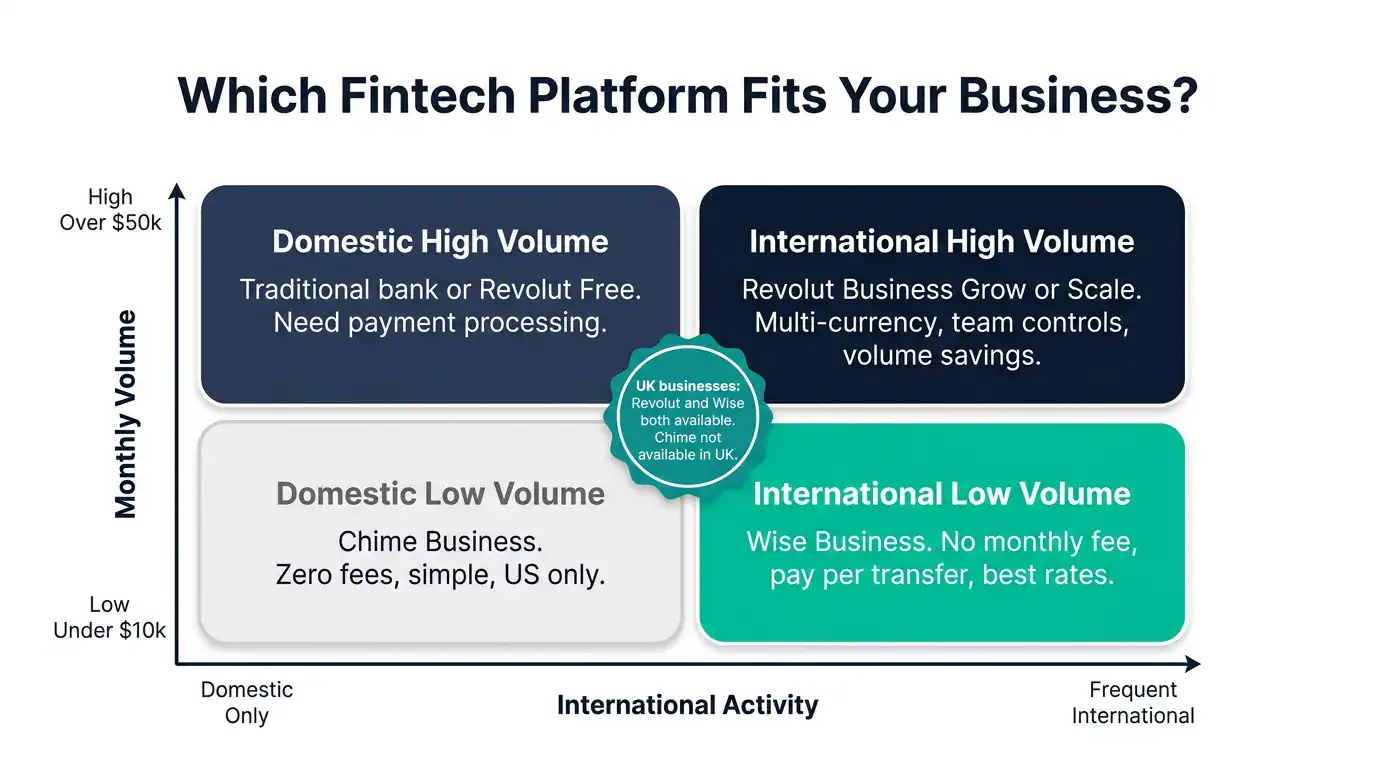
If your business sends or receives money internationally more than twice per month and you want a single platform handling international payments, team expense management, and accounting integration, Revolut Business on the Grow or Scale plan is the recommendation. The subscription cost is justified by feature breadth at moderate to high transaction volumes.
If your business has international activity but at lower or moderate volumes and you want to minimize fixed monthly costs, Wise Business is the recommendation. The transparent pay-per-transfer model and absence of a monthly fee make it more cost-effective than Revolut at lower volumes. The multi-currency account and local account details provide the core functionality most internationally active small businesses need without paying for features they do not use.
If your business is US-based with primarily domestic cash flows and you want zero monthly banking fees, Chime Business is the recommendation. For any business with international requirements, consider Chime only as a supplementary domestic account alongside a dedicated international transfer platform.
For broader context on managing small business finances in 2026, see our guide on best online banks for small business in the US and our comparison of AI-powered budgeting apps versus traditional methods.
Frequently Asked Questions
Is it safe to keep my business money in Revolut, Wise, or Chime?
Yes, within the deposit protection limits. All three platforms offer FDIC-equivalent deposit protection in the United States through partner bank arrangements covering balances up to 250,000 US dollars per depositor. In the United Kingdom, Revolut holds deposits under its banking licence with FSCS protection up to 85,000 GBP, and Wise holds client funds in ring-fenced accounts under FCA regulatory requirements. These protections mean your deposits at these platforms carry equivalent safety to deposits at traditional banks within the coverage limits. For balances above these thresholds, spreading funds across multiple institutions is advisable regardless of whether they are traditional banks or fintech platforms.
Can I use one of these platforms as my only business bank account?
For many small businesses yes. However there are situations where a traditional business bank account may also be necessary. Businesses receiving significant cash deposits need branch access. Businesses requiring business loans, lines of credit, or letters of credit need a traditional banking relationship that these fintech platforms do not provide. Businesses with certain point-of-sale payment processing needs may find some POS integrations work more smoothly with traditional accounts. For businesses whose banking needs are primarily digital payments, payroll, and international transfers, any of these platforms can serve as a primary account.
Which is better for international transfers, Revolut or Wise?
Both use mid-market exchange rates with comparable fee structures averaging 0.4 to 0.41 percent per transfer. Wise is more cost-effective for low to moderate transfer volumes because there is no monthly fee and you pay only for what you send. Revolut becomes more competitive at higher volumes where the subscription cost is offset by included transaction allowances and broader business features. For businesses making fewer than five to seven significant international transfers per month, Wise typically produces the lower total cost. For businesses with higher volumes needing broader features, Revolut’s paid plans become more economical.
Is Chime available in the UK?
No. Chime is a US-only platform. It does not operate in the United Kingdom and has no announced plans to expand to the UK market. UK businesses should evaluate Revolut Business or Wise Business instead, both of which are FCA regulated and available in the UK with strong international transfer capabilities and Sterling account functionality.
What are the risks of using a fintech business account instead of a traditional bank?
The main practical risks are customer support resolution time, which can be slower than a dedicated business banking relationship for complex disputes, and the absence of certain traditional banking products such as business loans, overdraft facilities, and letters of credit. Deposit safety within protection limits is comparable to traditional banks. For businesses that occasionally need services beyond basic payment and transfer functions, maintaining a relationship with a traditional bank alongside a fintech account provides a useful fallback. Many small businesses in 2026 use this hybrid approach: fintech for daily operations and international transfers, traditional bank for lending and complex financial products.
Latest Research