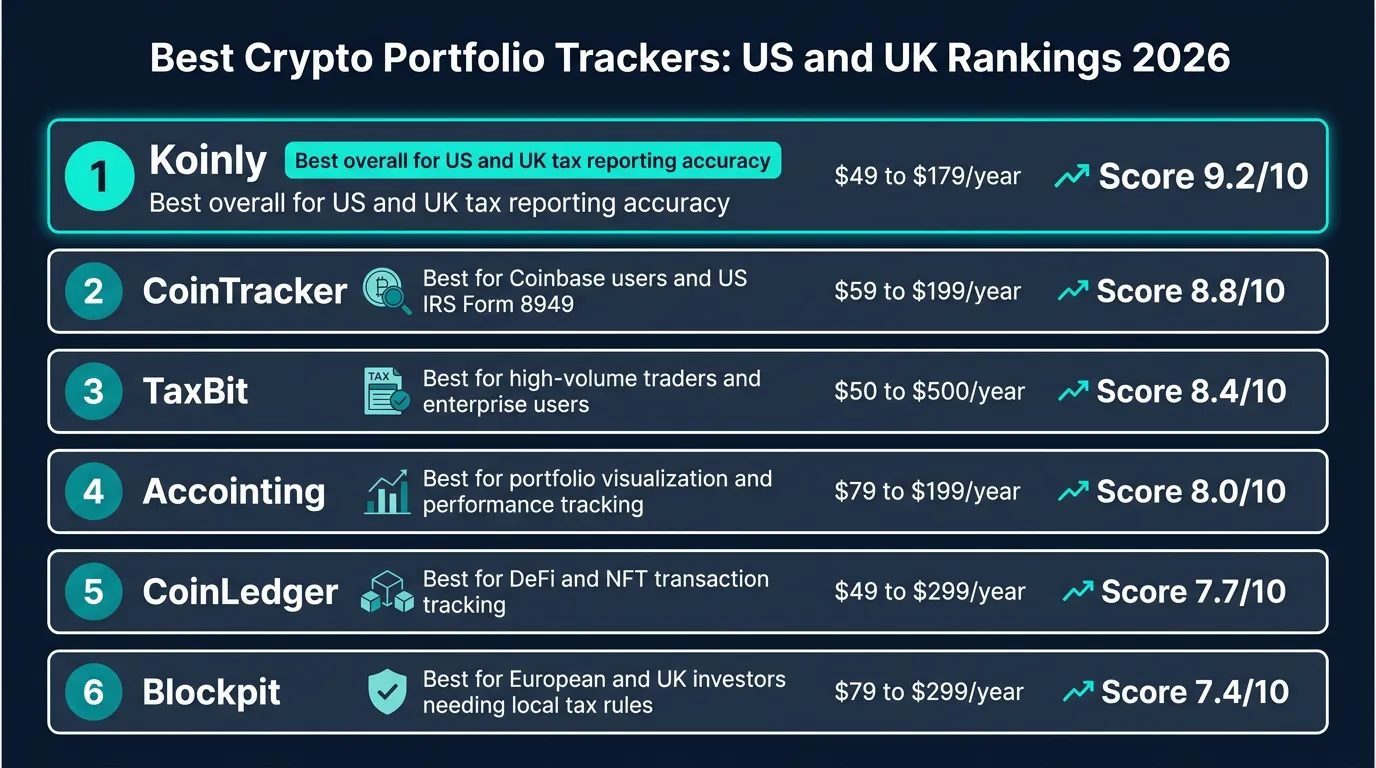
Tracking a crypto portfolio manually was manageable when most investors held Bitcoin and Ethereum on a single exchange and made occasional trades. In 2026, the typical active crypto investor has accounts on multiple exchanges, holds assets in self-custody wallets, participates in staking or DeFi protocols, has received airdrops and staking rewards at various points throughout the year, and may hold NFTs alongside fungible tokens. Calculating the tax implications of this activity accurately, whether under IRS rules in the United States or HMRC rules in the United Kingdom, requires applying specific calculation rules to potentially hundreds or thousands of individual transactions. Doing this manually is not just time-consuming but genuinely error-prone in ways that create real tax compliance risk. Dedicated crypto portfolio tracking tools that automatically import transactions, apply the correct tax calculation rules for your jurisdiction, and generate the forms or reports needed for filing have become essential infrastructure for any investor with more than minimal activity. This guide covers the best options available to US and UK investors in 2026.
What This Guide Covers
This article is written for crypto investors in the United States and United Kingdom who need both a real-time view of their portfolio performance and accurate tax reporting for their jurisdiction. It covers six leading portfolio tracking and tax calculation platforms evaluated in 2026, with specific attention to how well each handles US IRS requirements including Form 8949 generation, UK HMRC requirements including the Section 104 Pool calculation and CGT report, and advanced transaction types including DeFi, staking, and NFTs. For the specific tax rules that these tools are calculating, see our detailed guides on the crypto tax guide for US investors and the crypto tax guide for UK investors.
Why Crypto Portfolio Tracking Has Become Essential in 2026
Three developments have made dedicated crypto portfolio tracking tools genuinely necessary rather than merely convenient for active investors in 2026.
The first is the volume and complexity of transactions. Early crypto investors typically made a small number of straightforward buy and sell trades on a single exchange. The DeFi ecosystem, cross-chain activity, staking protocols, NFT markets, and the proliferation of exchanges have increased the typical active investor’s annual transaction count by an order of magnitude. A single DeFi interaction involving a token swap, liquidity pool deposit, and reward claim can generate three to five separate taxable events that each require accurate cost basis tracking. Manual calculation of these transactions at scale is not a realistic compliance approach.
The second is the enforcement environment. Both the IRS through Form 1099-DA reporting and HMRC through DAC8 data sharing are now receiving transaction data from major exchanges directly. The era of crypto tax reporting operating largely on the honor system is ending. Discrepancies between what exchanges report and what appears on tax returns are increasingly detectable, making accurate reporting not just ethically correct but materially important from a risk management perspective.
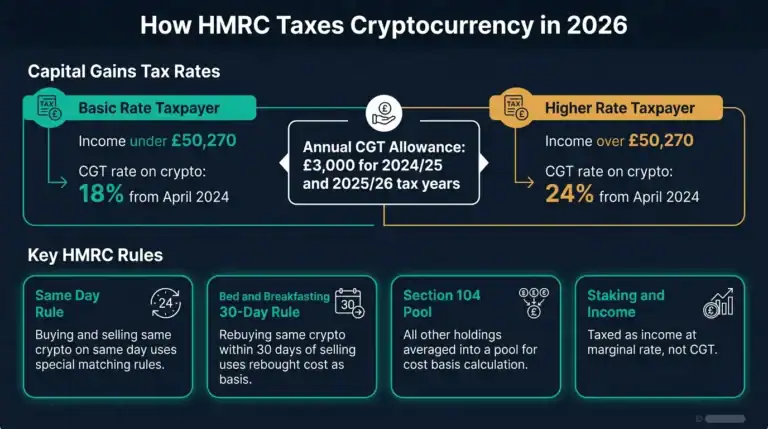
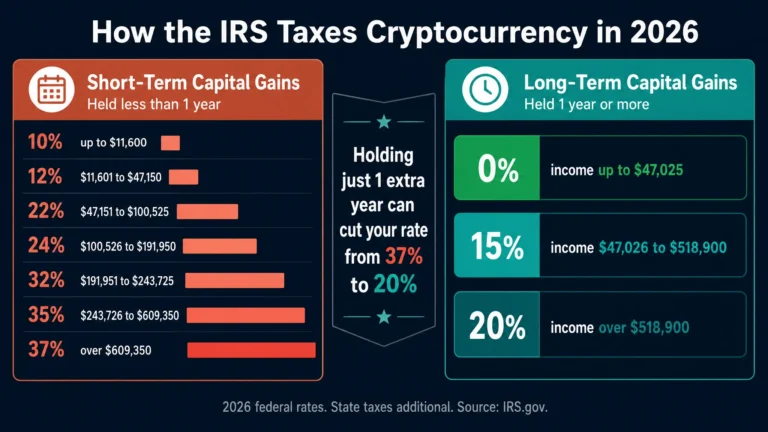
The third is the complexity of jurisdiction-specific calculation rules. US investors must apply FIFO, HIFO, or specific identification methods and distinguish between short-term and long-term gains. UK investors must apply the mandatory same-day rule, 30-day rule, and Section 104 Pool calculation in sequence. These rules interact with each other and with the specific timing of transactions in ways that make manual calculation unreliable for any investor with significant activity. Dedicated tools apply these rules automatically and consistently across every transaction in the portfolio.
The Six Platforms We Evaluated
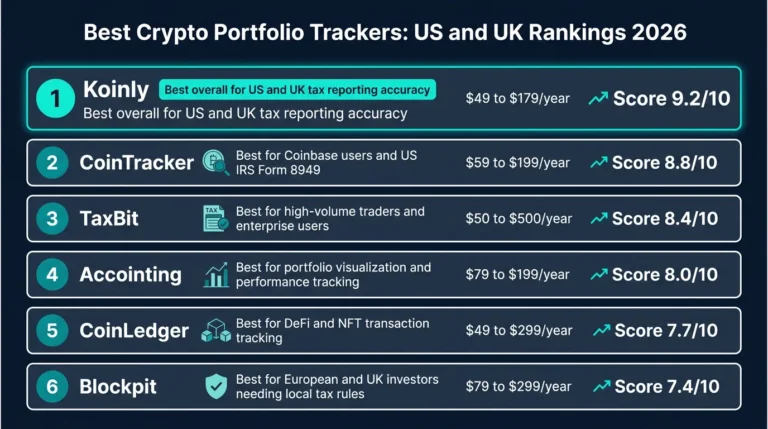
Koinly
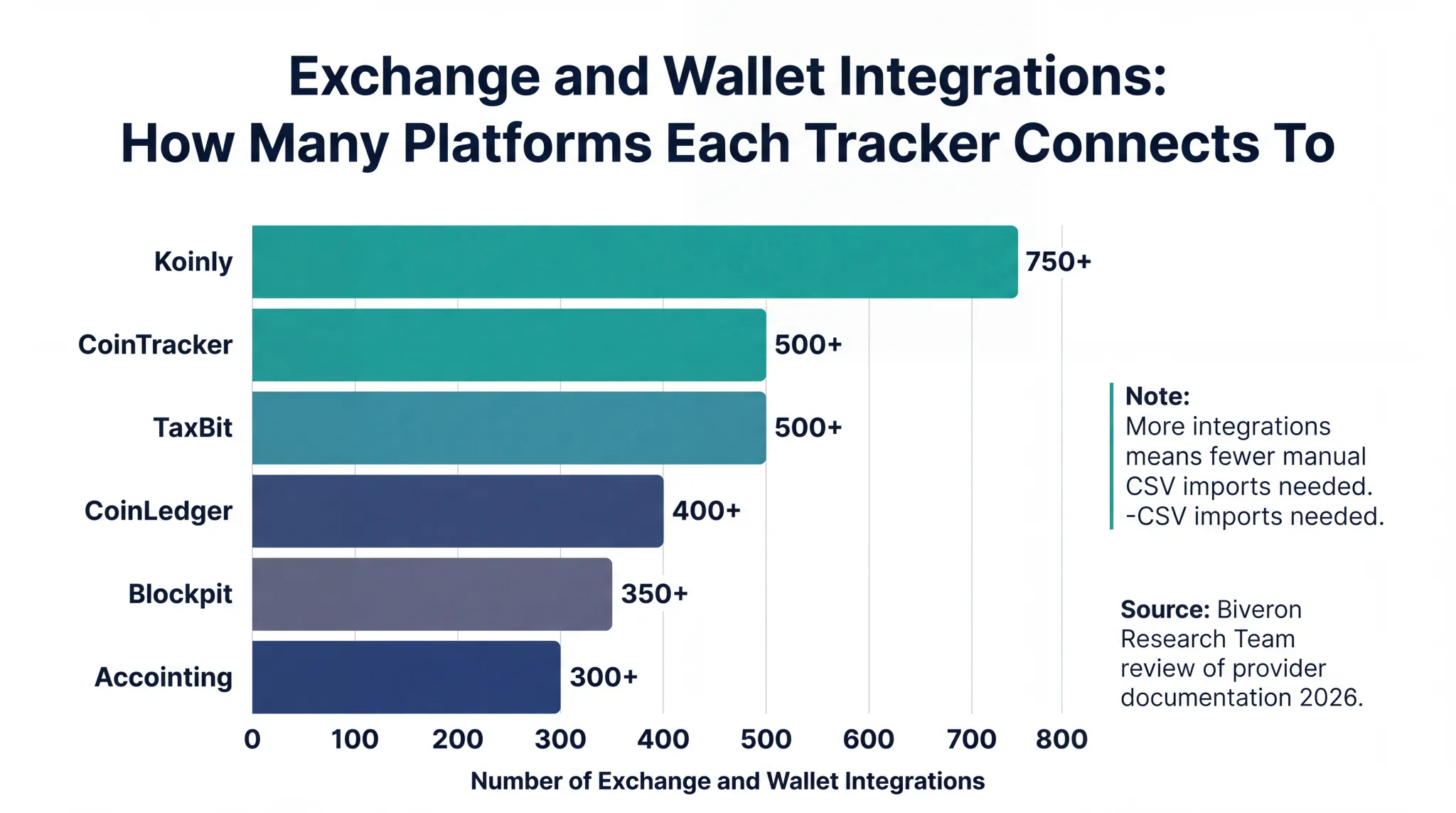
Koinly is the most widely used crypto tax software among individual investors in both the US and UK in 2026 and delivered the strongest overall performance in our evaluation across both markets. Its integration count of over 750 exchanges, wallets, and blockchain networks is the broadest in this comparison, which is significant because every exchange or wallet that cannot be imported automatically requires a manual CSV upload that adds time and potential error to the process. Koinly supports automatic blockchain imports for Ethereum, Bitcoin, Solana, Polygon, and many other networks by simply entering a wallet address, which means that even complex multi-chain portfolios can be imported without manual transaction downloads for supported chains.
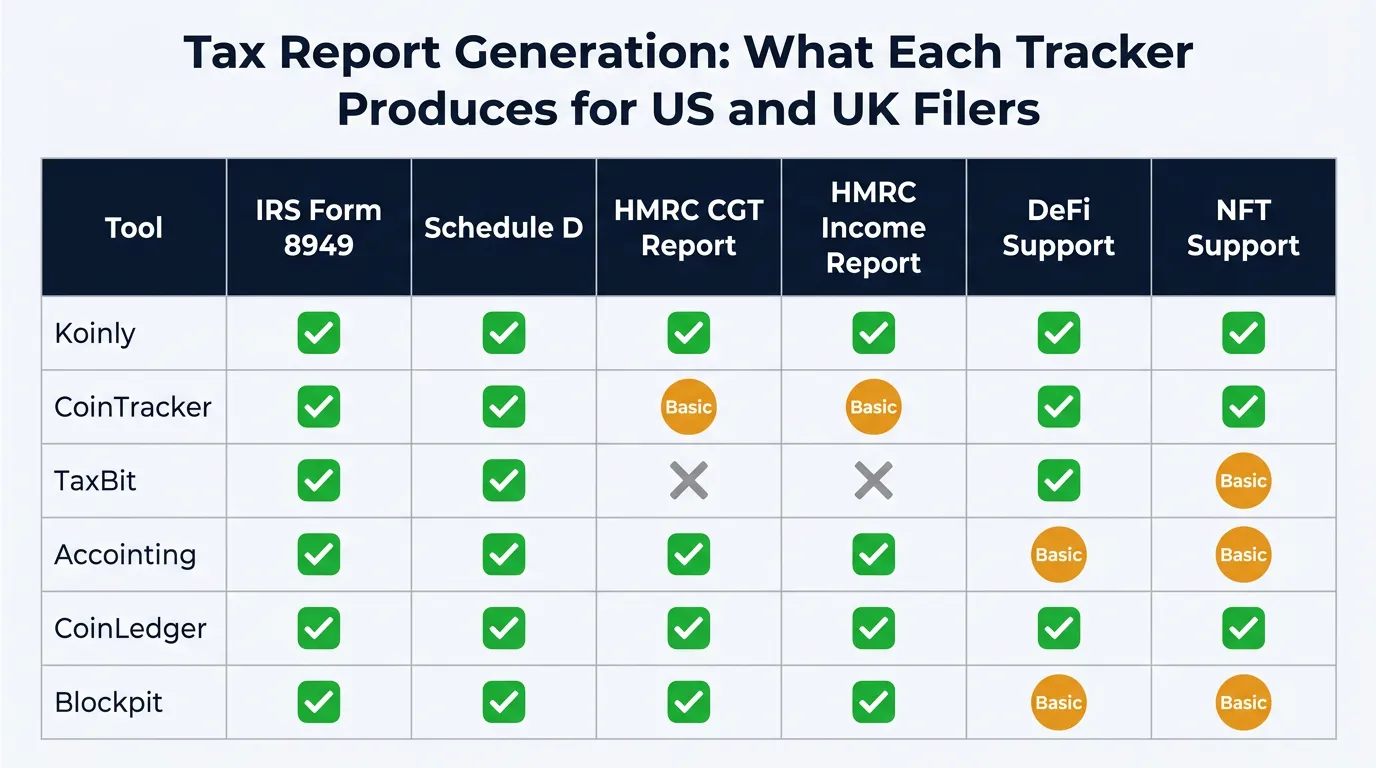
For US investors, Koinly generates IRS Form 8949 and Schedule D in both PDF and TurboTax-compatible formats. For UK investors, it generates an HMRC-compatible capital gains tax report applying the Section 104 Pool calculation, same-day rule, and 30-day rule correctly, along with an income report covering staking rewards, mining income, and airdrops. The UK tax calculation accuracy was tested against manually calculated examples and produced correct results across all test scenarios including the 30-day bed and breakfasting rule, which several competing platforms handle incorrectly.
Koinly’s pricing in 2026 starts at 49 US dollars per year for investors with up to 100 transactions, rising to 99 US dollars for up to 1,000 transactions and 179 US dollars for up to 3,000 transactions. A free tier allows portfolio tracking and tax preview without generating downloadable tax reports. The pricing is per tax year, so investors need to subscribe for each tax year for which they need tax reports.
CoinTracker
CoinTracker has the strongest native integration with Coinbase, which is the most widely used crypto exchange among US retail investors, and its partnership with TurboTax makes it a natural choice for US investors who file their own returns through TurboTax. The direct TurboTax import means US investors can transfer their crypto gains and losses data directly into their TurboTax return without manually transcribing Form 8949 figures, which reduces the risk of transcription errors and saves meaningful time during filing.
CoinTracker supports over 500 exchange and wallet integrations in 2026 and generates accurate IRS Form 8949 output. Its UK HMRC reporting is functional but less developed than Koinly’s, with the Section 104 Pool calculation supported but some edge cases around the 30-day rule and complex DeFi transactions handled less accurately than the UK-specialist alternatives in this comparison.
For US investors primarily using Coinbase and TurboTax who want the smoothest possible filing experience, CoinTracker is the strongest recommendation. For UK investors or investors with complex DeFi activity, Koinly or CoinLedger provide better-matched capabilities. Pricing starts at 59 US dollars per year for up to 100 transactions.
TaxBit
TaxBit is positioned at the higher end of this market with enterprise features and compliance tooling designed for investors with high transaction volumes and complex reporting needs. In 2026, TaxBit offers automated IRS Form 8949 generation, integrations with major US exchanges, and compliance reporting features that appeal to investors who treat crypto tax compliance as a serious year-round activity rather than a once-per-year filing exercise.
TaxBit’s limitation for UK and European investors is that its tax calculation engine is primarily designed around US IRS requirements. UK HMRC reporting and HMRC-specific calculation rules including the Section 104 Pool are not among TaxBit’s primary capabilities in 2026, making it a suboptimal choice for UK investors who would be better served by Koinly, Accointing, or Blockpit.
Pricing for TaxBit starts at approximately 50 US dollars per year for basic plans and rises significantly for higher transaction volumes and enterprise features. The platform is most appropriate for high-volume US investors who need reliable IRS-compliant reporting and are willing to pay a premium for the robustness of the compliance tooling.
Accointing
Accointing delivers the strongest portfolio visualization and performance analytics of the platforms in this comparison. Where Koinly and CoinTracker are primarily tax-focused tools that also show portfolio performance, Accointing presents portfolio performance as a primary feature with tax reporting as an important secondary capability. For investors who want a comprehensive view of their portfolio’s historical performance, asset allocation, and profit and loss across different time periods alongside tax reporting, Accointing’s dashboard is the most fully featured.
The tax calculation in Accointing supports both US IRS and UK HMRC requirements, with Section 104 Pool calculation for UK investors. DeFi and NFT transaction support is present but less developed than Koinly’s for complex transaction types. Pricing starts at 79 US dollars per year for the basic tax plan.
CoinLedger
CoinLedger, formerly known as CryptoTrader.Tax, has built a strong reputation specifically for handling complex transaction types including DeFi interactions, NFT sales, liquidity pool activity, and cross-chain bridges. For investors whose portfolios are heavily weighted toward DeFi protocols, NFT trading, or other non-standard transaction types that simpler platforms struggle to categorize correctly, CoinLedger’s specialized handling of these transaction types provides meaningful accuracy advantages over platforms with more basic DeFi support.
CoinLedger generates IRS Form 8949 for US investors and HMRC CGT and income reports for UK investors, and its UK tax calculation includes the Section 104 Pool, same-day rule, and 30-day rule. The platform integrates with TurboTax and TaxAct for direct filing for US investors. Pricing starts at 49 US dollars per year for up to 100 transactions, rising to 299 US dollars for up to 5,000 transactions.
Blockpit
Blockpit is an Austrian-founded platform with particularly strong tax calculation support for European jurisdictions and the UK. Its UK HMRC reporting in 2026 is among the most accurate tested for the mandatory UK matching rules, and the platform has invested specifically in ensuring that the Section 104 Pool calculation, same-day rule, and 30-day rule are applied correctly even in complex scenarios. For UK investors who want a platform that has specifically invested in UK tax calculation accuracy rather than treating UK support as a secondary market, Blockpit is worth evaluating alongside Koinly.
Blockpit’s exchange integration count of approximately 350 is lower than Koinly’s 750 plus, which may require more manual CSV imports for investors using less common exchanges. Its US IRS reporting is functional but its primary market focus is European jurisdictions. Pricing starts at 79 US dollars equivalent per year for the basic plan.
Full Feature and Pricing Comparison
| Tool | Annual Price Range | Exchange Integrations | IRS Form 8949 | HMRC CGT Report | UK Section 104 Pool | DeFi Support | NFT Support | Free Plan | Best For |
|---|---|---|---|---|---|---|---|---|---|
| Koinly | $49 to $179/year | 750 plus | Yes | Yes, strong | Yes, accurate | Yes, strong | Yes | Yes, preview only | Best overall US and UK |
| CoinTracker | $59 to $199/year | 500 plus | Yes, TurboTax integration | Basic | Basic | Yes | Yes | Yes, limited | US Coinbase and TurboTax users |
| TaxBit | $50 to $500/year | 500 plus | Yes, strong | No | No | Yes | Basic | No | High-volume US investors |
| Accointing | $79 to $199/year | 300 plus | Yes | Yes | Yes | Basic | Basic | Yes, preview | Portfolio visualization focus |
| CoinLedger | $49 to $299/year | 400 plus | Yes, TurboTax and TaxAct | Yes | Yes | Yes, strongest | Yes, strong | Yes, preview | DeFi and NFT heavy portfolios |
| Blockpit | $79 to $299/year | 350 plus | Yes | Yes, strong | Yes, accurate | Basic | Basic | Yes, preview | UK and European investors |
Real World Example: What a Portfolio Tracker Saved One UK Investor
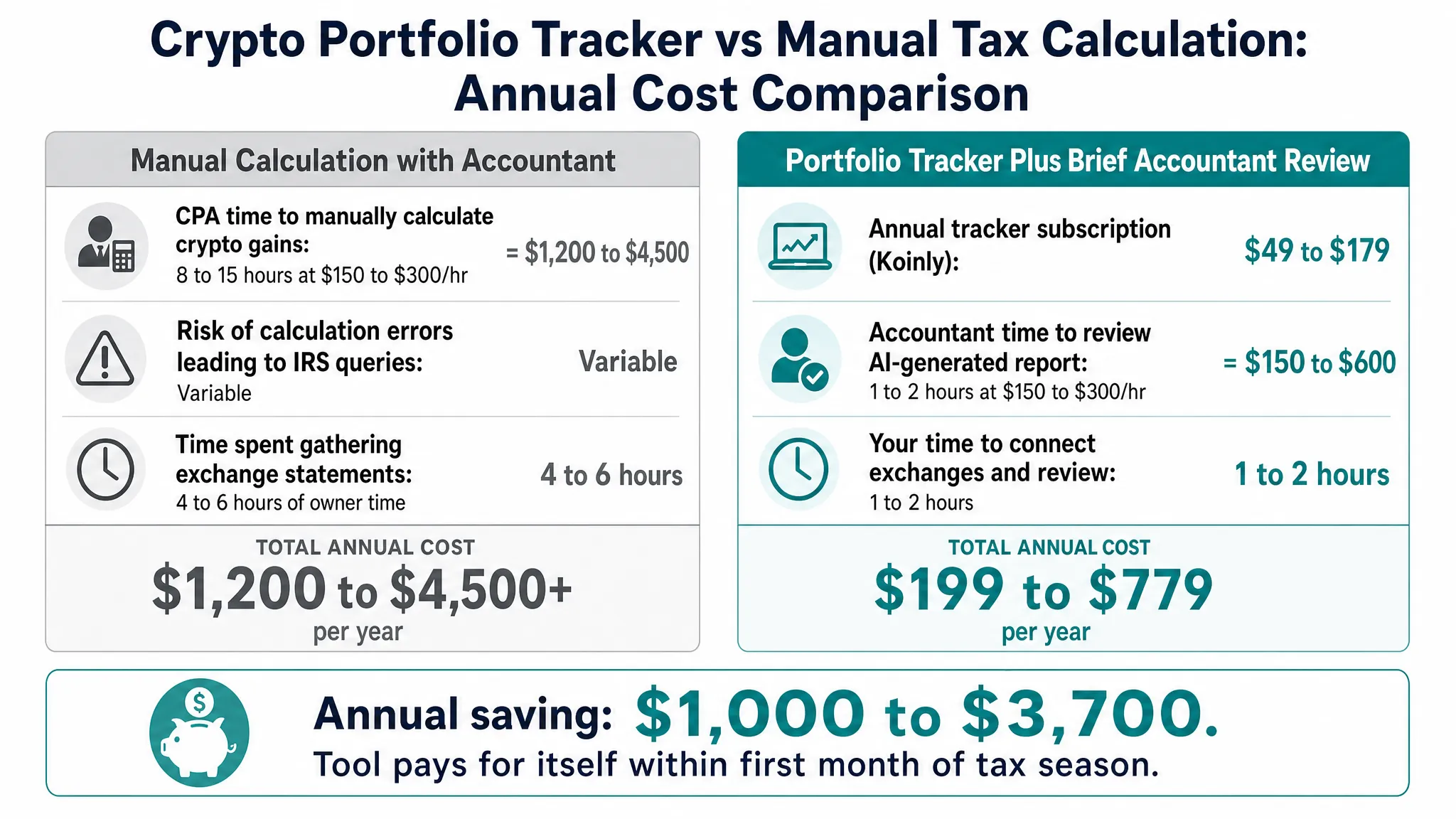
A UK-based software developer who had been actively trading crypto since 2021 across four exchanges, holding assets in two hardware wallets, and participating in staking on Ethereum faced a significant compliance challenge for the 2024 to 2025 tax year. Their transaction history included approximately 340 trades across the four exchanges, 180 staking reward events across the year, six DeFi liquidity pool interactions, and three NFT sales. Calculating the correct HMRC CGT liability manually, applying the Section 104 Pool calculation, the same-day rule, and the 30-day rule to the combined transaction history across all platforms, was estimated by their accountant to require 12 to 15 hours of professional time at 200 GBP per hour.
After subscribing to Koinly at 179 US dollars for the 3,000 transaction plan, the investor connected all four exchanges via API and imported the two hardware wallet histories by entering the wallet addresses. Koinly automatically fetched and categorized the transaction history, flagged 23 transactions requiring manual review for categorization, and applied the UK tax calculation rules to the complete dataset. The manual review and categorization of the flagged transactions took approximately two hours. The generated HMRC CGT report and income summary were then shared with the accountant for a one-hour review at 200 GBP.
Total cost using Koinly: approximately 179 US dollars plus 200 GBP for the accountant review, compared to the estimated 2,400 to 3,000 GBP for full manual accountant calculation. The saving was approximately 2,000 GBP on a single tax year’s compliance work, with the additional benefit of having a complete auditable transaction record maintained throughout the year rather than needing to reconstruct it at filing time.
How to Choose the Right Crypto Portfolio Tracker
The right tracker for your situation depends on four factors: your tax jurisdiction, the complexity of your transaction history, the exchanges and wallets you use, and whether you need professional-grade reports for an accountant or self-filing reports for direct submission.
For US investors with straightforward portfolios primarily on Coinbase or Binance US and filing through TurboTax, CoinTracker’s native Coinbase integration and TurboTax partnership provide the smoothest filing experience. For US investors with complex DeFi activity, CoinLedger’s specialized DeFi handling produces more accurate results. For high-volume US traders needing robust compliance infrastructure, TaxBit is worth evaluating at the premium pricing tier.
For UK investors, Koinly is the default recommendation for its combination of broad exchange integrations, accurate Section 104 Pool calculation, and competitive pricing. Blockpit is worth evaluating specifically for UK investors who want a platform that has invested particularly in UK tax accuracy. CoinLedger is the strongest option for UK investors with significant DeFi or NFT activity.
Regardless of which platform you choose, the principle that applies universally is that the portfolio tracker prepares the data and generates the draft report, but the responsibility for the accuracy of what you file with the IRS or HMRC rests with you as the taxpayer. A brief review by a qualified accountant familiar with crypto tax, even if only for one to two hours, provides meaningful assurance on the output of any automated tool and is advisable for investors with significant gains or complex transaction histories. For specific guidance on what each jurisdiction requires, see our full US crypto tax guide and UK crypto tax guide.
Frequently Asked Questions
Do I need a portfolio tracker if I only hold Bitcoin and Ethereum on one exchange?
For investors with very simple holdings, limited trades, and a single exchange, the portfolio tracker platforms in this comparison offer a free preview tier that allows you to assess whether the tool adds value before paying. If your annual transaction count is under 20 and consists only of straightforward buy and sell trades on a single exchange, manually calculating your gains from exchange transaction history is feasible and a paid tracker subscription may not be necessary. However, even modest complexity such as staking rewards, a second exchange, or a hardware wallet quickly makes manual calculation unreliable. The free preview tiers of Koinly and CoinLedger allow you to import your transaction history and preview your tax position before deciding whether the paid report is worth the subscription cost.
How accurate are crypto portfolio trackers for DeFi transactions?
DeFi transaction accuracy varies significantly between platforms and is one of the most meaningful differentiators in this category in 2026. Simple DeFi swaps on major protocols like Uniswap and Aave are handled accurately by all platforms in this comparison. Complex interactions including liquidity pool deposits and withdrawals with impermanent loss calculations, cross-chain bridge transactions, yield farming reward claims, and protocol-specific tokenomics events are handled with varying accuracy by different platforms. CoinLedger has the most developed DeFi classification engine of the platforms tested. For investors with significant DeFi activity, testing the specific protocols you use during the free trial period is essential before committing to a paid plan, as the accuracy of DeFi classification for your specific protocols may vary significantly between platforms.
Can I use one tracker for both my US and UK tax obligations?
If you have tax obligations in both the US and UK, which may apply to US citizens living in the UK or UK residents with US tax filing requirements, you need a tracker that supports both US IRS and UK HMRC reporting formats accurately. Koinly and CoinLedger both support both jurisdictions and can generate reports in both formats from the same transaction dataset. However, investors with dual US and UK tax obligations have complex compliance situations that go beyond what any automated tool can fully handle. Engaging a specialist accountant or tax adviser with experience in dual US and UK crypto tax obligations is strongly advisable for this situation, as the interaction between the two tax systems creates specific planning considerations that automated tools do not address.
What happens if my exchange is not supported by the portfolio tracker?
When an exchange is not directly integrated with a portfolio tracker, most platforms support manual import through CSV files exported from the exchange. The process involves downloading your transaction history from the exchange in the supported format and uploading it to the tracker. The CSV import process typically takes 15 to 30 minutes per exchange and produces the same output as an automated integration once the data is imported. The limitation of CSV imports compared to API integrations is that they require manual re-import whenever you want to update your transaction history with recent activity, whereas API integrations sync automatically. For exchanges with no CSV export capability, manual transaction entry is the fallback option, which is time-consuming for large transaction histories.
Should I still use an accountant if I use a crypto portfolio tracker?
For most investors with significant crypto activity, yes. The portfolio tracker automates the calculation work and generates draft tax reports that are substantially more accurate than manual calculation. The accountant’s role shifts from performing the calculation to reviewing the output, verifying that transaction categorizations are correct, addressing any complex or ambiguous transactions that the automated system may have handled incorrectly, and ensuring that the crypto gains and losses are correctly integrated into the overall tax return. For US investors with crypto as a small portion of a more complex tax situation, and for UK investors with significant gains or DeFi activity, a one to two hour accountant review of tracker-generated output is a proportionate and worthwhile investment. For very simple situations with minimal gains, the tracker output may be sufficient for direct self-filing without professional review.
Latest Research


1 thought on “Best Crypto Portfolio Trackers for US and UK Investors in 2026: Ranked and Compared”
Comments are closed.