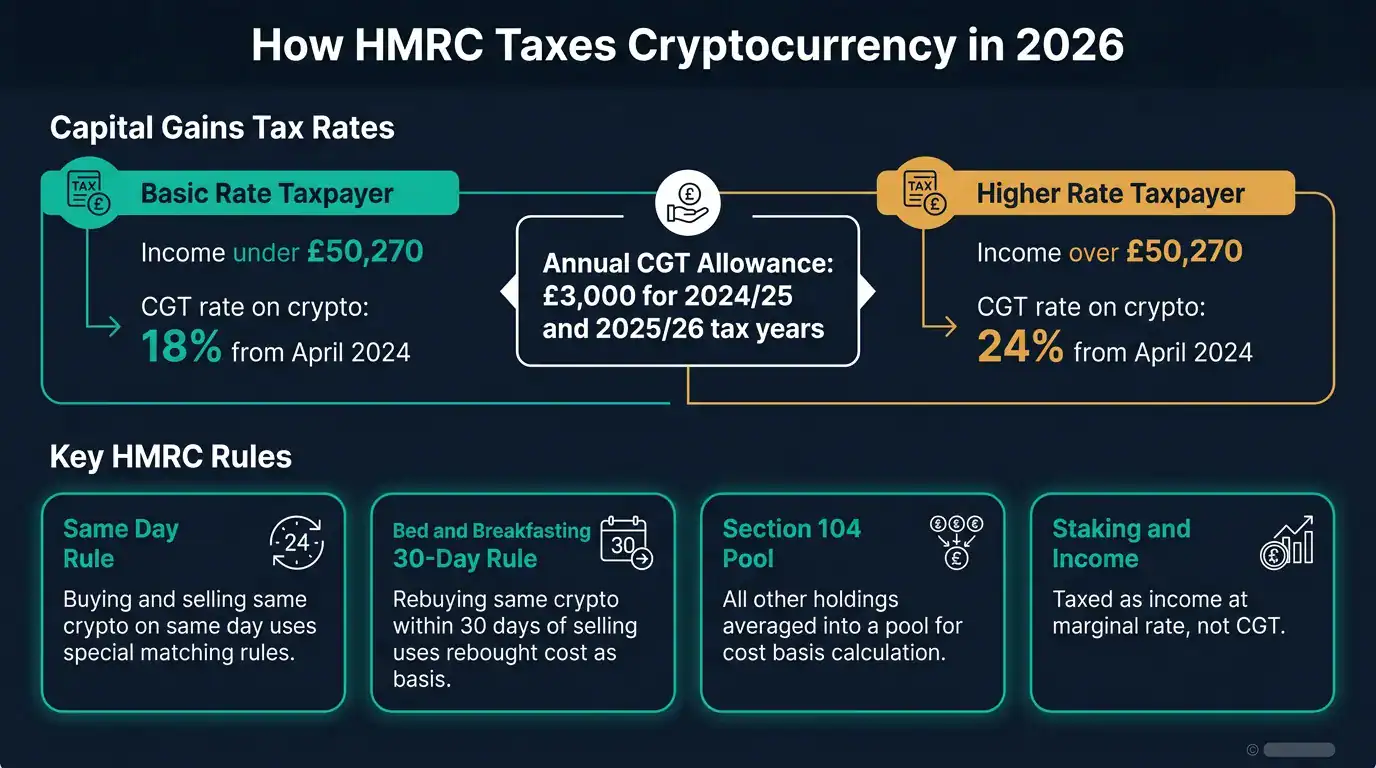
The UK crypto tax landscape changed significantly between 2022 and 2026, and not in a direction that favors investors who have been treating their digital asset activity as informally as they might have in the early days of cryptocurrency in Britain. The annual Capital Gains Tax allowance has been reduced from 12,300 pounds in 2022/23 to 3,000 pounds from 2024/25 onwards. CGT rates on crypto gains were increased to 18 percent for basic rate taxpayers and 24 percent for higher rate taxpayers in the October 2024 Budget. HMRC has implemented mandatory data sharing with crypto platforms operating in the UK and European Union through the DAC8 framework, meaning the agency is now receiving transaction data on UK crypto investors from exchanges directly. For UK investors who have not been fully reporting their crypto activity, the risk profile of that decision has increased substantially. This guide explains exactly how HMRC taxes cryptocurrency in 2026, which transactions require reporting, how to calculate your obligations correctly, and what the consequences of non-compliance look like in the current enforcement environment.
What This Guide Covers
This article is written for UK residents and domiciles who hold, trade, or earn cryptocurrency and need to understand their tax obligations under HMRC rules in 2026. It covers how HMRC classifies cryptoassets, which transactions trigger taxable events, the three mandatory matching rules that determine how gains are calculated, which forms to complete for Self Assessment, and how HMRC’s enforcement capabilities have evolved. It does not constitute tax advice. Cryptocurrency tax obligations in the UK depend on individual circumstances including residency status, domicile, the nature of trading activity, and whether activities are classified as trading or investment. Always consult a qualified accountant or tax adviser familiar with UK cryptoasset taxation before filing your return. For US investors looking for equivalent guidance, see our crypto tax guide for US investors in 2026.
How HMRC Classifies Cryptocurrency
HMRC’s position on the tax treatment of cryptoassets, established in its Cryptoassets Manual and updated progressively since 2018, treats most cryptocurrency held by individuals as a capital asset for tax purposes. This means that buying and selling cryptocurrency is subject to Capital Gains Tax rules in the same way as selling shares or investment property, rather than being treated as currency exchange or as a form of gambling.
The capital asset classification applies to Bitcoin, Ethereum, and the vast majority of other cryptocurrencies held as investments. There is a specific exception for crypto that is genuinely traded as a business activity at a professional level, where HMRC may classify the activity as a trade subject to Income Tax rather than CGT. However, HMRC takes the view that most individual crypto investors, even those who trade frequently, are engaged in investment activity rather than a trade for tax purposes. The distinction matters because trading income is subject to Income Tax and National Insurance contributions rather than CGT, which can produce meaningfully different tax outcomes depending on your income level and the size of your gains.
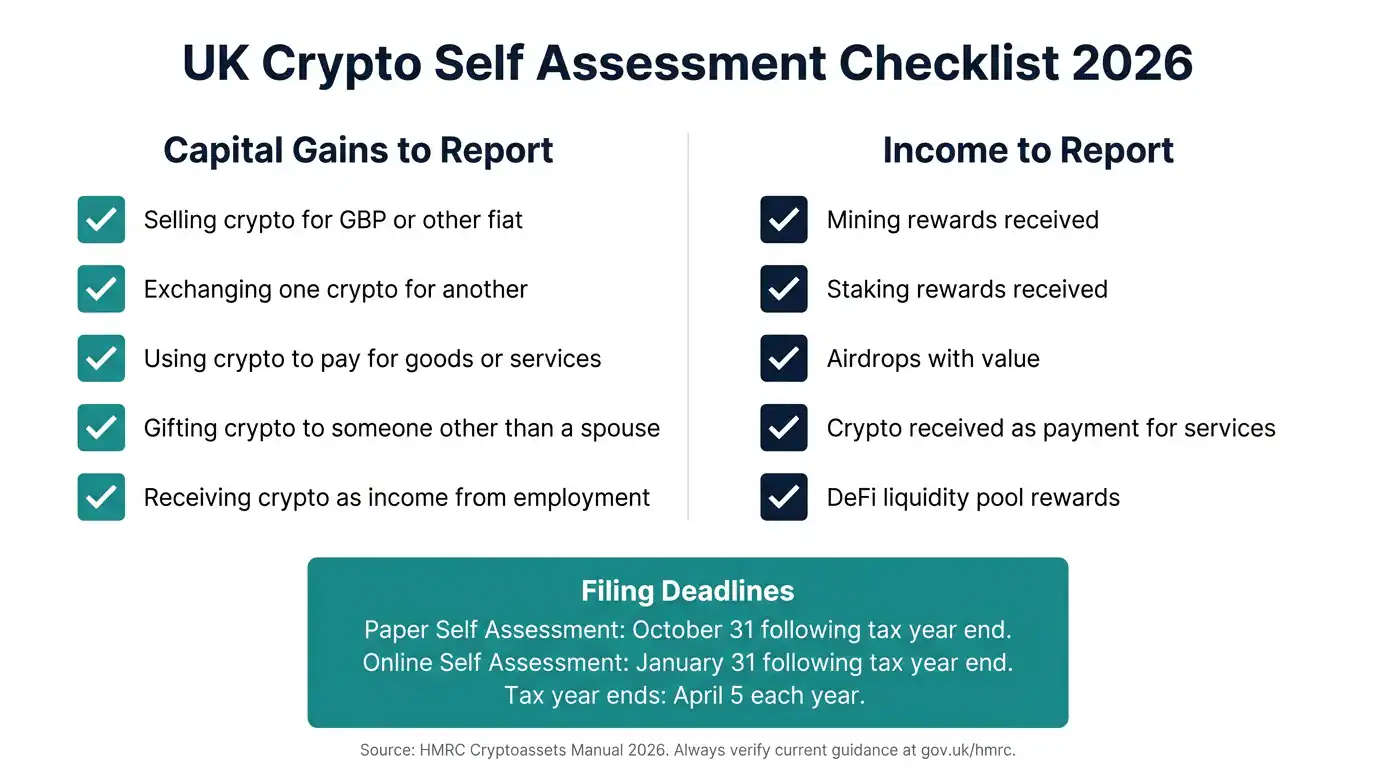
Certain crypto activities are treated as income rather than capital gains regardless of whether the overall activity is classified as investment or trading. Mining rewards, staking rewards, airdrops that represent payment for services, and crypto received as employment income are all treated as income subject to Income Tax at your marginal rate in the tax year of receipt. This income then establishes the cost basis for any future capital gains calculation when the received crypto is later disposed of.
Why 2026 Is a Critical Year for UK Crypto Tax Compliance
Several developments make 2026 particularly significant for UK crypto investors from a compliance perspective.
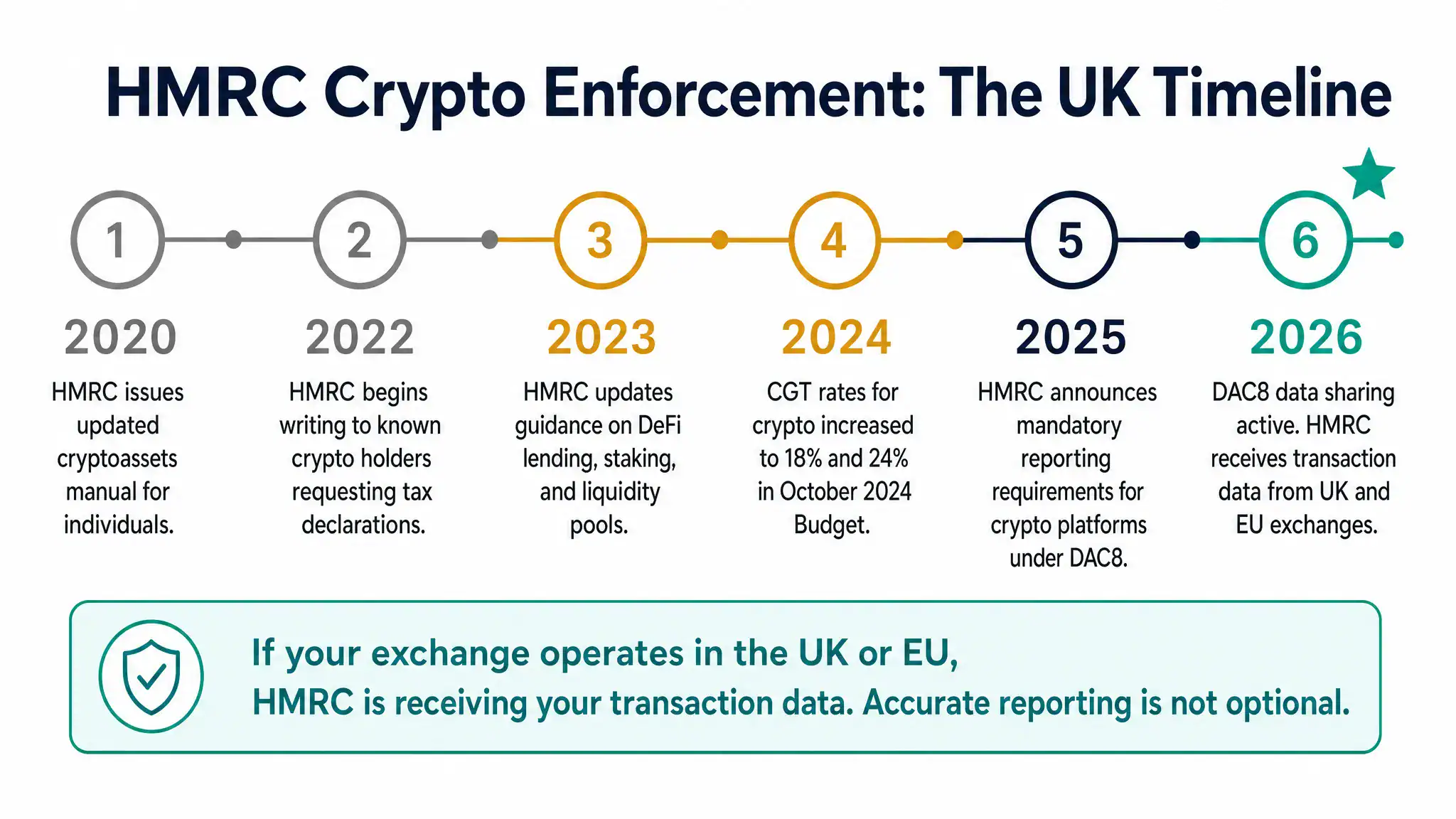
The DAC8 Directive, which requires crypto asset service providers operating in the European Union to report user transaction data to tax authorities, has been implemented with information sharing arrangements extending to UK HMRC under the post-Brexit tax cooperation framework. This means that UK investors using EU-based exchanges, as well as UK-regulated exchanges that have voluntarily adopted similar reporting standards, are having their transaction data shared with HMRC directly. The era of crypto transactions being effectively invisible to HMRC for investors using major exchanges is ending.
HMRC has also significantly expanded its use of data analytics capabilities for cryptoasset compliance. The agency has published information about its use of blockchain analytics tools and its capacity to trace transaction flows across public blockchains, and has indicated that it cross-references exchange data with Self Assessment returns to identify investors whose reported gains do not match the transaction records it holds.
The reduction in the annual CGT allowance from 12,300 pounds to 3,000 pounds has brought many investors who were previously covered by the allowance into reporting territory. An investor with 5,000 pounds in crypto gains who paid no tax in 2022/23 because the full amount was covered by the then-current allowance now has a 2,000 pound taxable gain at the same activity level. Many investors have not adjusted their compliance behaviour to reflect this change.
The Three Matching Rules: How HMRC Calculates UK Crypto Gains
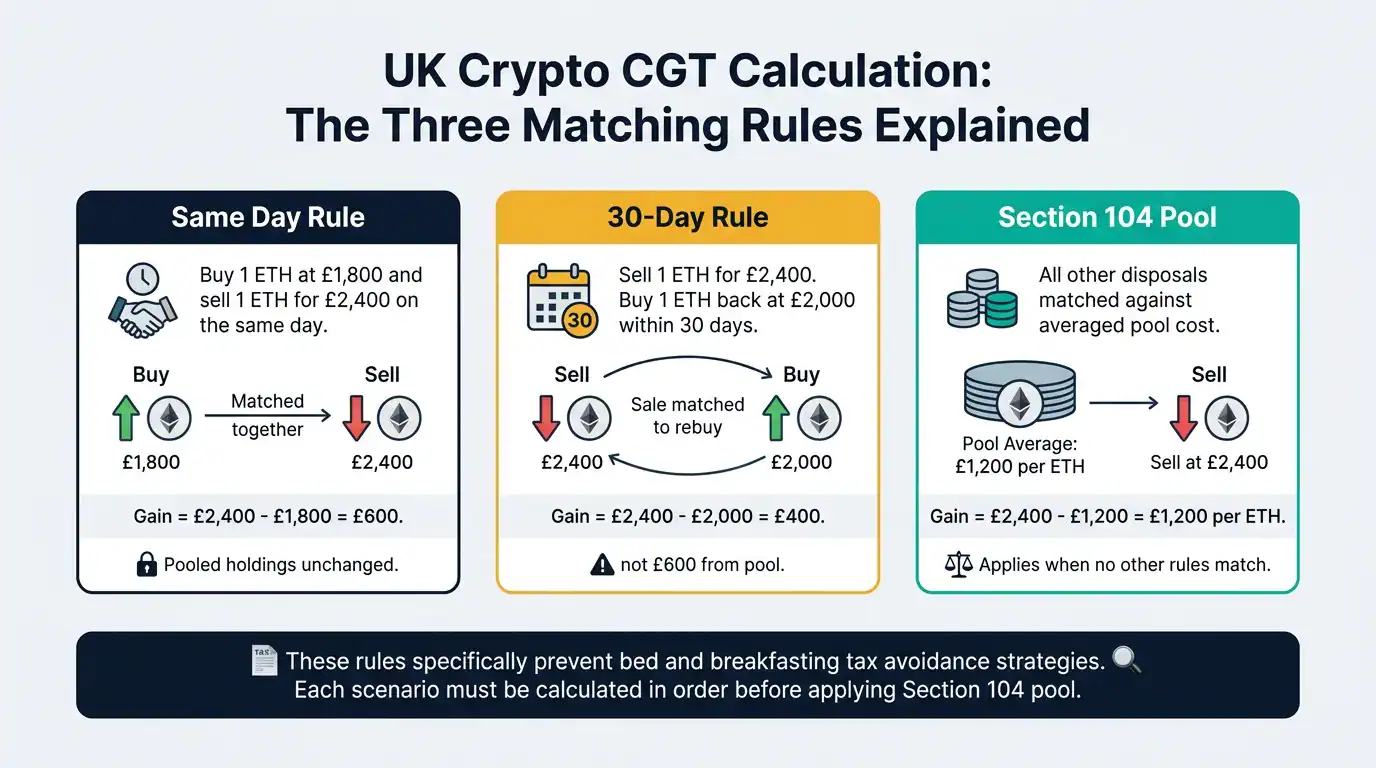
The most distinctive and frequently misunderstood aspect of UK crypto capital gains calculation is the mandatory matching rule system, which determines which acquisition cost is used when calculating the gain on a disposal. Unlike the US system where investors can choose between FIFO, HIFO, and specific identification methods, UK investors must apply three rules in a specific order regardless of their preference.
Rule 1: Same Day Rule
When an investor both acquires and disposes of the same cryptoasset on the same day, the disposal is matched against the same-day acquisition first. This prevents investors from using intraday price fluctuations to manufacture artificial gains or losses by buying and selling on the same day. If you sell 1 Bitcoin and buy 1 Bitcoin on the same day, the sale is matched against the same-day purchase rather than against your existing pool of Bitcoin holdings.
Rule 2: Bed and Breakfasting Rule (30-Day Rule)
If an investor disposes of a cryptoasset and then acquires the same cryptoasset within 30 days after the disposal, the disposal is matched against the later acquisition rather than against the existing pool. This rule specifically prevents the bed and breakfasting tax planning strategy, where investors sell an asset to crystallize a gain or loss and immediately repurchase it to reset their cost basis. If you sell 1 Ethereum for 2,400 pounds and buy 1 Ethereum back at 2,000 pounds within 30 days, your disposal is matched against the repurchase at 2,000 pounds, producing a gain of 400 pounds, not the larger gain that would result from matching against your original lower cost basis.
Rule 3: Section 104 Pool
All acquisitions and disposals that are not matched under Rules 1 or 2 are accounted for through the Section 104 Pool, which treats all holdings of the same cryptoasset as a single pool with an averaged cost basis. Each time you acquire more of a cryptoasset, the total cost of the pool increases by the acquisition cost. Each time you dispose of some of the cryptoasset, you calculate the gain or loss by comparing the disposal proceeds against the relevant proportion of the pool’s total cost. The Section 104 Pool is the mechanism that applies to the vast majority of crypto disposals made by typical long-term investors.
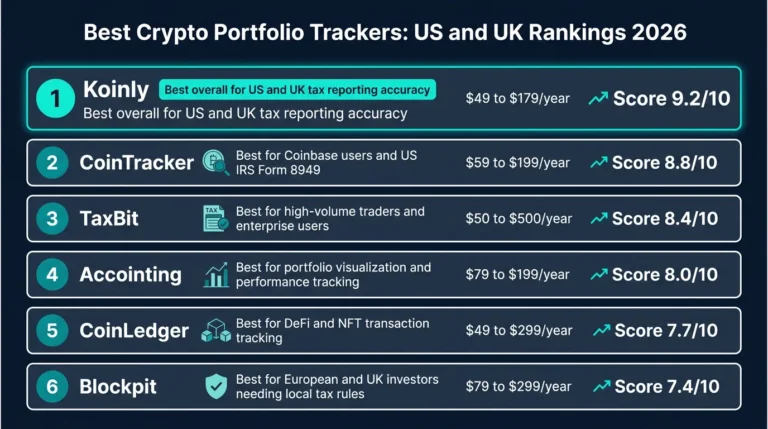
Understanding and correctly applying these three rules in order is one of the most technically demanding aspects of UK crypto tax compliance, and is a common source of errors in self-prepared returns. Dedicated crypto tax software that applies these rules automatically to imported transaction data significantly reduces the risk of calculation errors compared to manual application of the rules to a transaction history.
Which Transactions Require Reporting to HMRC
| Transaction Type | Tax Treatment | Rate | Report In | Key Consideration |
|---|---|---|---|---|
| Selling crypto for GBP or fiat | Capital Gains Tax | 18% basic rate, 24% higher rate | Self Assessment CGT pages | Apply three matching rules in order before calculating gain |
| Exchanging one crypto for another | Capital Gains Tax disposal at market value | 18% or 24% | Self Assessment CGT pages | Treated as two transactions: disposal of first and acquisition of second at market value |
| Using crypto to buy goods or services | Capital Gains Tax disposal | 18% or 24% | Self Assessment CGT pages | Market value of goods or services received is the disposal proceeds |
| Gifting crypto to another person | Capital Gains Tax disposal at market value | 18% or 24% | Self Assessment CGT pages | Transfers between spouses and civil partners are exempt. Gifts to others use market value as proceeds. |
| Mining rewards | Income Tax if trading activity, miscellaneous income otherwise | 20% to 45% plus NI | Self Assessment income pages | Business miners can deduct equipment and electricity costs against mining income |
| Staking rewards | Income Tax as miscellaneous income on receipt | 20% to 45% | Self Assessment income pages | Value at receipt establishes cost basis for future CGT calculation on disposal |
| Airdrops | Income Tax if received for services, possibly CGT if unsolicited | Depends on classification | Self Assessment income or CGT pages | HMRC guidance on airdrop treatment is nuanced. Professional advice advisable for significant airdrops. |
| Transfer between own wallets | Not a disposal, no tax event | None | Not required | Maintain records proving both wallets belong to you. Transfer fees may adjust pool cost. |
| Buying crypto with GBP | Not a disposal, establishes cost basis | None | Not required, but keep records | Acquisition cost including fees enters the Section 104 Pool for future calculations |
| DeFi liquidity pool activity | Complex, HMRC guidance updated 2023 | Varies by activity structure | Self Assessment as appropriate | Professional advice strongly recommended for DeFi activity given evolving HMRC guidance |
Real World Example: Calculating UK Crypto CGT Correctly
A worked example makes the Section 104 Pool calculation concrete. Consider a UK higher rate taxpayer who has made the following Bitcoin transactions over two tax years.
In 2023/24 they purchased 0.5 Bitcoin for 12,000 pounds including fees in October 2023. In February 2024 they purchased a further 0.3 Bitcoin for 9,000 pounds. Their Section 104 Pool at the end of 2023/24 contains 0.8 Bitcoin with a total pooled cost of 21,000 pounds, giving an average cost per Bitcoin of 26,250 pounds.
In 2025/26 they sell 0.4 Bitcoin for 22,000 pounds in November 2025. There are no same-day purchases and no repurchases within 30 days, so Rule 3 applies. The allowable cost for the 0.4 Bitcoin disposed of is 0.4 divided by 0.8 multiplied by 21,000 pounds, which equals 10,500 pounds. The capital gain is 22,000 pounds minus 10,500 pounds, giving 11,500 pounds. After deducting the 3,000 pound annual CGT allowance, the taxable gain is 8,500 pounds. At the higher rate of 24 percent, the CGT liability is 2,040 pounds.
The Section 104 Pool is then updated: 21,000 pounds minus 10,500 pounds leaves a remaining pool cost of 10,500 pounds covering the remaining 0.4 Bitcoin. This updated pool figure carries forward for any future disposals.
The calculation is mathematically straightforward but becomes significantly more complex when there are hundreds of transactions across multiple cryptoassets, staking rewards establishing new cost bases, and same-day or 30-day rule matches to apply. This is why crypto tax software that maintains the Section 104 Pool automatically for all assets simultaneously is genuinely useful for investors with more than minimal transaction history.