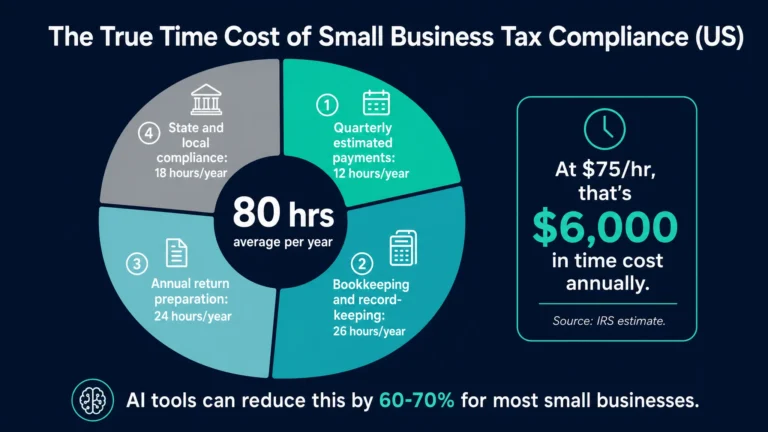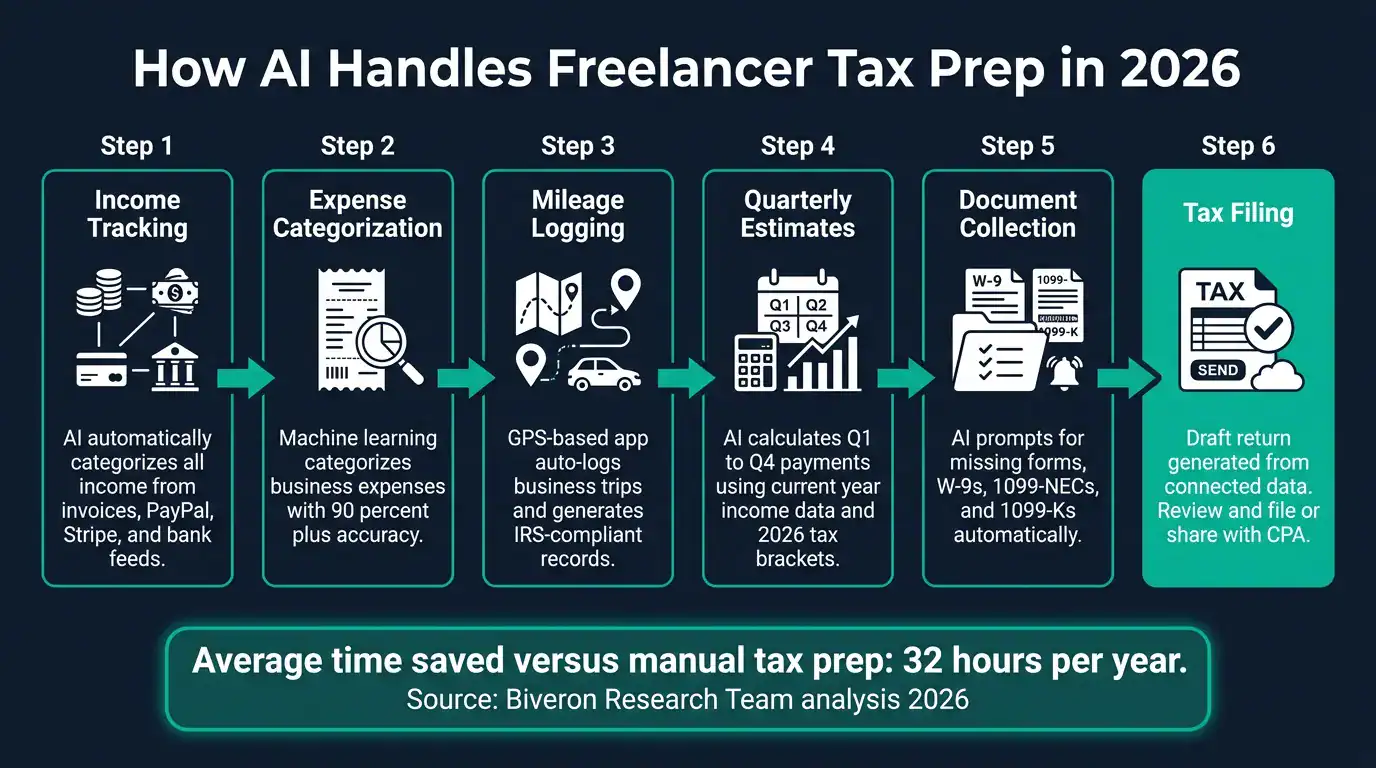
Tax preparation for US freelancers and self-employed professionals has always carried a disproportionate administrative burden compared to employed workers. The quarterly estimated payment system, self-employment tax obligations, Schedule C preparation, mileage tracking, receipt organization, and the ever-present risk of an IRS underpayment penalty combine to create a compliance workload that routinely consumes 30 to 40 hours per year for freelancers who manage it manually. In 2026, AI tax tools have meaningfully changed what that workload looks like. Not by replacing the need for professional judgment on complex matters, but by automating the data gathering, categorization, calculation, and reminder functions that consume the majority of that time. This guide explains what AI tax tools are actually doing for freelancers right now, which tools are worth paying for, and where human expertise remains essential.
What This Guide Covers
This article is written for freelancers, independent contractors, and self-employed professionals in the United States who want to understand how AI tools can reduce their annual tax compliance burden without creating new risks. It covers the specific tax problems freelancers face that AI addresses most effectively, the tools available in 2026 and how they compare, a worked example showing real time savings, and the specific situations where professional tax advice remains essential regardless of which AI tools you use. For broader context on tax compliance automation, see our guide on using AI to automate tax compliance for small US businesses and our calculator for estimating quarterly tax payments as a self-employed person.
The Specific Tax Problems Freelancers Face That AI Addresses
Understanding why AI tax tools are particularly valuable for freelancers requires understanding the specific ways freelancer tax compliance differs from that of employed workers and even from that of small businesses with employees.
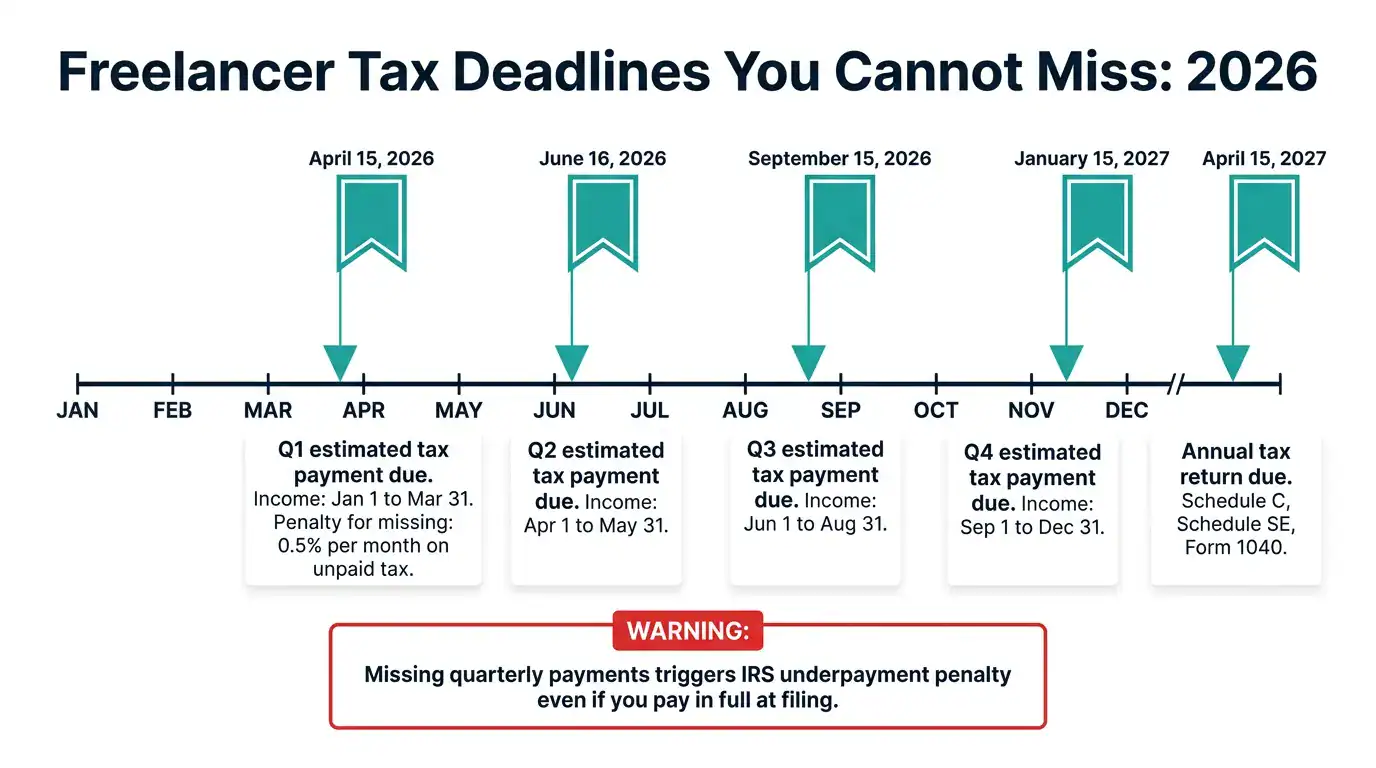
The quarterly estimated payment system is the most immediately painful difference. Employed workers have taxes withheld from every paycheck, producing a predictable, automatic compliance process that requires minimal active management. Freelancers are responsible for calculating and remitting their own quarterly estimated payments to the IRS by four deadlines throughout the year. Getting these calculations wrong, either by underpaying or missing a deadline, results in underpayment penalties regardless of whether the full amount is paid by the annual filing deadline. AI tools that maintain a running estimate of quarterly obligations based on current year income data address this problem directly and continuously rather than requiring a calculation exercise before each deadline.
The self-employment tax is the second specific burden. US freelancers pay both the employee and employer portions of Social Security and Medicare taxes, totaling 15.3 percent on net self-employment income up to the Social Security wage base of 168,600 US dollars in 2026, with the 2.9 percent Medicare component continuing above that threshold. For a freelancer netting 80,000 US dollars, the self-employment tax alone is approximately 11,300 US dollars before income tax is calculated. This is frequently underestimated by freelancers new to self-employment, and the surprise at filing time is a consistent source of cash flow problems. AI tools that incorporate self-employment tax into quarterly estimates prevent this surprise from occurring.
Income irregularity is the third complication. Employed workers with consistent salaries can rely on year-end projection from any single month. Freelancers with variable monthly income need to track actual year-to-date figures continuously to maintain accurate quarterly estimates. AI tools connected to income data provide this tracking automatically rather than requiring manual calculation each quarter.
Business expense tracking across a mix of digital and physical transactions is the fourth challenge. Freelancers have legitimate deductions across software subscriptions, home office costs, professional development, equipment, health insurance premiums, and business travel that employed workers do not manage. Capturing these accurately throughout the year requires consistent habits that most freelancers find difficult to maintain. AI expense categorization tools that connect to bank accounts and automatically classify transactions address this at the source rather than requiring a reconstruction exercise at year end.
What AI Tax Tools Are Actually Doing in 2026
The AI capabilities embedded in tax tools for freelancers in 2026 fall into five distinct functional categories, each addressing a specific part of the annual compliance burden.
Automated Income Aggregation
Modern AI tax platforms connect directly to the payment systems that freelancers typically use to receive income: bank accounts, PayPal, Stripe, Venmo for Business, and direct deposit arrangements. Transactions flowing through these channels are automatically identified as income, categorized by source, and aggregated into a running annual income total. For freelancers receiving income from multiple clients through multiple channels, this eliminates the most time-consuming part of year-end tax preparation, which is reconstructing all income sources from disparate records.
The 1099-NEC and 1099-K reporting thresholds that apply to freelancers have been adjusted in recent years, with the 1099-K threshold for platforms like PayPal and Stripe reduced to 600 US dollars from the previous 20,000 US dollar threshold, meaning more freelancer income is now formally reported to the IRS by payers. AI tools that import 1099 data directly and reconcile it against your recorded income help identify discrepancies before they become audit triggers.
Expense Categorization
AI expense categorization tools in 2026 achieve accuracy rates of 88 to 92 percent on typical freelancer business expenses after an initial learning period of four to six weeks. The remaining categorization errors are typically unusual transactions that fall outside common patterns and require brief manual review. The time saving compared to manual categorization is significant: what previously took three to four hours of monthly bookkeeping is reduced to 15 to 20 minutes of reviewing AI-generated categorizations and correcting the small proportion that require adjustment.
The deduction categories most relevant to freelancers, including home office, vehicle use, professional development, software, and health insurance premiums, require specific documentation standards that AI tools help maintain. Home office deductions, for example, require consistent documentation of the square footage used exclusively for business and the total home square footage. AI tools that prompt for this information at setup and maintain the calculation throughout the year prevent the common problem of discovering inadequate documentation when the deduction is needed at filing time.
Mileage and Vehicle Expense Tracking
GPS-based mileage tracking through AI apps represents one of the clearest time-saving automations available to freelancers in 2026. The IRS standard mileage rate for 2026 makes accurate mileage records directly valuable as deductions. Apps that use GPS to automatically detect and log trips, then prompt the user to classify each trip as business or personal, produce IRS-compliant mileage logs that would otherwise require manual record-keeping throughout the year. The classification step typically takes under ten seconds per trip. The alternative of maintaining a manual mileage log is one of the most consistently abandoned tax compliance habits among freelancers.
Quarterly Estimated Tax Calculation
AI tools that maintain a running quarterly tax estimate by connecting to current year income and expense data address the most consequential compliance risk for freelancers: underpaying quarterly estimates and incurring IRS penalties. These tools update estimates as income changes throughout the year, send reminders before each quarterly deadline, and in some cases allow direct payment to the IRS through the platform. The estimate accuracy depends on the quality of income and expense data connected to the tool, which is why income aggregation and expense categorization capabilities are more valuable when they exist within an integrated platform rather than as separate tools.
Tax Return Preparation and Filing
The most comprehensive AI tax platforms for freelancers in 2026 generate draft Schedule C, Schedule SE, and Form 1040 entries directly from the connected income and expense data, producing a near-complete draft return that requires review and verification rather than construction from scratch. For freelancers with straightforward income and expense structures, this draft is typically 80 to 90 percent complete and requires a review period of one to two hours rather than the six to eight hours that manual preparation from organized records typically requires. The remaining 10 to 20 percent typically involves judgment calls around specific deduction amounts, retirement contribution elections, and health insurance deduction calculations that benefit from professional review regardless of how the underlying data is prepared.
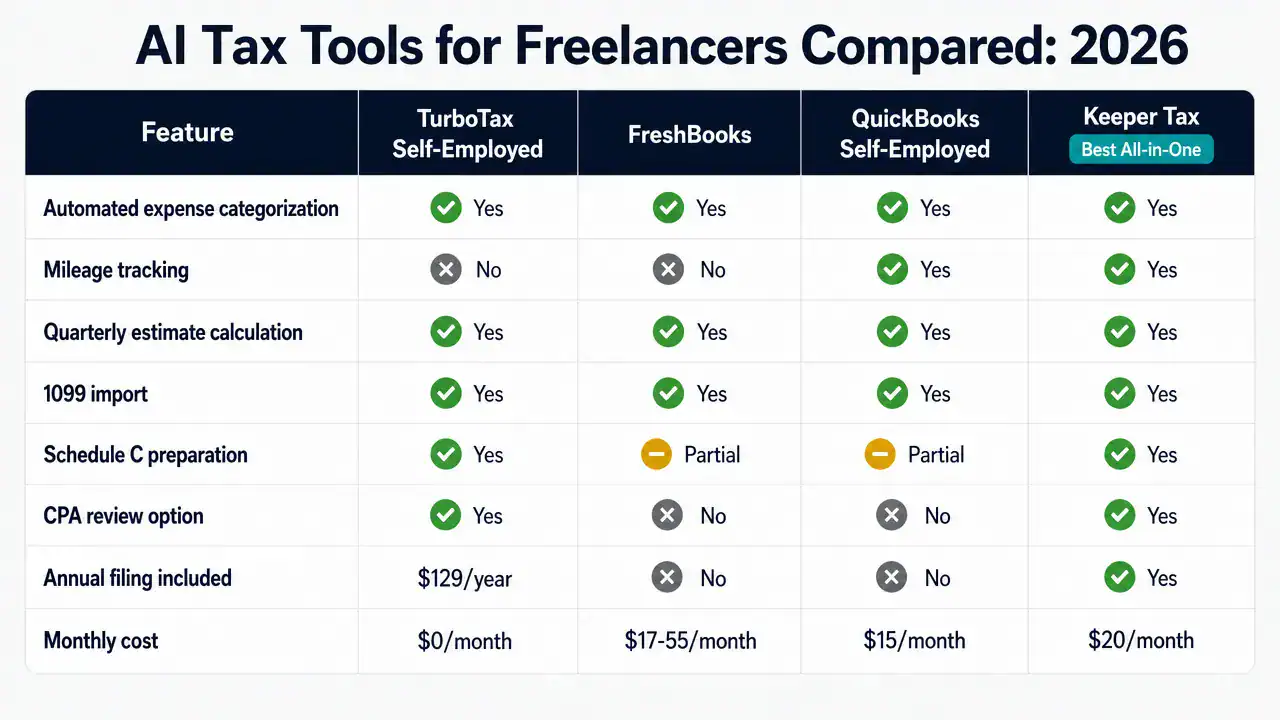
AI Tax Tools for Freelancers Compared
| Tool | Monthly Cost | Income Tracking | Expense AI | Mileage Tracking | Quarterly Estimates | Schedule C Prep | Filing Included | CPA Access |
|---|---|---|---|---|---|---|---|---|
| Keeper Tax | $20/month or $192/year | Yes | Yes, chat-based review | Yes | Yes | Yes | Yes, included | Yes, tax pro review included |
| QuickBooks Self-Employed | $15/month | Yes | Yes, automatic | Yes, built in | Yes | Partial, exports to TurboTax | No, separate cost | No |
| TurboTax Self-Employed | $129/year filing fee | Yes, imports 1099s | Basic | No | Yes | Yes, guided | Yes, included in fee | Yes, TurboTax Live add-on |
| FreshBooks | $17 to $55/month | Yes, invoice-based | Yes, automatic | No | Yes, estimates | Partial, exports data | No, separate cost | No |
| Wave | Free for accounting | Yes | Basic | No | No | No, exports for manual filing | No | No |
| Stride | Free | Basic income log | Basic | Yes, free | Yes, basic estimates | No | No | No |
Real World Example: How AI Tools Changed One Freelancer’s Tax Season
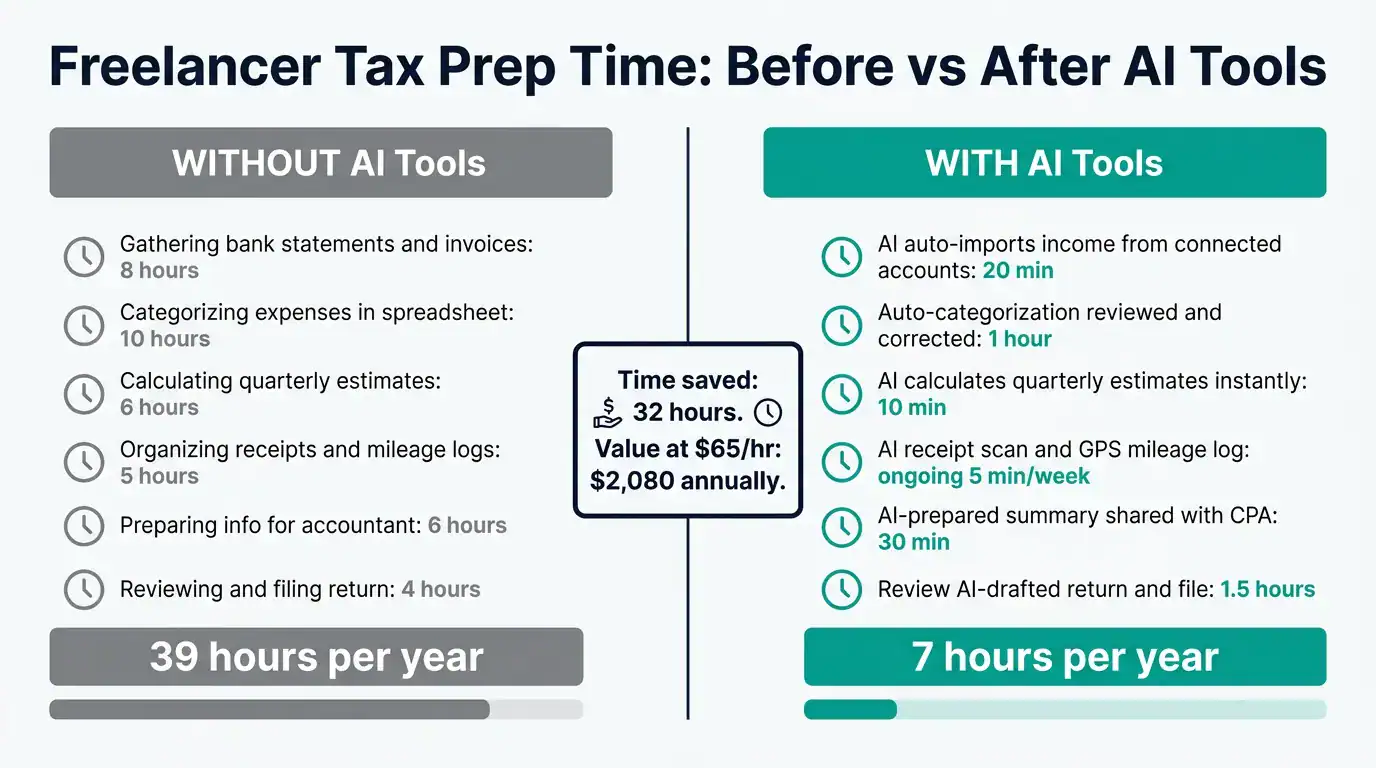
A pattern that illustrates the practical value of AI tax tools for freelancers involves a content strategist working with eight clients across a mix of direct contracts, a content platform that issues 1099-K forms, and occasional project-based payments through PayPal. In previous years, this freelancer spent approximately 39 hours annually on tax-related tasks: gathering statements from multiple sources, manually categorizing business expenses in a spreadsheet, calculating quarterly estimates in the week before each deadline using rough income projections, reconstructing mileage records from memory and calendar entries, and preparing a summary document for their accountant before filing season.
After connecting Keeper Tax to their primary bank account, PayPal account, and credit card, the same annual compliance process in 2026 takes approximately seven hours. Income from all sources is imported and aggregated automatically. Business expenses are categorized with 89 percent accuracy in the first month, requiring approximately 15 minutes of review and correction per week during the learning period and less than five minutes per week thereafter. Quarterly estimates are calculated automatically from current year data and sent as reminders two weeks before each IRS deadline. Mileage is logged automatically through the GPS app with a brief trip classification step after each business drive. The year-end package shared with the accountant is generated by the platform in 20 minutes.
The 32 hours recovered annually at this freelancer’s effective hourly rate of 65 US dollars represents over 2,000 US dollars in time value from tools costing approximately 240 US dollars per year. The return on investment is clear. More significant for many freelancers is the reduction in anxiety around quarterly deadlines and the confidence that their records are accurate throughout the year rather than only at filing time.
<
Where Professional Tax Advice Remains Essential
AI tax tools in 2026 handle the data-gathering, calculation, and organization functions of freelancer tax preparation with increasing reliability. They do not handle the judgment-intensive aspects of tax planning and compliance that carry real financial consequences when done incorrectly. Understanding where this line falls is as important as understanding what AI tools do well.
Retirement account contribution decisions represent one of the most financially significant judgment calls for self-employed individuals that AI tools handle inadequately. The choice between a SEP-IRA, Solo 401k, and SIMPLE IRA for a self-employed person, the optimal contribution amount given current and projected future income, and the interaction of these contributions with qualified business income deductions all require analysis of individual circumstances that AI tools are not equipped to perform reliably. The potential tax savings from optimal retirement account strategy for a freelancer netting 100,000 US dollars annually can exceed 10,000 US dollars, making professional advice on this topic worth the cost many times over.
The qualified business income deduction, which allows eligible self-employed individuals to deduct up to 20 percent of qualified business income from taxable income, has specific limitations and phase-outs based on income level and business type. Whether a freelancer in a specified service trade or business qualifies for the full deduction, a reduced deduction, or no deduction at all depends on their total taxable income and requires accurate calculation. AI tools provide preliminary estimates of this deduction but the final calculation should be verified by a qualified tax professional particularly for freelancers approaching the income thresholds where phase-outs apply.
IRS correspondence of any kind should involve professional response. If you receive an IRS notice about a discrepancy, a proposed adjustment, an audit notification, or any other communication, engaging a CPA or enrolled agent with experience in self-employment tax is the appropriate response. AI tools are not equipped to handle IRS communications and attempting to respond without professional guidance carries significant risk of worsening the situation.
Setting Up an AI Tax System as a Freelancer: The Right Sequence
For freelancers who want to implement AI tax tools effectively rather than adopting them piecemeal, the setup sequence matters. Starting with the wrong tool or in the wrong order creates data fragmentation that reduces the time saving and accuracy benefits significantly.
The right sequence starts with connecting an AI bookkeeping or expense categorization tool to all income and payment accounts simultaneously, not just one or two. Partial connection creates gaps in the income record that require manual reconciliation and partially defeats the automation benefit. The setup typically takes 30 to 45 minutes and produces immediate value by beginning to import and categorize historical transactions.
The second step is setting up mileage tracking if vehicle use is part of your business activity. This should happen before the next business trip rather than at year end, since reconstructing mileage records retroactively is both time-consuming and less reliable for IRS purposes than contemporaneous logs.
The third step is establishing your quarterly tax estimate cadence. Most AI tax platforms provide a current year estimate dashboard that updates automatically as income and expense data flows in. Setting a calendar reminder two weeks before each quarterly deadline to review the estimate and make any necessary adjustments before the payment due date is the minimum additional habit required.
The fourth step is establishing a document storage habit for any expense receipts or documentation that does not flow through connected digital accounts. This includes cash expenses, paper receipts for business meals, and any documentation related to home office or equipment deductions. Most AI tax platforms include a receipt capture feature that allows photographs of physical receipts to be stored and linked to the relevant expense automatically. Use the Biveron Quarterly Tax Estimator to verify your platform’s quarterly estimate against an independent calculation before each deadline.
Frequently Asked Questions
Can AI tax tools file my taxes for me or do I still need to review everything?
Most AI tax tools for freelancers generate a draft return or a complete tax package that requires your review and approval before filing. Even the most comprehensive platforms in 2026 recommend that you review the final return before submission, particularly the Schedule C deductions, the self-employment tax calculation, and any retirement account deductions. The value of AI tools is that the review of an AI-prepared draft takes one to two hours rather than the six to eight hours that preparation from raw records requires. For freelancers with straightforward income and expense structures, some platforms do offer guided filing with minimal human input required, but a final review remains advisable regardless of the platform’s AI capabilities.
What is the 1099-K threshold change and how does it affect freelancers?
The IRS reduced the Form 1099-K reporting threshold for payment platforms like PayPal, Venmo, and Stripe from 20,000 US dollars and 200 transactions to 600 US dollars with no transaction minimum. This means freelancers who receive even modest amounts through these platforms will receive 1099-K forms that are also reported directly to the IRS. AI tax tools that import 1099-K data automatically and reconcile it against your recorded income help ensure that what you report matches what the IRS has received from payment platforms, which is important for avoiding discrepancy notices.
How accurate are AI expense categorization tools for freelancer business expenses?
In 2026, leading AI expense categorization tools achieve accuracy rates of 88 to 92 percent on typical freelancer business transactions after a four to six week learning period. The most common categorization errors involve transactions that could reasonably be either personal or business, such as a meal that might or might not be a client dinner, or a technology purchase that might be personal consumer use or business equipment. These ambiguous transactions require a brief human judgment call regardless of the AI tool used. The 8 to 12 percent of transactions requiring human review is a small proportion of the total but should be reviewed consistently rather than assumed correct.
Do I still need an accountant if I use AI tax tools?
For freelancers with complex situations, yes. Retirement account strategy, qualified business income deduction optimization, the decision between sole proprietor and S-corporation structures at higher income levels, multi-state income situations, significant asset purchases involving depreciation elections, and any IRS correspondence all benefit from qualified professional guidance that AI tools cannot reliably provide. For freelancers with straightforward single-state income from service-based work and standard deductions, AI tax tools can reduce or eliminate the need for annual accountant engagement for routine filing, while still warranting a professional review every few years or when circumstances change significantly.
What happens if the AI tool miscategorizes an expense and I claim a deduction I am not entitled to?
The responsibility for the accuracy of your tax return rests with you as the filer regardless of which tools you used to prepare it. An AI tool miscategorization that results in an incorrect deduction creates a tax return error that is your responsibility to correct. This is the primary reason that reviewing AI-generated expense categorizations before filing is important rather than optional. The good news is that most AI miscategorization errors are minor and, if discovered by an IRS examination, typically result in adjustments and interest charges rather than penalties, particularly if the error is demonstrably not willful. Maintaining records that support every deduction claimed, even in AI-categorized categories, provides protection in the event of an IRS inquiry.
Latest Research