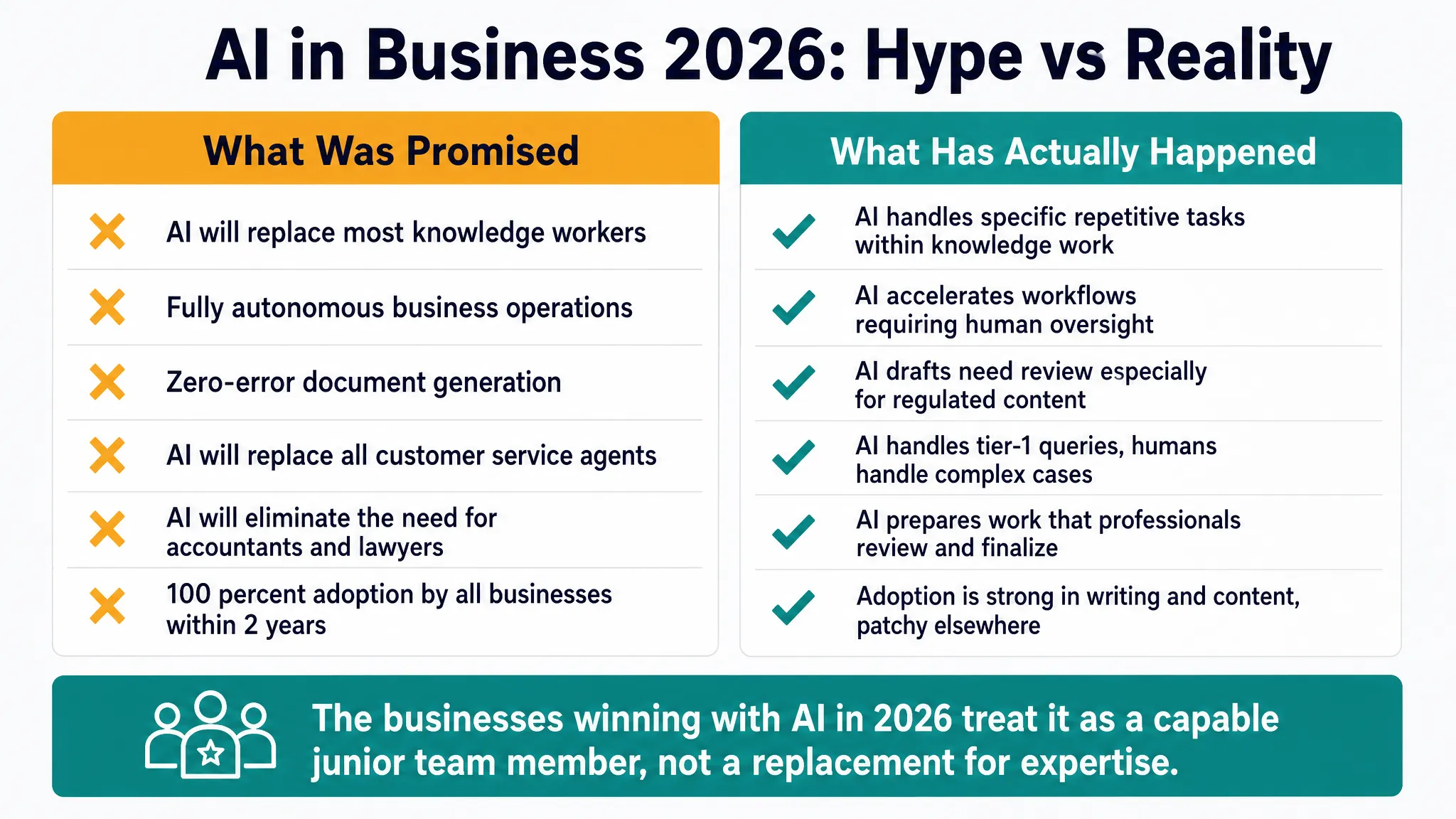
In July 2026, the conversation about artificial intelligence in business has split into two distinct camps that rarely intersect. One camp is still trading in the language of revolution: AI will transform everything, eliminate entire job categories, and reshape the global economy within five years. The other camp has grown quietly skeptical: AI tools are expensive, outputs need constant correction, and the promised productivity revolution has not materialized in any meaningful way for their specific business. Both camps are wrong in ways that matter practically, and the businesses that are extracting real, measurable value from AI in 2026 tend to share a different understanding of what these tools actually are and what they are genuinely capable of delivering today rather than in some projected future state.
What This Article Covers
This is Biveron’s assessment of where AI actually stands in business as of July 2026. It draws on publicly available research, industry surveys, and the patterns we observe across our coverage of AI tools, business productivity, and financial compliance. It covers what AI is genuinely delivering for different types of businesses right now, where the technology still falls short of its marketing, which business types are seeing the strongest returns, and what the practical next steps look like for businesses at different stages of AI adoption. This article connects to the broader Biveron research library including our detailed comparison of the leading AI assistants for business use and our guide to how AI is changing business productivity in 2026.
The Honest Assessment: What AI Is Delivering Right Now
The most useful framing for AI capabilities in July 2026 is this: AI tools are excellent at accelerating tasks that involve transforming, organizing, or generating text and data based on patterns. They are significantly less capable at tasks that require original judgment, contextual understanding of specific relationships, creative synthesis across genuinely novel domains, or accountability for the accuracy of their outputs in high-stakes situations.
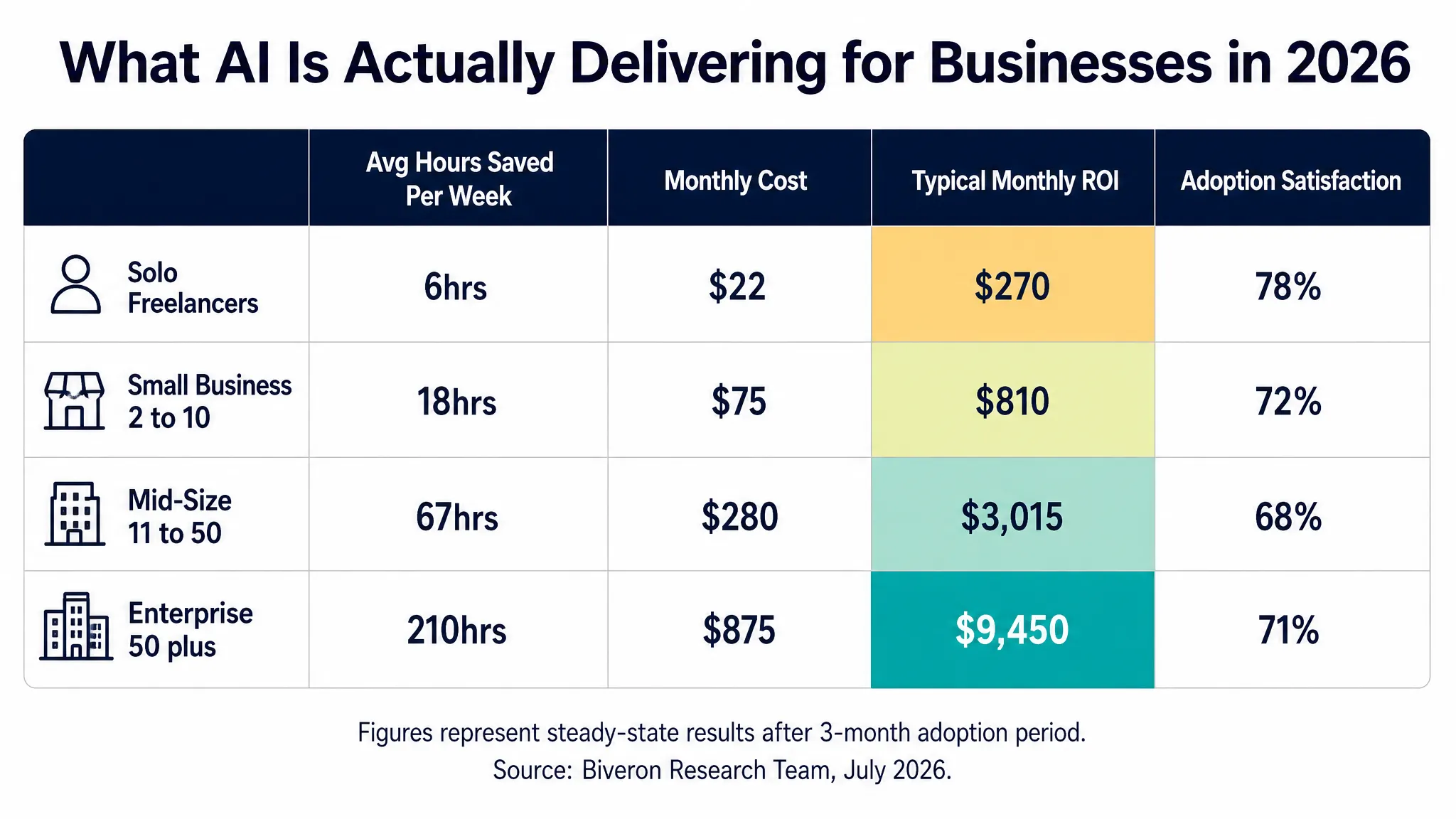
Within that framing, the productivity gains that businesses are actually reporting are real and often significant. The pattern that emerges consistently across different business types and sizes is that AI tools deliver the most value when they handle the first 70 to 80 percent of a task that would otherwise require a skilled human to start from zero, allowing that human to spend their time on the remaining 20 to 30 percent that actually requires judgment, relationship knowledge, or professional accountability.
A marketing agency writer who previously spent 45 minutes drafting a client email from scratch now spends 12 minutes refining an AI-generated draft that captures the right tone and covers the key points. The time saving is real. The writer is still essential because the 12 minutes of refinement requires knowledge of the client relationship, the brand voice, and the specific context that the AI tool does not have access to. The task has not been automated. It has been restructured in a way that makes the human’s time significantly more productive.
This pattern, AI handling the templatable portion of skilled work while humans handle the contextual and judgment-intensive portions, is the dominant value delivery mechanism in 2026. Businesses that understood this early and restructured their workflows accordingly are seeing meaningful productivity and cost benefits. Businesses that either dismissed AI tools entirely or implemented them expecting full automation have generally been disappointed.
Where AI Genuinely Falls Short in 2026
An honest assessment of AI in business requires covering what these tools consistently fail to deliver, not just what they do well. There are several areas where the gap between AI marketing and AI reality remains significant as of July 2026.
Factual Accuracy in Specialized Domains
AI language models produce confident-sounding output that is factually incorrect with a frequency that makes them unreliable as primary sources on specialized topics. In legal, financial, medical, and regulatory contexts, the rate of plausible-sounding errors is high enough that every AI-generated output in these domains requires verification by a qualified professional before use. The risk is not that AI tools are obviously wrong. It is that they are subtly wrong in ways that require expertise to detect.
For businesses in regulated industries, this creates a specific risk profile: AI tools can accelerate the production of draft content in legal, financial, and compliance contexts, but the verification requirement means that the total time saving is smaller than it appears, and the consequence of a verification failure is potentially significant. The appropriate operating model is AI for drafting, human expert for verification and approval, with that workflow explicitly documented for any compliance purposes.
Complex Relationship and Context Management
AI tools have no persistent memory of your specific business relationships, client history, or organizational context across sessions. Every prompt starts from zero unless you provide the relevant context explicitly. For tasks that depend on deep knowledge of a specific client, project history, or internal business context, the overhead of providing sufficient context often reduces the time saving significantly. This is an area where AI capabilities are improving rapidly, with memory features and integration with business data systems expanding in 2026, but as of July 2026, context management remains a real limitation for complex relationship-dependent tasks.
Creative Work Requiring Genuine Originality
AI tools produce competent, pattern-based content across a wide range of formats. They consistently struggle with work that requires genuinely original thinking, unexpected creative synthesis, or a distinctive voice that is not derivable from existing patterns. For businesses whose value proposition depends on creative originality, AI tools function as useful assistants for the mechanical and structural aspects of creative work rather than as creative partners capable of generating the ideas that differentiate the work.
AI Tool Landscape in July 2026: What Has Changed
| AI Category | Leading Tools July 2026 | Key Development Since January 2026 | Best Business Application | Primary Limitation |
|---|---|---|---|---|
| General AI assistants | Claude Sonnet, ChatGPT-4o, Gemini 1.5 Pro | Significantly improved context windows and memory features across all three platforms | Writing, analysis, research, drafting across business functions | Factual accuracy in specialized domains still requires human verification |
| AI coding assistants | GitHub Copilot, Claude Code, Cursor | Agentic coding capabilities now handle multi-file projects with less supervision | Software development acceleration, code review, documentation | Security review of AI-generated code remains essential |
| AI image and video generation | Midjourney v7, DALL-E 4, Adobe Firefly 3 | Video generation quality has improved substantially, text in images now more reliable | Marketing visuals, product imagery, social content | Licensing and copyright questions around training data remain unresolved in many jurisdictions |
| AI meeting and transcription tools | Otter.ai, Fireflies, Zoom AI Companion | Real-time action item extraction and CRM integration now standard in paid tiers | Meeting summarization, action item tracking, client call documentation | Accuracy with heavy accents and technical terminology still requires review |
| AI financial and accounting tools | QuickBooks AI, Xero AI, FreshBooks AI features | AI categorization accuracy has improved to 90 percent plus for typical business transactions | Bookkeeping automation, expense categorization, invoice processing | Complex or unusual transactions still require manual classification |
| AI customer service platforms | Intercom Fin, Zendesk AI, HubSpot AI | Resolution rates for tier-1 queries now reaching 70 to 80 percent without human handoff | First-response customer support, FAQ handling, ticket routing | Complex or emotionally sensitive customer situations still require human agents |
| AI legal and compliance tools | Harvey AI, Clio AI, ContractPodAi | Contract review and clause flagging now reliable enough for first-pass review in enterprise contexts | Contract review acceleration, compliance checking, legal research | All AI legal outputs require qualified attorney review before reliance or execution |
The Three Business Profiles Getting the Most Value From AI Right Now
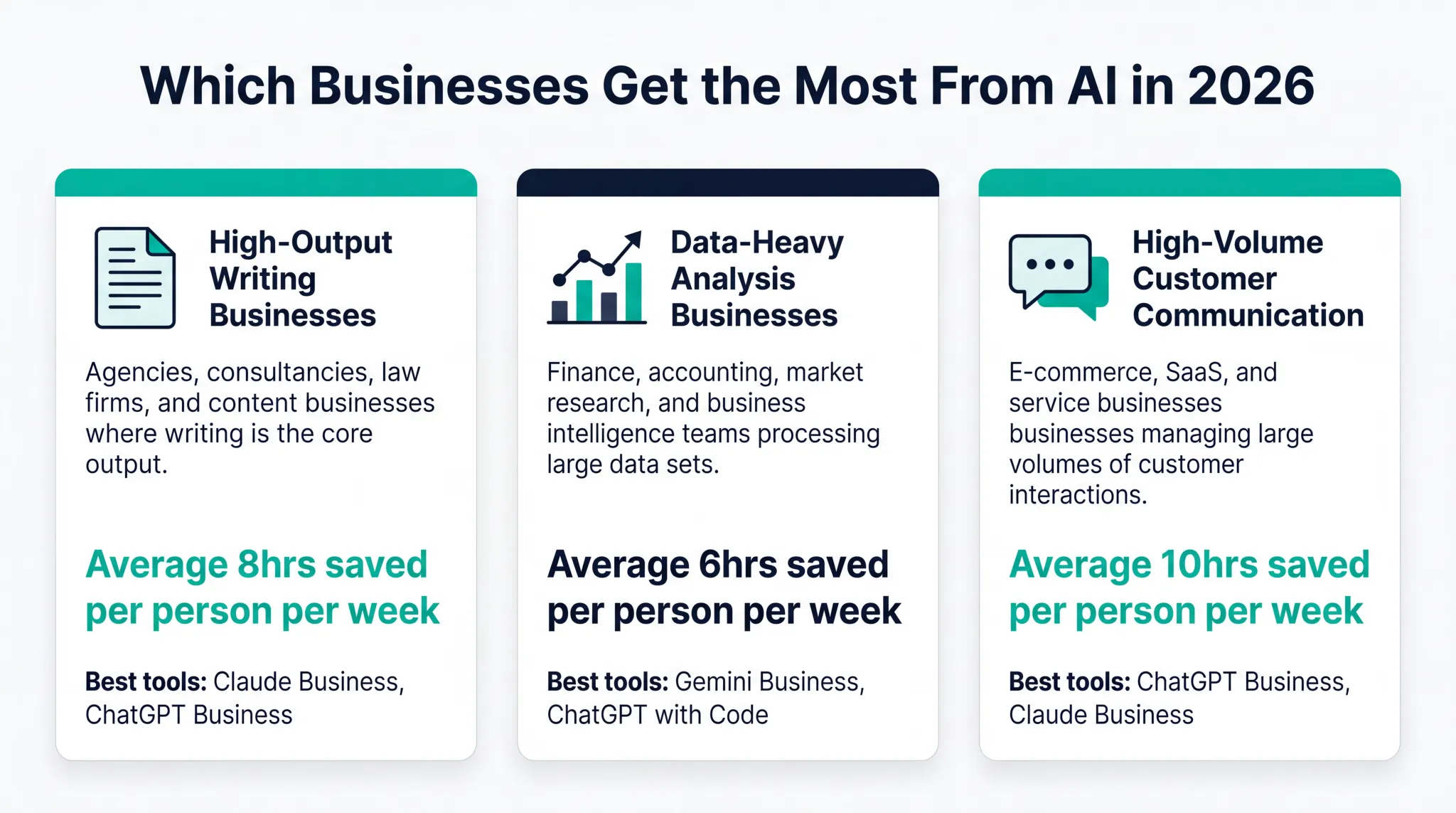
Looking across the businesses that are reporting the strongest measurable returns from AI tool adoption in July 2026, three distinct profiles emerge consistently.
Profile 1: High-Output Writing and Content Businesses
Agencies, consultancies, law firms, content publishers, and any business where the primary deliverable is written output have seen the most consistent and significant productivity gains from AI writing tools. The reason is structural: in these businesses, a large proportion of skilled worker time is spent producing first drafts of text that then requires review and refinement. AI tools that accelerate the first draft stage while maintaining acceptable quality produce immediate, measurable time savings that translate directly to capacity or cost reduction.
The specific pattern in high-output writing businesses is that AI adoption has increased output volume without proportionally increasing headcount. An editorial team that previously produced 20 long-form pieces per month can produce 35 to 40 with the same people, if the AI-assisted drafting workflow is implemented well and the review process is maintained.
Profile 2: Data-Heavy Analysis and Reporting Businesses
Finance, accounting, market research, business intelligence, and consulting businesses that regularly process large volumes of data to produce analysis and reports have seen strong returns from AI tools that accelerate the analysis and synthesis stages of their work. AI tools that can summarize large data sets, identify patterns, and produce structured analytical frameworks reduce the time from raw data to client-ready output significantly in these contexts.
The important caveat for this profile is that the accuracy verification requirement is particularly important. Financial analysis, market research findings, and business intelligence outputs that contain AI-generated errors have real consequences for clients and for the professional reputation of the business producing them. Businesses in this profile that are seeing strong AI returns have invested in verification workflows, not just AI adoption.
Profile 3: High-Volume Customer Communication Businesses
E-commerce businesses, SaaS companies, and service businesses managing large volumes of customer support interactions have seen strong returns from AI customer service tools. The economics are particularly clear: AI handling of tier-1 customer queries at scale, with human escalation for complex cases, reduces cost per interaction significantly while maintaining acceptable resolution rates. The businesses seeing the strongest returns in this profile have invested in training their AI customer service tools on their specific products, policies, and common edge cases rather than deploying generic AI assistants without customization.
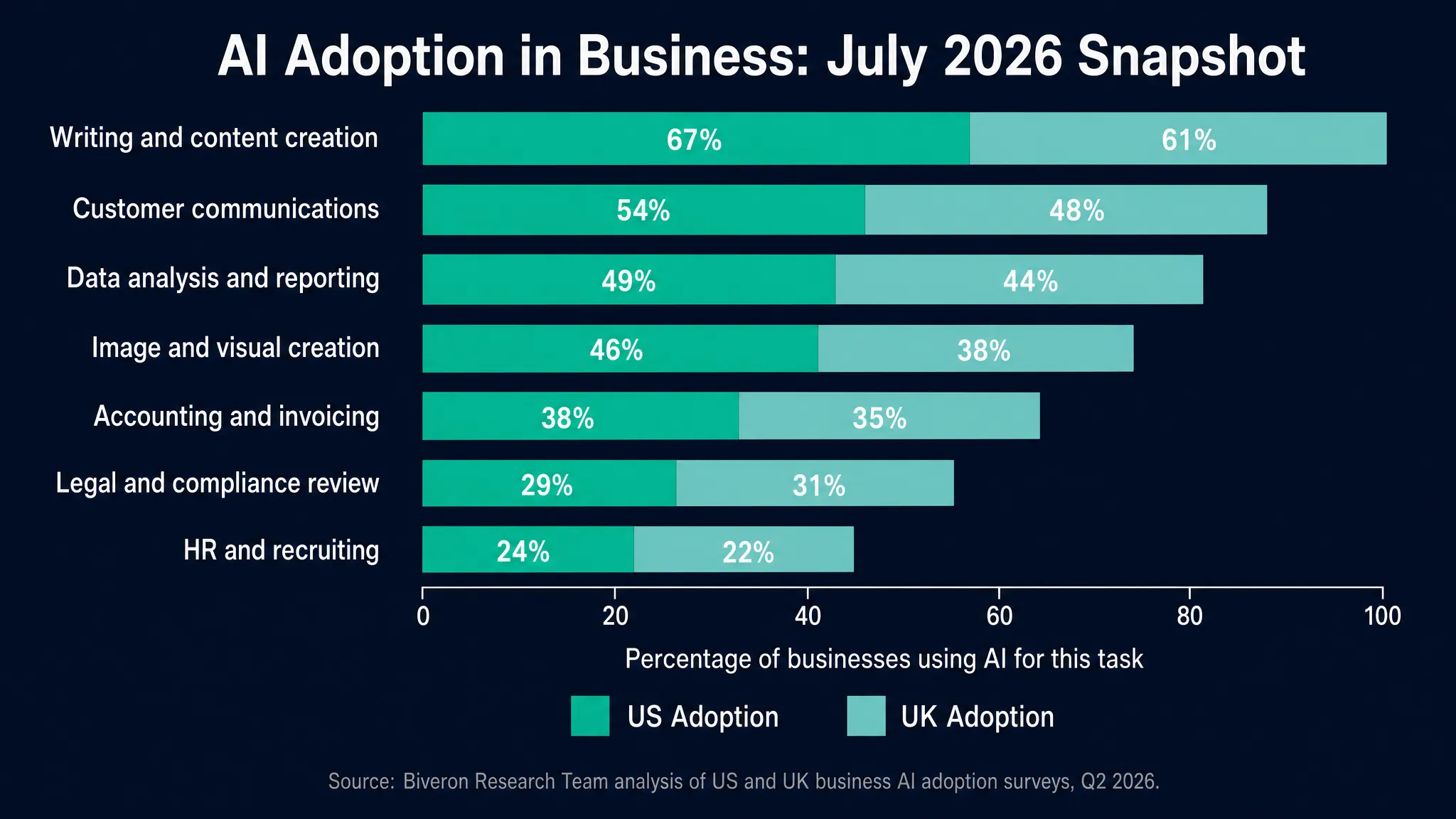
US and UK Market Difference: AI tool adoption patterns differ meaningfully between the United States and the United Kingdom as of July 2026. US businesses have adopted AI writing and content tools at a higher rate, driven partly by the larger volume of content marketing activity and the stronger culture of technology adoption in customer-facing functions. UK businesses show higher adoption rates in compliance and regulatory technology applications, reflecting the more complex and frequently changing regulatory environment that UK businesses navigate including FCA requirements, UK GDPR, and Making Tax Digital. UK businesses also show stronger interest in AI tools that integrate with HMRC-compliant accounting software and compliance monitoring systems. For businesses operating in both markets, the practical implication is that AI tool selection and implementation priorities may differ between US and UK operations even within the same organization.
The AI Adoption Mistakes That Are Still Being Made in 2026
Despite three years of mainstream AI tool availability for businesses, several predictable adoption mistakes continue to reduce returns and create frustration in organizations that should by now be past the early experimentation phase.
The most common mistake is tool proliferation without workflow integration. Many businesses now have employees using five to ten different AI tools, each adopted individually for a specific task, with no consistent workflow, no shared context, and no systematic approach to quality control. The result is high subscription costs, inconsistent output quality, and a lack of the organizational learning that comes from systematic AI adoption. The businesses seeing the strongest returns in July 2026 are generally using fewer AI tools but using them more systematically and consistently.
The second common mistake is insufficient attention to output quality control. AI tools produce output that looks correct far more often than it is correct, particularly in specialized domains. Organizations that have adopted AI without building explicit review processes into their workflows are accumulating quality and accuracy risks that have not yet produced visible consequences but represent a real liability. The enforcement actions and professional liability cases involving AI-assisted work that have emerged in the legal and financial sectors in 2025 and 2026 have made this risk more visible, but adoption of systematic review processes has lagged adoption of the tools themselves.
The third mistake is failing to account for the learning curve in productivity calculations. AI tools typically deliver their full productivity benefit only after team members have developed consistent prompting habits and understand the specific strengths and limitations of the tools they are using. Organizations that evaluate AI tool ROI in the first four to six weeks of adoption and conclude the tools are not delivering value are measuring the learning period rather than the steady-state performance. Realistic evaluation periods of three months minimum produce significantly more accurate pictures of the actual productivity impact.
What Businesses Should Actually Do With AI Right Now
The practical guidance that emerges from an honest assessment of where AI stands in July 2026 is more specific than the general advice to embrace or avoid AI tools.
For businesses that have not yet adopted AI tools in any systematic way, the starting point is identifying the single highest-time-cost repeatable task in your operation that involves text production or data synthesis and evaluating one AI tool against that specific task for a full three months. The Biveron AI Tool ROI Calculator can help you quantify whether the time savings justify the investment before committing. Do not start with the most complex or highest-stakes use case. Start with something where a mistake has low consequences while you develop reliable workflows and prompting habits.
For businesses that have adopted AI tools but are not seeing strong returns, the diagnostic question is whether the tools are being used systematically with clear quality review processes, or whether adoption is ad hoc and the outputs are going directly into client-facing or decision-critical use without review. Most underperforming AI implementations fail at the workflow design stage rather than the tool selection stage.
For businesses that are already seeing strong AI returns and want to expand their AI capabilities, the most productive next step in July 2026 is evaluating AI tools in the compliance, financial reporting, and customer service functions where adoption remains lower but ROI data is becoming clearer. Our detailed guides on AI for tax compliance and AI customer service tools cover the specific options and implementation considerations in these areas.
Where AI in Business Is Heading in the Next 12 Months
Looking forward from July 2026, several developments in AI capability and adoption are likely to affect business users in the near term, based on announced product roadmaps and current capability trajectories.
Memory and context persistence across AI sessions is improving rapidly. Several leading AI platforms have announced or already released features that allow AI assistants to remember specific client contexts, organizational preferences, and past interactions across sessions. As these features mature, they will reduce one of the most significant practical limitations of current AI tools for complex, relationship-dependent business work.
AI agent capabilities, where AI tools can take multi-step actions autonomously rather than generating text for human review, are expanding. In business contexts this includes AI agents that can research, draft, send, and follow up on communications, or that can navigate internal systems to retrieve and update information without human guidance at each step. These capabilities create both productivity opportunities and governance challenges that businesses will need to develop specific policies around.
Regulatory frameworks governing AI use in business are developing in both the United States and the European Union, with implications for UK businesses post-Brexit as well. The EU AI Act provisions affecting high-risk AI applications in financial services, employment, and other regulated domains are progressively coming into effect, and US regulatory agencies including the SEC and FTC have begun enforcing existing regulations in ways that explicitly address AI-generated content and AI-assisted decision-making.
Frequently Asked Questions
Is AI actually replacing jobs in small businesses or is that still mostly speculation?
The evidence from small business employment data as of mid-2026 shows that AI adoption has primarily restructured tasks within existing roles rather than eliminated positions at the small business level. The most common pattern is that individuals or small teams are handling higher output volumes without proportionally increasing headcount, which means hiring growth is slower in AI-adopted businesses than in comparable non-adopters. Full role elimination from AI adoption is more visible in larger organizations with highly standardized job functions. For most small businesses in 2026, AI tools are changing how work gets done rather than who does it, though the longer-term trajectory toward some role consolidation as AI capabilities improve is a reasonable expectation to plan for.
How do I know if an AI tool is worth the subscription cost for my business?
The most reliable method is to track the actual time spent on the specific task the AI tool addresses for two weeks before adoption, then track the same task for eight weeks after adoption including the learning curve period. If the total time including prompting, reviewing, and editing AI output is not at least 30 percent lower than the baseline by week eight, either the tool is not well matched to your task, your implementation needs refinement, or the tool genuinely does not deliver value for your specific use case. Use the Biveron AI Tool ROI Calculator to translate time savings into dollar value for your specific hourly rate and team size before making annual subscription commitments.
Which AI tools are most widely used by small businesses in the US and UK right now?
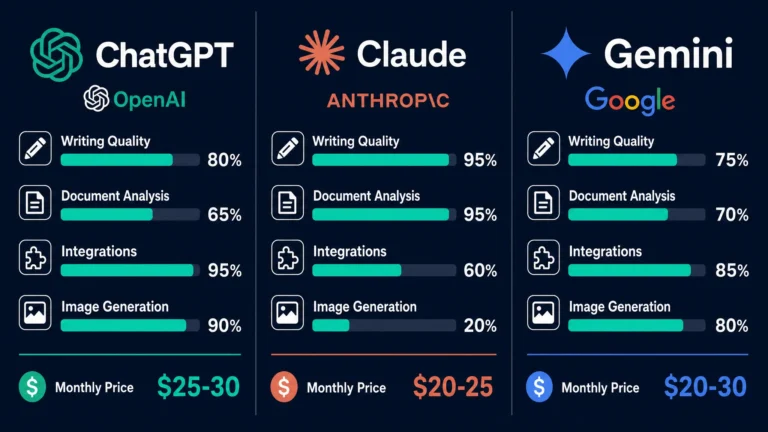
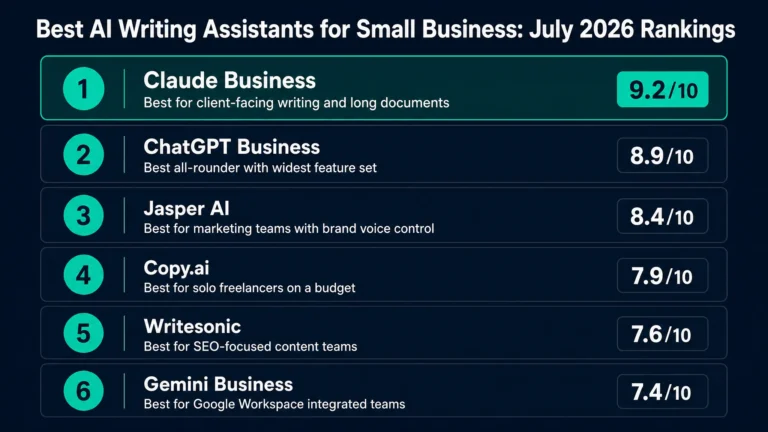
As of July 2026, ChatGPT remains the most widely adopted AI tool among small businesses in both the US and UK by number of users, driven by its early market entry and strong brand recognition. Claude has gained significant market share particularly among businesses with heavy document and writing workloads, where its output quality and context handling have driven strong word-of-mouth adoption. Gemini has seen strongest adoption among businesses deeply embedded in Google Workspace. In specialized categories, Otter.ai and Fireflies lead for meeting transcription, while QuickBooks AI and Xero AI features lead for accounting automation. Our detailed comparison of the leading AI assistants covers the specific strengths of each platform for different business needs.
Should I be concerned about data privacy when using AI tools for business?
Yes, data privacy should be a specific and ongoing consideration rather than a general concern. The key questions are whether the AI tool uses your inputs to train its models, where your data is processed and stored, whether the tool’s data handling is compatible with your obligations under applicable privacy regulations including CCPA for California businesses, UK GDPR for UK operations, and any sector-specific regulations relevant to your industry. Most leading AI tools offer business tier plans with stronger privacy protections including opt-outs from training data use and data processing agreements suitable for GDPR compliance. Free tier plans generally offer weaker privacy protections and should not be used with sensitive client or customer data.
What is the single most impactful thing a small business can do with AI right now?
Based on consistent patterns across business types and sizes, the highest-impact single AI adoption for most small businesses in July 2026 is using an AI writing assistant for all first drafts of external communications including client emails, proposals, reports, and follow-up sequences. This addresses a task that consumes significant skilled worker time across virtually every business type, produces immediate and measurable time savings, has a low risk profile since all outputs are reviewed before sending, and builds the prompting habits that make subsequent AI adoptions more effective. The time saving from this single change, typically three to five hours per person per week for communication-heavy roles, justifies the subscription cost many times over at any reasonable hourly rate.
Disclaimer: This article represents Biveron’s editorial assessment of the AI in business landscape as of July 2026 and is for informational purposes only. Statistics cited reflect our analysis of publicly available research and industry surveys. AI tool capabilities, pricing, and market positions change rapidly and information in this article may not reflect developments that occurred after our July 2026 review date. References to specific AI tools do not constitute endorsements. Some links in this article may be affiliate links. See our Affiliate Disclosure for details.
Latest Research