If you bought, sold, traded, or earned any cryptocurrency in the United States during 2025 or 2026 and have not reported it to the IRS, the risk of that decision is higher than it has ever been. The era of crypto tax ambiguity in the United States is effectively over. In 2026, cryptocurrency exchanges are required to report transaction data directly to the IRS through the new Form 1099-DA system, which means the IRS already has access to much of the data that US investors previously assumed was private. This guide explains exactly how the IRS taxes cryptocurrency in 2026, which transactions trigger a tax obligation, how to calculate what you owe, and what happens if you get it wrong.
This article is for educational purposes only and does not constitute tax or legal advice. Cryptocurrency tax rules are complex and change frequently. Always consult a qualified CPA or tax attorney with experience in digital assets before filing your return or making decisions based on this guide.
What This Guide Covers
This guide is written for US residents and citizens who hold, trade, or earn cryptocurrency and need to understand their federal tax obligations in 2026. It covers how the IRS classifies cryptocurrency, which transactions trigger taxable events, how to calculate gains and losses, which forms you need to file, and what the consequences of non-compliance look like in the current enforcement environment. It does not cover state tax obligations, which vary significantly by state, or international tax treatment for US persons with foreign crypto accounts, both of which require specific professional guidance.
How the IRS Classifies Cryptocurrency in 2026
The foundation of cryptocurrency taxation in the United States is IRS Notice 2014-21, which established that virtual currency is treated as property for federal tax purposes. This classification has remained consistent through 2026 and applies to Bitcoin, Ethereum, and essentially all other cryptocurrencies regardless of whether they are used as a medium of exchange, held as an investment, or used in decentralized finance protocols.
The property classification means that the same rules that apply to selling stocks, real estate, or other capital assets apply to cryptocurrency. Every disposal of cryptocurrency, whether by selling it for dollars, trading it for another cryptocurrency, or using it to buy goods or services, is a taxable event that requires you to calculate and report a gain or loss. The gain or loss is determined by the difference between what you paid for the cryptocurrency, known as your cost basis, and what you received when you disposed of it.
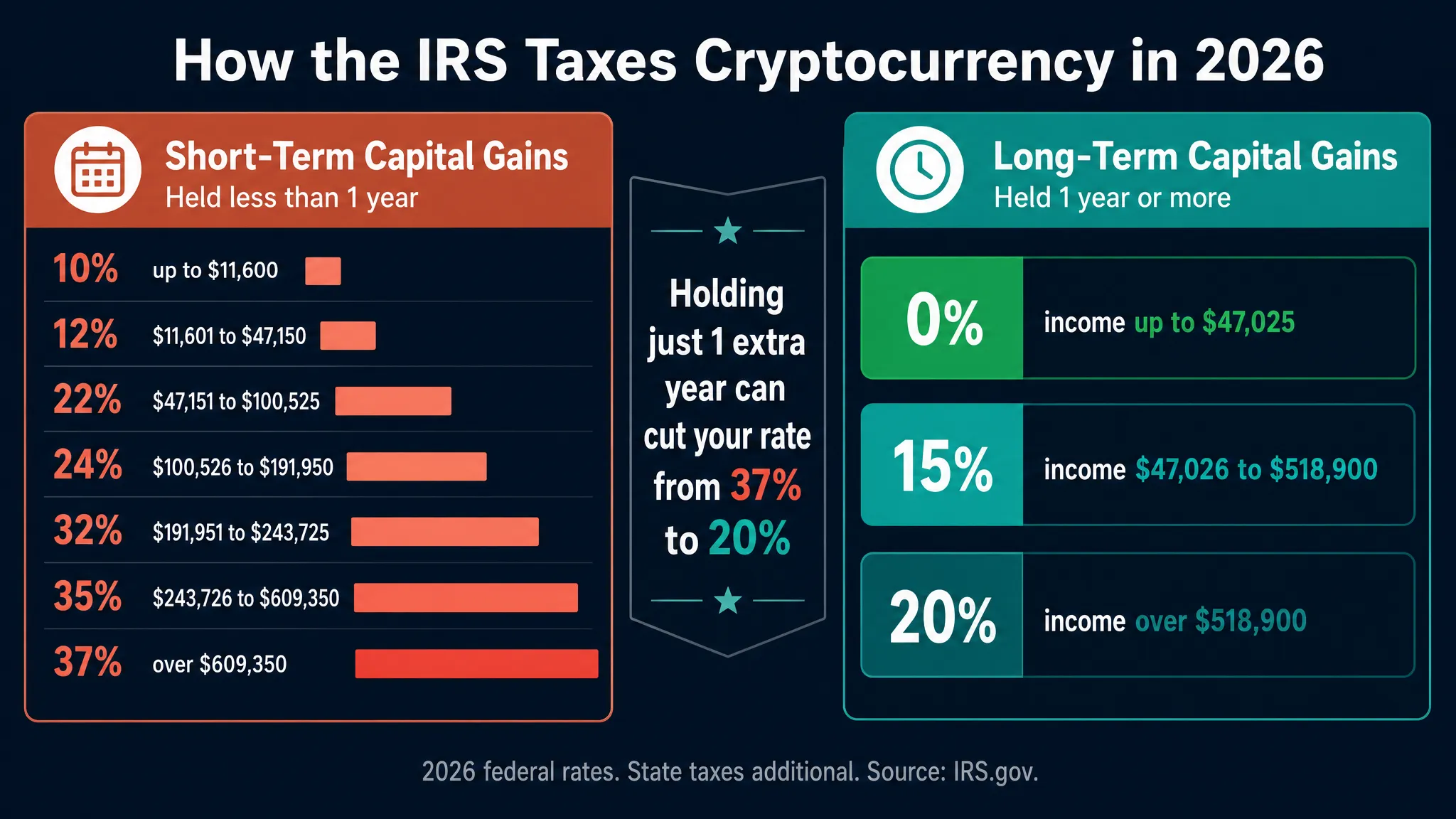
The holding period determines whether a gain is classified as short-term or long-term, which has a significant impact on the tax rate that applies. Cryptocurrency held for one year or less before disposal is subject to short-term capital gains tax, which is taxed at the same rate as ordinary income ranging from 10 to 37 percent depending on your total taxable income. Cryptocurrency held for more than one year before disposal qualifies for long-term capital gains rates of 0, 15, or 20 percent depending on your income level. The difference between these two rates is one of the most significant variables in crypto tax planning, and understanding it before making disposal decisions can meaningfully reduce your tax liability.
Why 2026 Is a Critical Year for Crypto Tax Compliance
Several developments make 2026 particularly significant for US crypto investors from a compliance perspective.
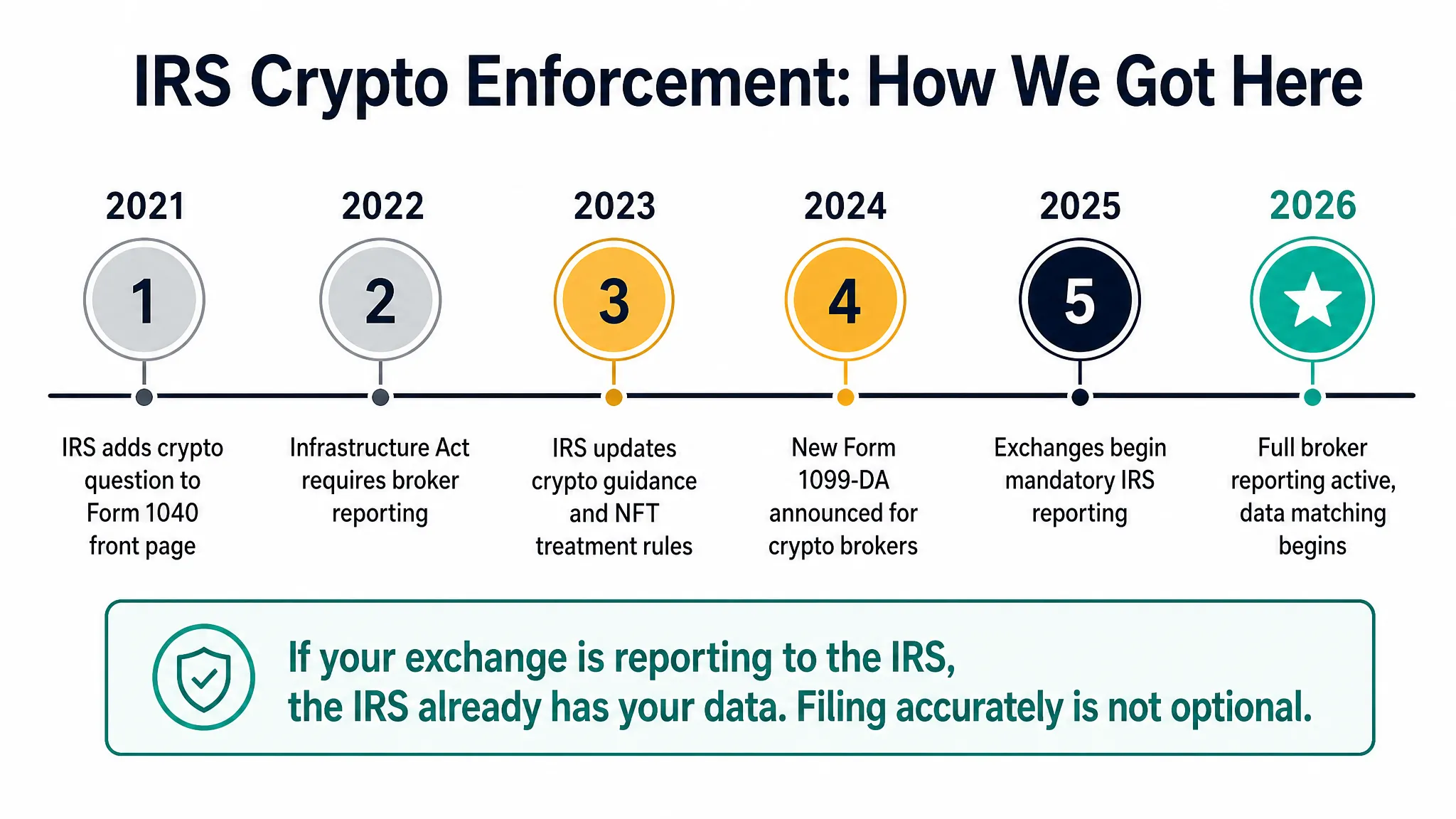
The most important is the full implementation of Form 1099-DA reporting requirements. Under rules established by the Infrastructure Investment and Jobs Act of 2021 and subsequent IRS guidance, cryptocurrency exchanges and brokers are now required to report customer transaction data to the IRS, similar to how stock brokers report transactions through Form 1099-B. This means that for transactions occurring on major exchanges in 2026, the IRS will receive information about your trades regardless of whether you report them on your tax return. The era of crypto transactions being invisible to tax authorities is over for exchange-based trading in the United States.
The IRS has also significantly expanded its enforcement resources dedicated to cryptocurrency compliance. The agency has invested in blockchain analytics capabilities, engaged with specialized firms that trace cryptocurrency transactions, and increased the number of cases involving unreported crypto income referred for criminal investigation. While the vast majority of crypto tax enforcement remains civil rather than criminal, the combination of third-party reporting and enhanced analytics means that discrepancies between what exchanges report and what appears on tax returns are increasingly detectable.
Which Crypto Transactions Create a Tax Obligation
One of the most common sources of confusion among US crypto investors is not knowing which transactions trigger a taxable event and which do not. The following covers the most common transaction types and their tax treatment under current IRS guidance.
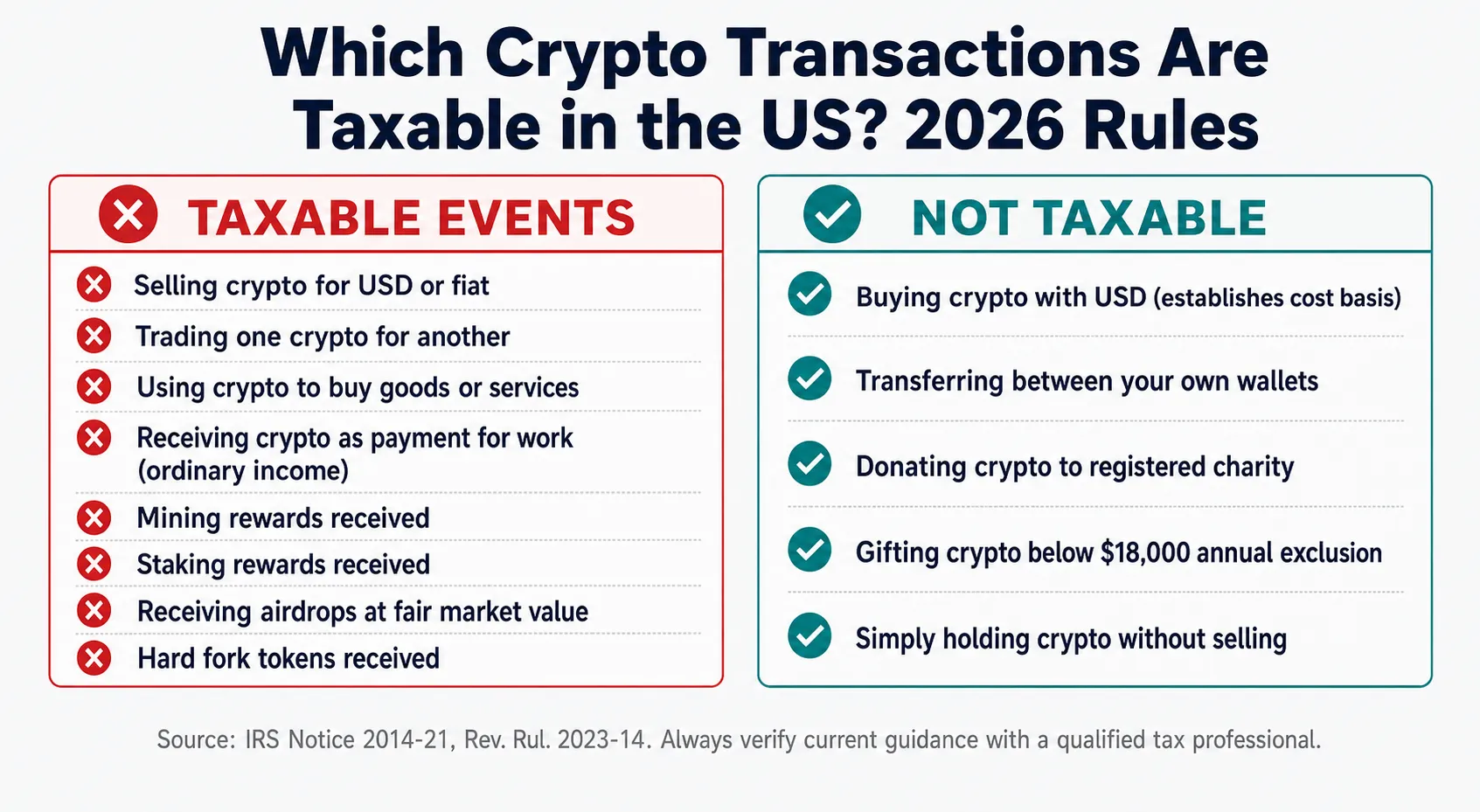
Taxable Events
Selling cryptocurrency for US dollars or other fiat currency is the most straightforward taxable event. The gain or loss is calculated as the sale proceeds minus your cost basis in the cryptocurrency sold. This applies regardless of the amount involved, whether you sell through an exchange, a peer-to-peer transaction, or any other method.
Trading one cryptocurrency for another is also a taxable event, even though no dollars are involved. When you trade Bitcoin for Ethereum, for example, the IRS treats this as if you sold the Bitcoin for its fair market value in dollars at the time of the trade, then used those dollars to purchase Ethereum. You must calculate and report the gain or loss on the Bitcoin at the time of the exchange.
Using cryptocurrency to pay for goods or services triggers a taxable event at the time of payment. If you pay for a laptop using Bitcoin worth 1,500 US dollars and your cost basis in that Bitcoin was 800 US dollars, you have a taxable gain of 700 US dollars that must be reported.
Receiving cryptocurrency as payment for work, services, or as an employee is treated as ordinary income at the fair market value of the cryptocurrency at the time of receipt. This income is subject to ordinary income tax rates and, for self-employed individuals, self-employment tax as well.
Staking rewards, mining rewards, and airdrops are generally treated as ordinary income at the fair market value at the time of receipt under current IRS guidance, establishing a new cost basis at that value for future disposition calculations.
Non-Taxable Events
Purchasing cryptocurrency with US dollars is not itself a taxable event, though it establishes your cost basis for future calculations. Transferring cryptocurrency between wallets you own is not a taxable event, provided you can document that both wallets belong to you. Holding cryptocurrency without disposing of it is not taxable regardless of how much its value increases while you hold it.
Calculating Your Crypto Gains and Losses
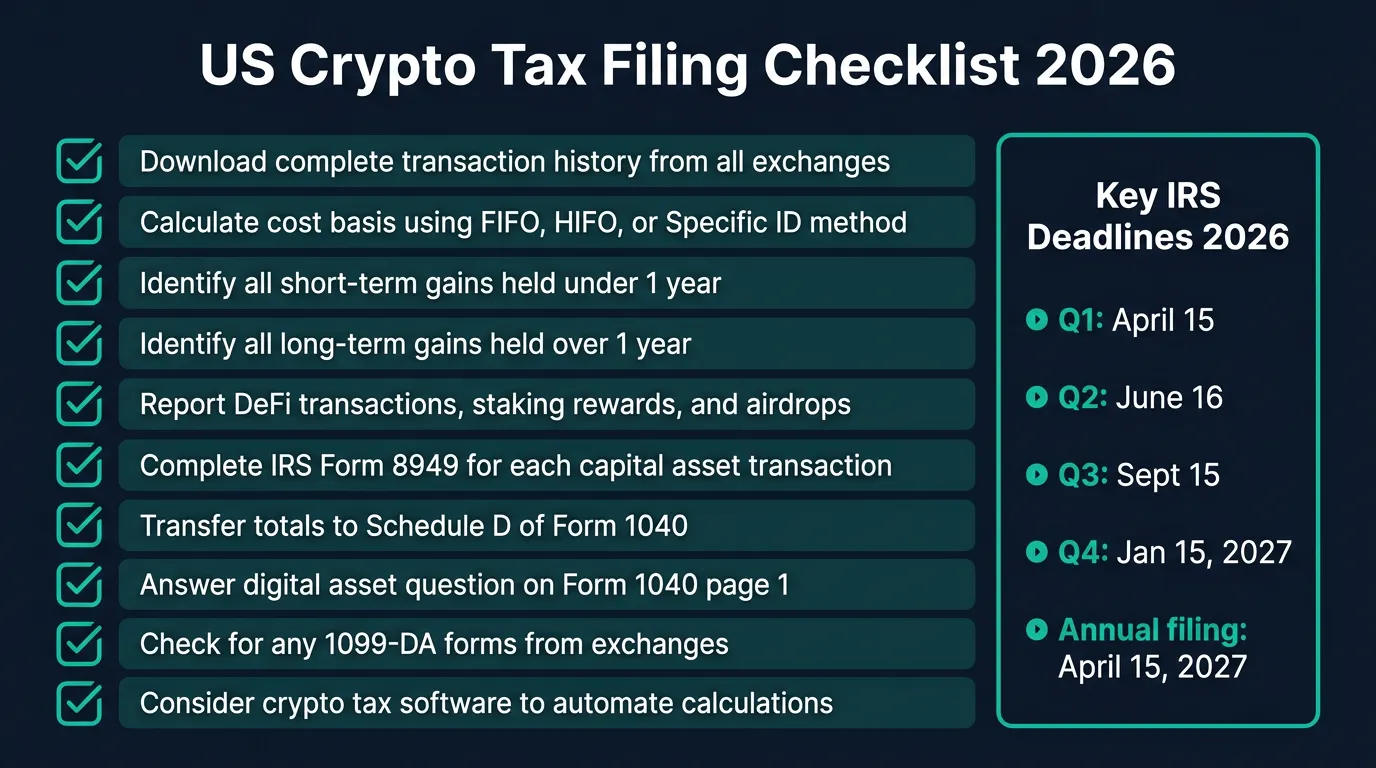
Accurate gain and loss calculation requires knowing your cost basis for each unit of cryptocurrency you dispose of. The cost basis is generally the amount you paid for the cryptocurrency including any transaction fees paid to acquire it. When you have purchased the same cryptocurrency at different times and prices and then sell a portion of your holdings, you must choose an accounting method to determine which units were sold.
The IRS allows several methods for identifying which units of cryptocurrency you are selling. First In First Out, known as FIFO, assumes you sell the oldest units first. Highest In First Out, known as HIFO, assumes you sell the highest-cost units first, which typically minimizes taxable gains and is often the most tax-efficient method. Specific Identification allows you to designate exactly which units you are selling, which requires detailed record-keeping but provides the most flexibility for tax planning.
The method you choose can have a significant impact on your tax liability in a given year, particularly if you have made purchases at very different price points. Switching methods between years may be possible but should be done carefully with professional guidance to avoid compliance issues.
Crypto Tax Treatment Comparison Table
| Transaction Type | Taxable Event | Tax Treatment | Form Required | Key Consideration |
|---|---|---|---|---|
| Sell crypto for USD | Yes | Capital gain or loss, short or long-term based on holding period | Form 8949, Schedule D | Holding period determines rate, long-term significantly lower |
| Crypto to crypto trade | Yes | Capital gain or loss on disposed asset at fair market value | Form 8949, Schedule D | Must calculate gain on disposed coin even though no USD received |
| Pay for goods or services | Yes | Capital gain or loss based on FMV at time of payment | Form 8949, Schedule D | Every purchase with crypto is a taxable disposal |
| Receive crypto as income | Yes | Ordinary income at FMV on receipt date | Schedule 1, Schedule C if self-employed | Subject to self-employment tax if received for services |
| Mining rewards | Yes | Ordinary income at FMV when received, capital gain or loss on later sale | Schedule C or Schedule 1 | Business miners may deduct equipment and electricity costs |
| Staking rewards | Yes, on receipt | Ordinary income at FMV when received per current IRS guidance | Schedule 1 or Schedule C | Subject to ongoing litigation, verify current guidance before filing |
| Airdrops | Yes, on receipt | Ordinary income at FMV when dominion and control established | Schedule 1 | Unsolicited airdrops of worthless tokens still technically taxable |
| Transfer between own wallets | No | Not taxable, cost basis carries over | None required | Maintain documentation proving both wallets belong to you |
| Buy crypto with USD | No | Not taxable, establishes cost basis | None required | Keep purchase records including fees for accurate basis calculation |
| Gift crypto to individual | No for giver if under annual exclusion | Recipient takes gifter’s basis and holding period | Form 709 if over annual exclusion amount | Annual gift tax exclusion is $18,000 per recipient in 2026 |
Real World Example: Calculating Tax on a Common Crypto Scenario
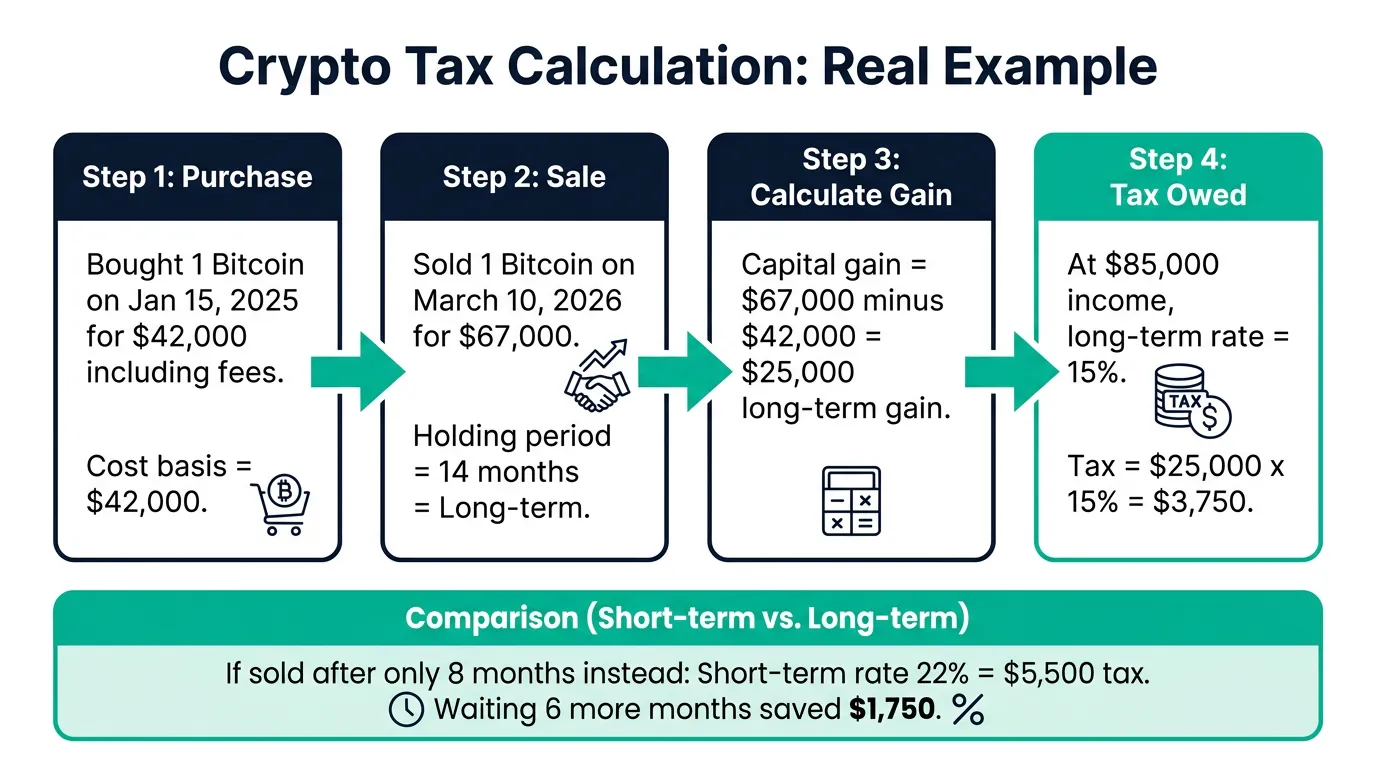
To make the calculation process concrete, consider a scenario that reflects a common pattern among individual US crypto investors. An investor purchased one Bitcoin on January 15, 2025 at a price of 42,000 US dollars including transaction fees. They held that Bitcoin through the volatility of 2025 and sold it on March 10, 2026 for 67,000 US dollars.
Because the holding period exceeded one year, the 25,000 US dollar gain is classified as a long-term capital gain. For an investor with total taxable income of 85,000 US dollars in 2026, the long-term capital gains rate is 15 percent, resulting in a federal tax liability of 3,750 US dollars on that gain.
Had the same investor sold on July 15, 2025, just six months after purchase, the gain would have been classified as short-term. At an ordinary income rate of 22 percent for that income level, the tax on the same 25,000 US dollar gain would have been 5,500 US dollars, a difference of 1,750 US dollars from the same transaction simply based on timing.
This same investor also received staking rewards of 0.05 Ethereum valued at approximately 180 US dollars on the date of receipt in April 2025. That 180 US dollars must be reported as ordinary income on their 2025 return, and their cost basis in that 0.05 Ethereum is 180 US dollars for any future sale calculation.
The pattern this illustrates is one that applies broadly across crypto investors: the timing of disposals and the nature of how cryptocurrency is received both have significant tax implications that require planning rather than after-the-fact calculation.
US and UK Difference: UK crypto investors face a different tax framework under HMRC rules. In the United Kingdom, cryptocurrency is subject to Capital Gains Tax rather than the US system of short and long-term rates, with CGT rates of 10 or 20 percent for basic and higher rate taxpayers respectively on crypto gains above the annual CGT allowance, which was reduced to 3,000 GBP for the 2024 to 2025 tax year and beyond. UK investors also face different rules around pooling of assets, the 30-day same-asset purchase rule that prevents bed-and-breakfasting strategies, and different treatment of DeFi activities that HMRC updated with new guidance in 2024. UK readers should consult our dedicated guide on the crypto tax guide for UK investors in 2026 for HMRC-specific rules and rates.
Which Forms You Need to File
Crypto tax reporting in the United States involves several forms depending on the nature of your transactions. Understanding which forms apply to your situation is essential for filing correctly.
Form 8949 is the primary form for reporting capital asset transactions including cryptocurrency sales and trades. Every individual transaction, meaning every sale or exchange, must be listed on Form 8949 with the acquisition date, sale date, proceeds, cost basis, and resulting gain or loss. The totals from Form 8949 flow to Schedule D, which summarizes your total capital gains and losses for the year.
Schedule D is where your total short-term and long-term gains and losses are summarized and the applicable tax rates are applied. This schedule is part of your Form 1040 filing.
Schedule C is required if you operate a cryptocurrency mining business or receive cryptocurrency as self-employment income. Business mining expenses including equipment and electricity can be deducted on Schedule C, potentially reducing the taxable income from mining operations.
The digital asset question on the front page of Form 1040 must be answered by all filers. In 2026 this question asks whether you received, sold, exchanged, or otherwise disposed of any digital assets during the tax year. Answering this question accurately is a legal requirement regardless of the amount involved.
Using AI and Crypto Tax Software to Manage the Complexity
For investors with more than a handful of transactions, the manual calculation process quickly becomes unmanageable. A single year of active trading on multiple exchanges, combined with staking, DeFi activities, and multiple wallet transfers, can involve hundreds or thousands of individual transactions requiring cost basis calculation. Dedicated crypto tax software platforms have become essential tools for managing this complexity accurately.
These platforms connect to exchanges and wallets via API or CSV import, automatically classify transaction types, apply your chosen accounting method to calculate gains and losses, and generate the completed Form 8949 and Schedule D ready for filing or for your accountant to review. The time and accuracy savings compared to manual calculation are significant for anyone with more than minimal trading activity.
AI tools have also entered the crypto tax space, with some platforms using machine learning to classify complex DeFi transactions, identify potential cost basis errors, and flag transactions that may need manual review. For investors with significant DeFi activity, NFT transactions, or cross-chain activity, these AI-assisted classification tools can identify tax treatment questions that would otherwise be missed. For a broader view of how AI tools are changing tax compliance for small businesses more generally, see our guide on using AI to automate tax compliance for small US businesses.
Consequences of Non-Compliance
The consequences of failing to report cryptocurrency transactions accurately range from civil penalties to, in serious cases, criminal prosecution. Understanding the enforcement landscape helps contextualize why accurate reporting matters.
Civil penalties for failure to report capital gains include a failure to pay penalty of 0.5 percent of the unpaid tax per month up to 25 percent of the total, plus interest on the unpaid amount. For investors with significant unreported gains, these penalties can add up to substantial additional amounts owed beyond the original tax liability.
The IRS has the authority to audit returns up to three years after filing for typical underreporting, and up to six years if more than 25 percent of gross income was omitted. For unfiled returns or fraud, there is no statute of limitations. Voluntary disclosure before an IRS inquiry can typically result in significantly reduced penalties compared to the consequences of an audit discovering unreported income.
Criminal prosecution for willful tax evasion, while reserved for the most egregious cases, has occurred in the crypto space and carries potential penalties including imprisonment. The IRS Criminal Investigation division has specifically identified cryptocurrency non-compliance as a priority enforcement area.
Frequently Asked Questions
Do I have to report crypto if I did not cash out to dollars?
Yes. Reporting obligations are not limited to converting crypto to fiat currency. Trading one cryptocurrency for another, using crypto to pay for goods or services, and receiving crypto as income all create reportable tax events even if you never converted to US dollars. The IRS is clear that the taxable event is the disposal of the cryptocurrency, not the conversion to fiat, and the new Form 1099-DA reporting by exchanges will reflect these transactions regardless of whether they involved fiat conversion.
What happens if I lost money on crypto? Can I deduct those losses?
Yes. Capital losses from cryptocurrency can be used to offset capital gains from crypto or other capital assets in the same tax year. If your capital losses exceed your capital gains, you can deduct up to 3,000 US dollars of the excess loss against ordinary income per year, with any remaining losses carried forward to future tax years. This makes accurate loss tracking as important as gain tracking, since significant losses in a down market year can provide meaningful tax benefits if reported correctly.
I used a foreign crypto exchange. Does the IRS still know about my transactions?
Potentially yes. The IRS has several mechanisms for obtaining information about foreign exchange transactions, including information sharing agreements with other tax authorities, blockchain analytics that can trace transactions regardless of which exchange was used, and the Bank Secrecy Act reporting requirements that may apply to foreign crypto accounts meeting certain thresholds. Additionally, the Foreign Account Tax Compliance Act reporting requirements may apply to significant foreign crypto holdings depending on how those accounts are structured. US persons with foreign crypto accounts meeting certain thresholds may also have FBAR filing obligations. This is an area where professional guidance is particularly important given the evolving regulatory landscape.
How do I report crypto if I received it as payment for freelance work?
Cryptocurrency received as payment for freelance services is self-employment income reported on Schedule C. You report the fair market value of the cryptocurrency in US dollars at the time you received it as your income. This amount also becomes your cost basis in that cryptocurrency for any future sale calculation. The self-employment tax of approximately 15.3 percent applies to this income in addition to ordinary income tax, making cryptocurrency freelance income taxed at a higher effective rate than capital gains. Quarterly estimated tax payments should include this income to avoid underpayment penalties.
Can I avoid crypto taxes by moving to another country?
This is a complex area that requires professional legal and tax advice specific to individual circumstances. US citizens and permanent residents are generally subject to US taxation on worldwide income regardless of where they live, which means simply moving abroad does not eliminate US crypto tax obligations for most people. Renouncing US citizenship or giving up permanent resident status involves significant legal processes, substantial exit taxes on unrealized gains, and long-term consequences that go well beyond tax savings. Anyone considering this approach should engage qualified legal and tax counsel specializing in international tax law before taking any action.
Latest Research