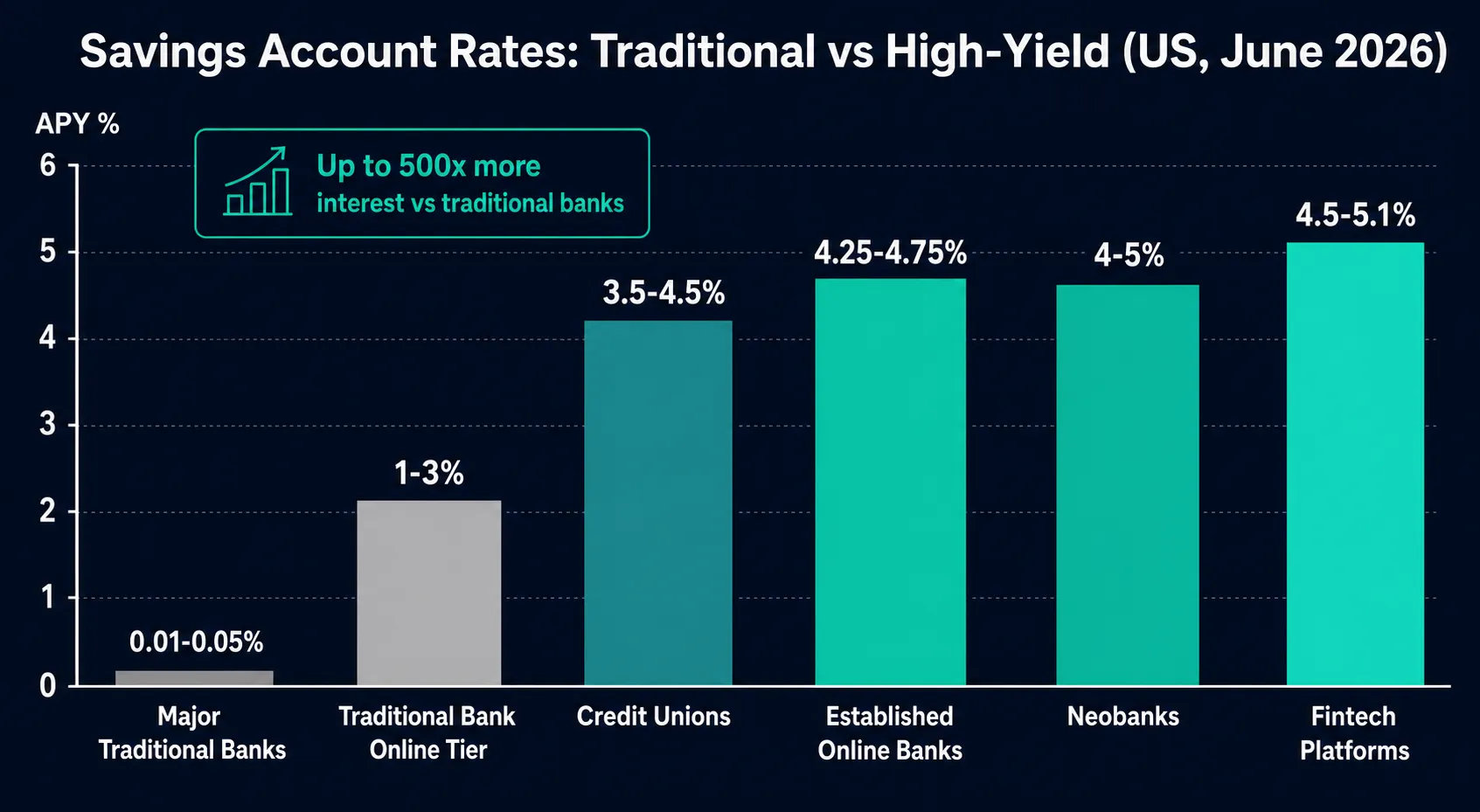
If you have been keeping your business or personal savings in a traditional bank account earning 0.01 percent interest while high-yield alternatives have been offering 4 to 5 percent or more, the gap between what you are earning and what you could be earning has likely cost you more than you realize. In 2026, the spread between the best and worst savings account rates in the US market remains wide enough that choosing the right account is one of the most straightforward financial decisions a small business owner or individual can make. This guide breaks down the top high-yield savings account options available to US residents in 2026, what separates the genuinely competitive accounts from the ones with misleading promotional rates, and how to match an account to your specific situation.
What This Guide Covers
This article is written for individuals and small business owners based in the United States who want to make their idle cash work harder without taking on investment risk. It covers the accounts with the most competitive rates available in mid-2026, the features and limitations that matter most in practice, and the specific circumstances where each account type makes the most sense. A note on scope: this guide focuses on deposit savings accounts insured by the FDIC, not money market funds, Treasury products, or investment accounts. All information was verified as of June 2026 and rates are subject to change. Always check current rates directly with each institution before opening an account.
Why High-Yield Savings Accounts Matter More in 2026
The interest rate environment of the past two years has created an unusual situation that many savers have not fully taken advantage of. While the Federal Reserve has adjusted rates through 2024 and 2025, the spread between traditional bank savings rates and the best high-yield alternatives has remained historically large. Major traditional banks including some of the largest by deposit volume in the United States continue to offer savings rates of 0.01 to 0.05 percent on standard savings accounts, while online banks and fintech institutions are offering rates in the 4 to 5 percent range on accounts with no minimum balance requirements and full FDIC insurance.
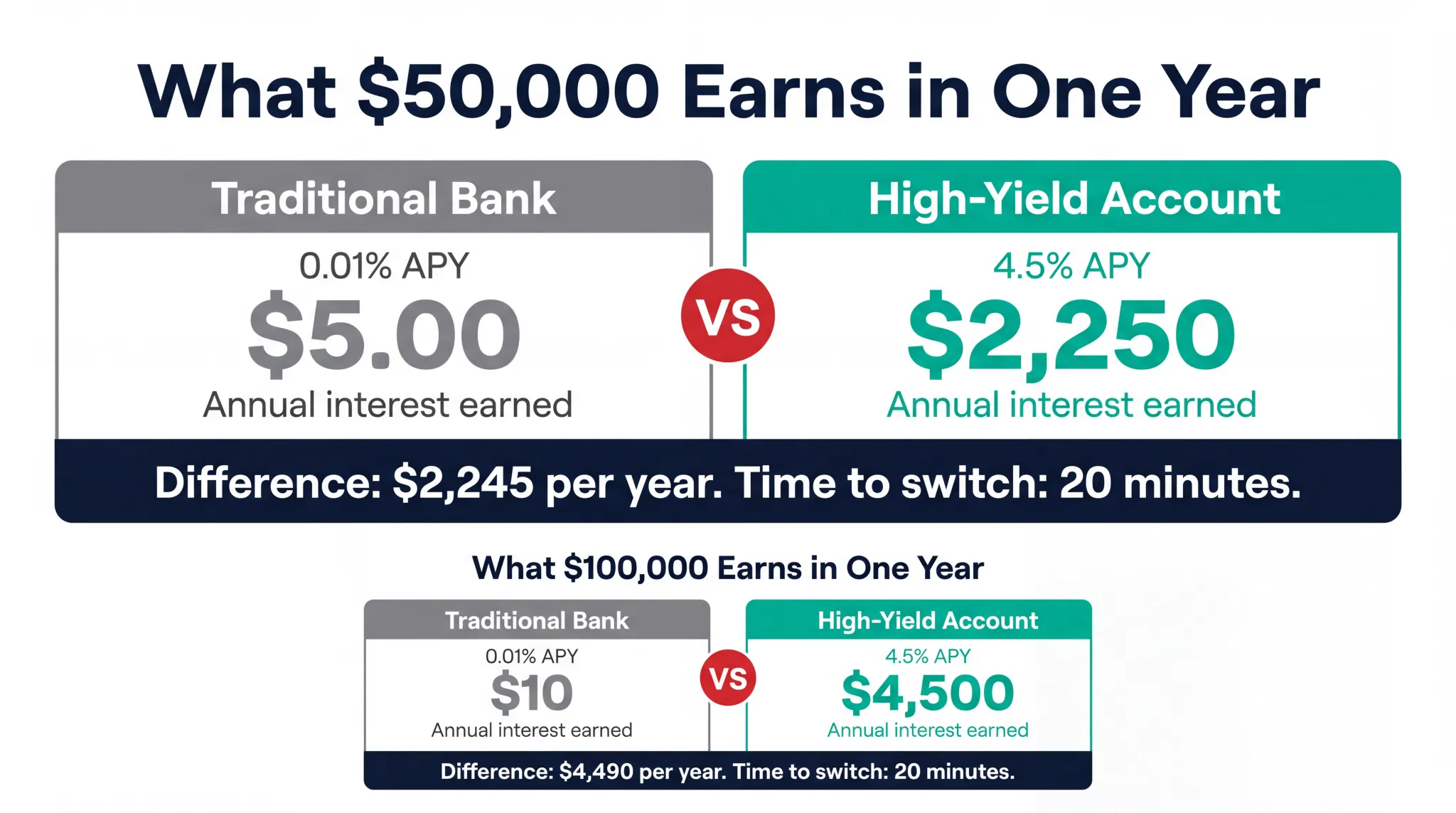
For a small business owner holding 50,000 US dollars in operating cash reserves, the difference between a 0.01 percent rate and a 4.5 percent rate is approximately 2,245 US dollars in annual interest. That is not a marginal improvement. It is the equivalent of recovering a meaningful portion of business banking fees, software subscriptions, or other operating costs simply by moving cash that was already sitting idle into a more appropriate account.
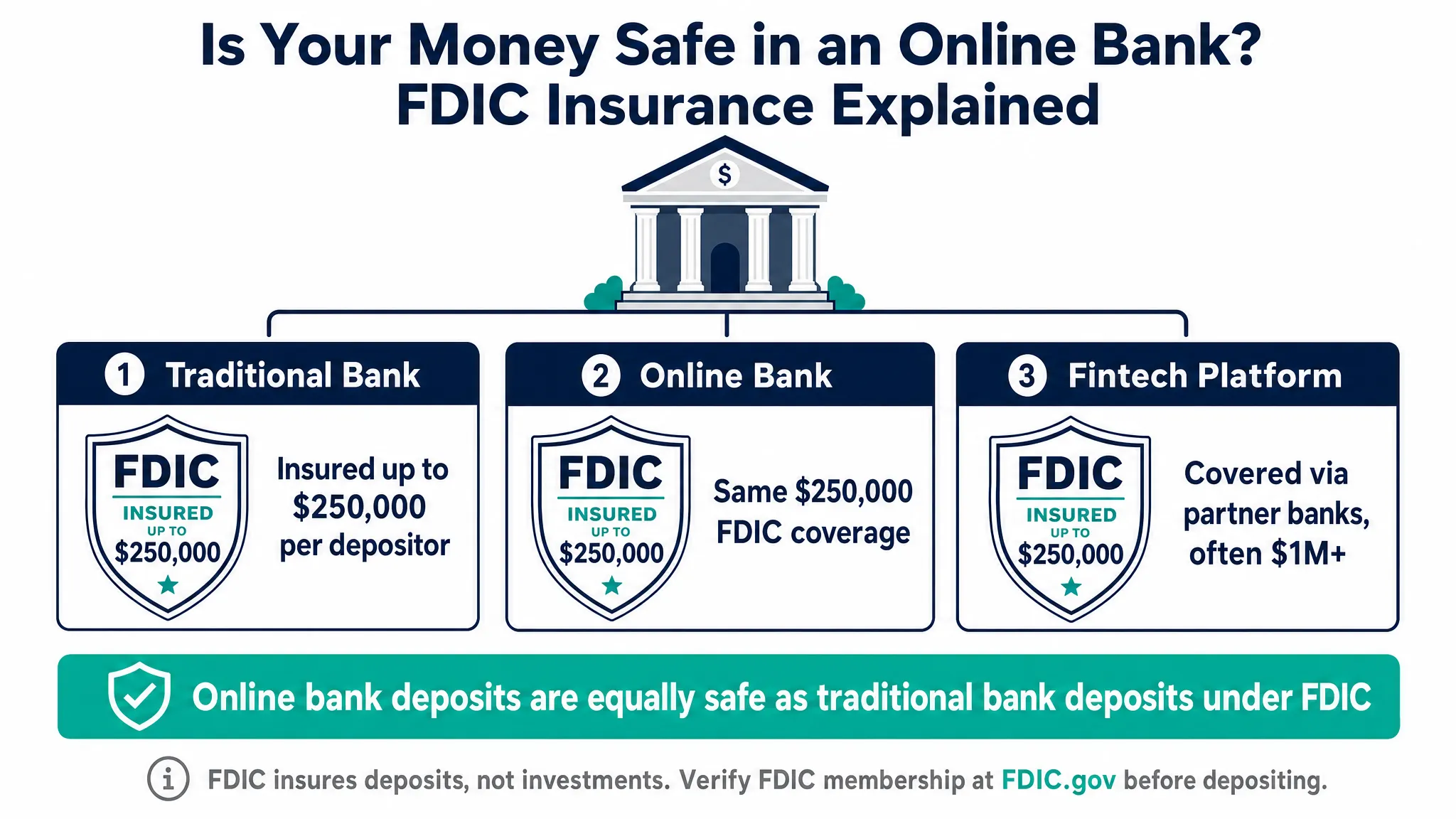
The reason many business owners and individuals have not made this switch is a combination of inertia, a belief that the process is more complicated than it is, and uncertainty about whether online banks and fintech institutions are as safe as traditional banks. On the safety question, the answer for FDIC-insured accounts is straightforward: deposits up to 250,000 US dollars per depositor per institution are insured by the federal government regardless of whether the institution is a traditional bank or an online-only bank. The safety of your deposits does not depend on the institution having physical branches.
What to Look for Beyond the Headline Rate
The headline APY rate is the most visible number in any high-yield savings account comparison, but it is not the only number that matters. Several other factors determine whether an account that looks great on paper actually works well in practice.
Rate Stability and Promotional Offers
Some institutions attract new customers with promotional rates that are significantly higher than their standard rates, then drop to a much lower rate after three to six months. Reading the fine print to distinguish between a standard ongoing rate and a promotional introductory rate is essential before committing to an account. Accounts where the promotional rate expires to a rate that is no longer competitive require the ongoing effort of moving funds again, which defeats the purpose of a low-maintenance savings strategy.
Minimum Balance Requirements
Some high-yield accounts require a minimum balance to earn the advertised rate. Accounts that require 10,000 to 25,000 US dollars to earn the top rate are not genuinely accessible to savers with smaller balances and should be evaluated against what rate they offer on balances below the minimum. For business owners building cash reserves, minimum balance requirements can also create cash flow complications if operating funds occasionally dip below the threshold.
Transfer Speed and Withdrawal Access
High-yield savings accounts at online banks typically process external transfers in one to three business days. For business owners who need same-day access to funds for payroll, vendor payments, or unexpected expenses, understanding the transfer timeline is important. Some institutions offer faster transfer options for a fee. Others have partnerships with specific checking account providers that enable faster movement of funds. Knowing how long it takes to access your money before you need it urgently is a basic due diligence step.
FDIC Insurance Coverage
Standard FDIC insurance covers up to 250,000 US dollars per depositor per institution per account ownership category. Business owners with larger cash reserves should be aware that deposits above this threshold are not federally insured and should consider spreading funds across multiple FDIC-insured institutions or exploring other coverage options. Some fintech platforms use a network of partner banks to provide extended FDIC coverage beyond the standard limit, which is worth understanding if you are holding larger balances.
Top High-Yield Savings Accounts Available in the US in 2026
The accounts listed below represent consistently competitive options as of June 2026. Rates are subject to change and should be verified directly with each institution before opening an account. This is not an exhaustive list of every high-yield savings account available in the US market, nor does inclusion in this comparison constitute an endorsement.
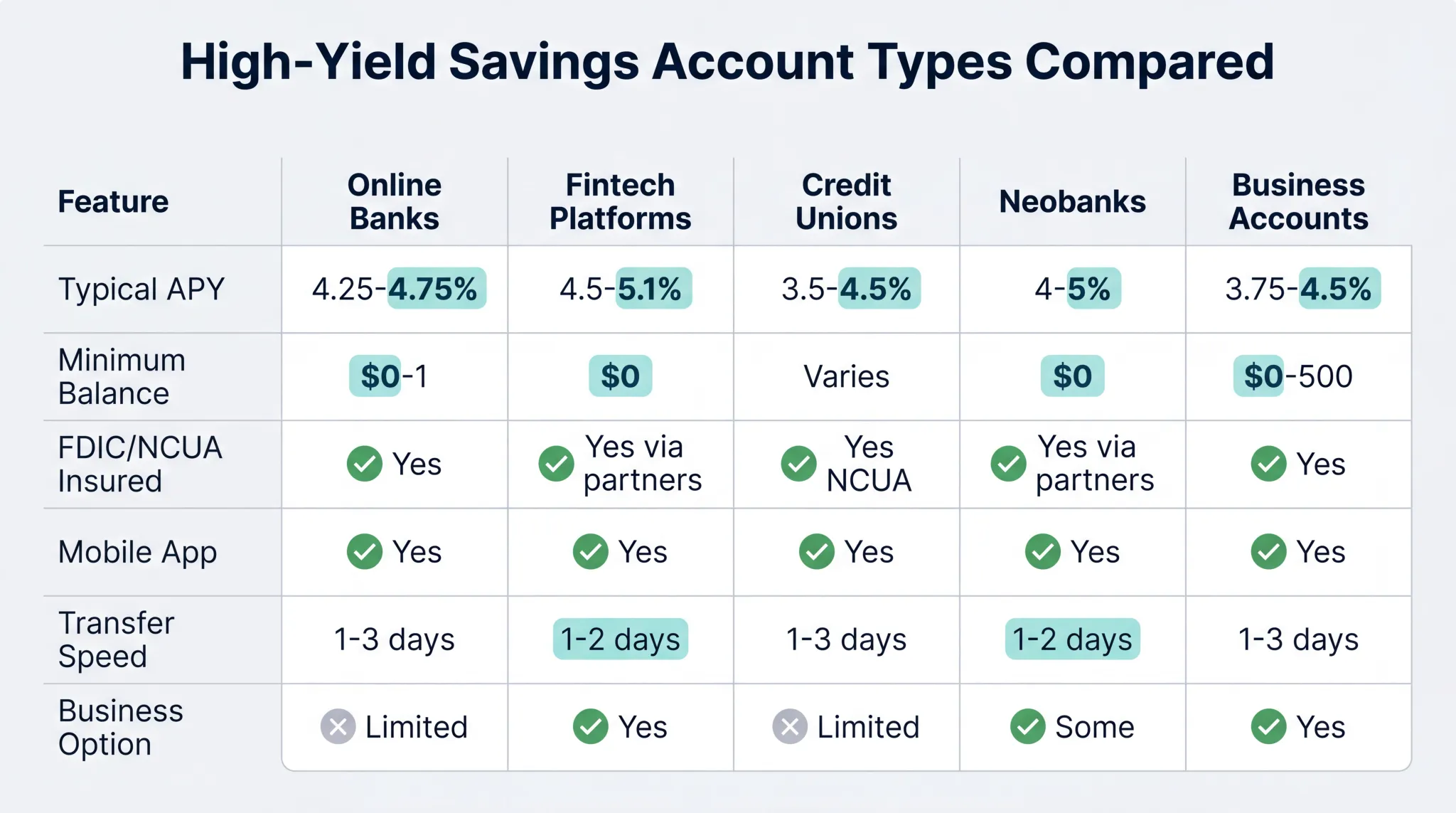
| Institution Type | Typical APY Range (June 2026) | Minimum Balance | FDIC Insured | Best For |
|---|---|---|---|---|
| Online banks (established) | 4.25 to 4.75 percent | None to 1 dollar | Yes, up to 250,000 USD | Most individuals and small businesses wanting stable competitive rates |
| Fintech platforms with bank partners | 4.50 to 5.10 percent | None | Yes, via partner banks, often higher coverage limits | Savers wanting highest available rates with extended insurance coverage |
| Credit unions | 3.50 to 4.50 percent | Membership requirement, varies | Yes, via NCUA up to 250,000 USD | Members who qualify and want relationship-based banking |
| Traditional banks (online savings tiers) | 1.00 to 3.00 percent | Often 1,000 to 10,000 USD | Yes, up to 250,000 USD | Existing customers wanting to upgrade within their current bank |
| Neobanks and challenger banks | 4.00 to 5.00 percent | None | Yes, via partner banks | Tech-comfortable users wanting mobile-first experience |
| Business savings accounts (online) | 3.75 to 4.50 percent | None to 500 USD | Yes, up to 250,000 USD | Small business owners separating operating and reserve cash |
A note on the rates in this table: the high-yield savings account market is competitive and rates adjust frequently in response to Federal Reserve policy decisions and competitive pressure between institutions. The ranges shown reflect what was consistently available from reputable institutions in mid-2026. The specific institution offering the highest rate at any given moment changes regularly, which is why this guide focuses on account types and selection criteria rather than naming a single winner.
Business Savings Accounts: Special Considerations for Small Business Owners
Small business owners face a specific set of considerations when choosing a high-yield savings account that differ from those of individual savers. The most important is the separation of business and personal funds, which is both a legal and accounting best practice and a requirement for maintaining the liability protection that business entity structures provide. Commingling personal and business funds in the same savings account is a common mistake that creates complications at tax time and can undermine the legal protections of an LLC or corporation structure.
Business savings accounts from online banks and fintech platforms have become significantly more accessible and competitive in recent years. Many now offer rates comparable to personal high-yield savings accounts with no minimum balance requirements and business-specific features like sub-accounts for separating different cash purposes, such as tax reserves, payroll buffers, and capital expenditure savings.
The most useful structure for most small businesses is a two-account approach: a business checking account at a bank with strong payment processing and integration capabilities, paired with a business high-yield savings account at an online bank offering the best available rate for idle cash. Funds needed for near-term operating expenses sit in the checking account. Everything beyond the operating buffer earns a competitive rate in the savings account and can be transferred back within one to three business days when needed.
Real World Example: How Much a Rate Switch Actually Makes
A practical illustration of the value of this decision involves a pattern seen commonly across independent contractors, freelancers, and small business owners in professional services. Consider a consultant who invoices 15,000 to 20,000 US dollars per month and maintains a cash reserve of approximately 30,000 US dollars in a standard checking account at a traditional bank, earning effectively nothing in interest.
Moving that 30,000 US dollar reserve to a high-yield savings account at 4.5 percent APY generates approximately 1,350 US dollars in annual interest with no change in risk profile, no reduction in liquidity, and no additional ongoing effort beyond the initial account setup. For a business owner who completes the account opening in 20 minutes online, that represents a return on time of roughly 4,050 US dollars per hour of effort invested, which is a straightforward case for taking action.
The larger the idle cash balance and the longer it sits without earning a competitive rate, the larger the cumulative opportunity cost. For businesses holding 100,000 US dollars in reserves, the annual difference between a 0.01 percent traditional bank rate and a 4.5 percent high-yield rate is approximately 4,490 US dollars in foregone interest per year.
US and UK Difference: This guide focuses on US-based savings accounts insured by the FDIC. UK readers looking for equivalent options should look at easy-access savings accounts from UK online banks and building societies, where competitive rates in 2026 are typically available from challenger banks and larger institutions that have moved aggressively into the savings market following Bank of England rate changes. UK deposits are protected up to 85,000 GBP per person per institution under the Financial Services Compensation Scheme, which is the UK equivalent of FDIC insurance. UK business owners should also be aware of tax treatment differences: interest earned in UK business accounts is subject to Corporation Tax rather than income tax, which affects the net value of interest earned depending on your business structure.
How to Open a High-Yield Savings Account: What to Expect
For anyone who has not opened an online bank account before, the process is straightforward and typically takes 15 to 30 minutes to complete. Most online banks and fintech platforms require your Social Security Number or Employer Identification Number for a business account, a government-issued ID for identity verification, and the routing and account number of an existing bank account to fund the initial deposit and set up external transfers.
Identity verification is typically completed through a combination of document upload and a selfie or video check, with most applications providing an immediate or same-day decision. Once approved, you will link your existing checking account for transfers and make an initial deposit. The transfer of your initial deposit typically takes one to three business days to complete and begin earning interest.
For business accounts, you may also need to provide your business formation documents such as your Articles of Organization or Incorporation, your Employer Identification Number from the IRS, and in some cases proof of your business address. The documentation requirements vary by institution.
Using the Biveron Savings Calculator to Model Your Earnings
Before choosing an account, it is worth running the numbers on what different rate scenarios mean for your specific balance and time horizon. The Biveron Business Savings Projection Calculator lets you input your starting balance, monthly contribution amount, interest rate, and time period to see a projected total. This makes it straightforward to compare the value of moving funds from a 0.01 percent account to a 4.5 percent account over one, three, or five years with your actual numbers rather than generalizations.
The compounding effect over longer time horizons is often more motivating than the annual interest figure alone. A 50,000 US dollar balance at 4.5 percent compounding monthly over three years grows to approximately 57,200 US dollars. The same balance at 0.01 percent grows to approximately 50,015 US dollars over the same period. The difference of over 7,000 US dollars requires no additional contribution, no investment risk, and no ongoing effort beyond the initial account setup.
For more context on how AI tools are changing personal finance management and helping individuals and businesses track and optimize their savings strategies, see our guide on how AI is transforming personal finance in the US and UK in 2026. For a broader look at the fintech apps that can complement a high-yield savings strategy with better overall financial visibility, see our comparison of the best AI-powered personal finance tracking apps in 2026.
Frequently Asked Questions
Are high-yield savings accounts safe to use for business cash reserves?
Yes, provided the account is at an FDIC-insured institution and your balance stays within the insurance coverage limits. FDIC insurance covers up to 250,000 US dollars per depositor per institution per ownership category, which means a business and its owner can each have separate coverage at the same institution. For businesses with larger cash reserves, spreading funds across multiple FDIC-insured institutions or using fintech platforms that offer extended coverage through partner bank networks provides additional protection. The safety of an online-only bank is equivalent to a traditional bank for FDIC-insured deposits.
How quickly can I access money in a high-yield savings account if I need it urgently?
Standard external transfers between a high-yield savings account and a linked checking account typically take one to three business days. Some institutions offer expedited transfer options for a fee. For business owners who need reliable same-day access to funds for operational purposes, the practical approach is to keep a sufficient operating buffer in a checking account and use the savings account for funds that can afford to be three business days away. Most experienced users of high-yield savings accounts plan for this timeline and find it manageable with a small operating buffer in a checking account.
Will switching to a high-yield savings account affect my taxes?
Interest earned in a high-yield savings account is taxable income in the United States and must be reported on your tax return. The institution will provide a Form 1099-INT at tax time showing the interest earned. For individual savers, this interest is taxed as ordinary income at your marginal rate. For business owners using a business savings account, interest earned is business income subject to your business tax structure. This does not eliminate the value of high-yield savings accounts but should be factored into your net return calculation, particularly if you are in a higher tax bracket. Always consult a qualified tax professional for advice specific to your situation.
Is there a penalty for withdrawing money from a high-yield savings account?
High-yield savings accounts are not the same as certificates of deposit, which impose early withdrawal penalties. Standard high-yield savings accounts do not charge penalties for withdrawals. However, federal regulations historically limited savings account withdrawals to six per month, though this restriction was suspended during the pandemic and has not been universally reinstated. Check the specific terms of any account you are considering regarding withdrawal frequency limitations, as policies vary by institution.
Can I open a high-yield savings account if I already have accounts at a traditional bank?
Yes. Opening a high-yield savings account at an online bank or fintech platform does not require closing or moving your existing bank accounts. Most savers and business owners use a combination: keeping a checking account at their primary bank for day-to-day transactions, payment processing, and branch access when needed, while using an online high-yield savings account for idle cash that is not needed immediately. This approach captures the rate advantage without sacrificing the convenience of an existing banking relationship.
Disclaimer: This article is for informational and educational purposes only and does not constitute financial advice. Interest rates referenced in this article were verified as of June 2026 and are subject to change without notice. FDIC insurance coverage limits and terms are set by the federal government and may be subject to change. Always verify current rates, terms, and insurance coverage directly with each financial institution before opening an account. Consider consulting a qualified financial advisor before making significant changes to your savings or cash management strategy. Some links in this article may be affiliate links. See our Affiliate Disclosure for details.
Latest Research